A used EV is a pre-owned electric vehicle that offers 40–55% savings over new models while retaining most battery capacity. In 2026, the used EV market is flooded with off-lease inventory, making it the best time to buy. Key checks: battery health (SOH above 85%), warranty transfer, and charging compatibility.
- Battery health matters more than mileage on any used EV
- Federal tax credits expired Sept. 30, 2025 but state rebates remain
- 2020–2022 models offer the best value with remaining warranty coverage
- Home charging is essential for maximizing cost savings
- Independent inspection costs $100–300 but saves thousands in surprises
Introduction
Buying a used EV in 2026 is one of the smartest financial moves a car shopper can make if you know what to check. The market is flooded with three- to four-year-old electric vehicles returning from lease, many with under 30,000 miles and batteries still at 90% capacity or higher. That means you can drive a Tesla Model 3, Hyundai Kona Electric, or Volkswagen ID.4 for roughly half the original price.
But used EVs are not like used gas cars. The odometer tells you almost nothing. The battery’s State of Health (SOH) not mileage determines whether you’re getting a deal or a liability. A 100,000-mile EV with 95% SOH is a better buy than a 30,000-mile EV at 80% SOH. Most buyers don’t know this. Most sellers won’t volunteer to do it.
This guide eliminates the guesswork. You’ll learn how to check battery health in 30 minutes, which models hold value best, what tax incentives still exist after the federal credit expired, and the seven mistakes that cost buyers thousands. Whether you’re a first-time EV shopper or upgrading from an older model, this is your complete roadmap to buying a used EV with confidence.
What Is a Used EV and Why Buy One in 2026?
A used EV is a previously owned battery-electric or plug-in hybrid vehicle. In 2026, off-lease inventory flooded the market, cutting prices by 40–55% while most batteries retained 85–95% capacity. Lower running costs and remaining factory warranties make used EVs a compelling alternative to new gas cars.
How Used EVs Differ from New EVs
Used EVs trade the latest battery tech and full warranty for massive depreciation savings. A 2021 Tesla Model 3 Long Range that cost $52,000 new now sells for $25,000–$30,000 a 42–52% drop. The battery typically retains 90–95% capacity, meaning range loss is minimal for daily driving. Warranty coverage transfers to second owners for the remaining 8-year/100,000-mile battery period, though mileage-based portions may be reduced.
The 2026 Depreciation Opportunity
EVs depreciate faster than gas cars due to rapid tech evolution and federal incentives that lowered original purchase prices. In 2026, the first major wave of three-year leases returned to dealer lots, creating a buyer’s market. Models like the VW ID.3 Pro (originally ~$38,000) now start at $18,000–$22,000 used. The previous owner absorbed the steepest depreciation you benefitted.
Running Cost Savings vs. Gas Cars
| Cost Category | Used EV (Annual) | Equivalent Gas Car (Annual) |
| Fuel/Energy (15,000 mi, home charging) | ~$600 | ~$1,800 |
| Scheduled Maintenance | $150–$400 | $600–$1,200 |
| Oil Changes | $0 | $200–$400 |
| Total Annual Savings | $1,000–$2,000 | — |
Understanding Used EV Battery Health: The #1 Factor
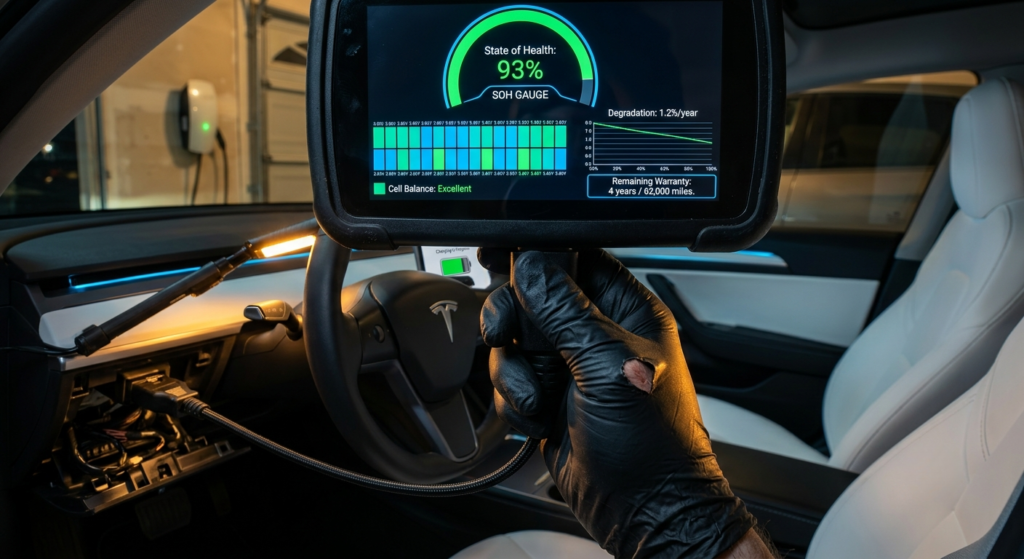
Battery State of Health (SOH) measures remaining capacity as a percentage of original. Most modern EVs lose 1–2% SOH per year. A healthy three- to four-year-old EV should show 85–95% SOH. Below 80% on a young vehicle warrants investigation before purchase.
What Is Battery State of Health (SOH)?
SOH is the percentage of original battery capacity still available. An SOH of 90% means the battery holds 90% of the energy it did when new. Unlike gas engines, where mileage indicates wear, an EV’s battery condition is invisible without diagnostic tools. SOH directly translates to real-world range: a car originally rated at 250 miles with 90% SOH delivers roughly 225 miles.
Expected SOH by Mileage and Age
| Mileage | Typical SOH | Assessment |
| Under 30,000 mi | 95–100% | Excellent |
| 30,000–60,000 mi | 90–96% | Very Good |
| 60,000–100,000 mi | 87–93% | Good |
| Over 100,000 mi | 85–91% | Acceptable (verify) |
Brand-by-Brand Battery Longevity Comparison
| Brand | SOH at 60K mi | Cooling System | Notes |
| Tesla | 93–95% | Active liquid | Best-in-class longevity |
| Hyundai/Kia | 92–95% | Active liquid | Excellent warranty (10 yr/100K mi) |
| VW ID Family | 92–94% | Active liquid | Solid, check early software issues |
| BMW i3 | 90–94% | Active liquid | Good with 120 Ah battery |
| Nissan Leaf | 85–90% | Passive air | Faster degradation in hot climates |
How Climate Affects Battery Degradation
Climate is the hidden variable most buyers ignore. Active liquid cooling (Tesla, Hyundai, VW, BMW) maintains stable battery temperatures, slowing degradation. Passive air cooling (Nissan Leaf) leaves batteries vulnerable to heat. In hot climates (Arizona, Texas, Florida), a Leaf can degrade 2–3× faster than a liquid-cooled rival. In temperate regions, the gap narrows. Always factor climate into your SOH expectations.
Step 1: How to Check a Used EV’s Battery Before Buying
Check battery health in five steps: (1) Request a seller battery report, (2) verify via the manufacturer app, (3) compare full-charge range to EPA rating, (4) run an OBD2 diagnostic, and (5) confirm warranty transfer in writing.
Request a Battery Health Report from the Seller
Ask the dealer or private seller for a current SOH percentage, full-charge range estimate, original EPA range for comparison, and any prior battery service history. If they cannot provide this, treat it as a red flag and proceed to independent verification.
Use the Manufacturer’s Owner App for Real-Time Data
Most EV makers expose battery data in their owner apps. Ask the seller to log in and show:
- Current battery state of charge and estimated full-charge range
- Any battery-related diagnostic codes or warnings
- Recent charging history (moderate home charging ages better than frequent DC fast charging)
Run a Real-World Range Check
Charge the vehicle to 100%. Compare the dashboard range estimate to the original EPA rating. A 250-mile EPA car showing 220 miles at full charge is roughly 88% SOH healthy for its age. A reading of 180 miles (72% SOH) demands investigation. Note: cold weather temporarily reduces displayed range without indicating true degradation.
Get an Independent OBD2 Diagnostic Inspection
Use brand-specific OBD2 apps for precise SOH readings:
| Brand | Recommended App | Cost |
| Tesla | ScanMyTesla or Tesla App | Free–$20 |
| VW ID/Skoda | Car Scanner Pro | $5–$15 |
| Hyundai/Kia | Torque Pro + EV scripts | Free–$10 |
| Nissan Leaf | LeafSpy (dedicated) | $20 |
| BMW i3 | Bimmercode / ISTA | $30–$50 |
Professional EV inspections cost $100–$300 and are worth it for any purchase over $15,000.
Verify Battery Warranty Transferability by VIN
Federal law mandates minimum 8-year/100,000-mile battery warranties. Confirm:
- Remaining warranty years and miles on this specific VIN
- Capacity loss threshold (often 70% of original)
- Whether salvage title or modifications void coverage
- Claim filing requirements (franchised dealer vs. authorized center)
Step 2: Understanding Used EV Depreciation and Pricing
EVs depreciated 40–55% in three years due to rapid tech evolution and federal incentives that reduced original prices. In 2026, a 2021 Tesla Model 3 costs $25,000–$30,000 used versus $52,000 new. Calculate total cost of ownership, not just sticker price.
Why EVs Depreciate Faster Than Gas Cars
Three forces drive EV depreciation: (1) federal and state incentives lowered the original buyer’s net cost, (2) battery and software tech evolves annually, making older models feel dated, and (3) many EVs were leased with low mileage limits, creating a supply surge when returned. The result: buyers in 2026 capture depreciation that original owners absorbed.
2026 Price Ranges for Top Used EV Models
| Model | Year | Typical Mileage | Used Price (2026) | Original MSRP | Depreciation |
| Tesla Model 3 LR | 2020–2022 | 20K–60K mi | $25,000–$30,000 | ~$52,000 | 42–52% |
| VW ID.3 Pro | 2020–2022 | 20K–60K mi | $18,000–$22,000 | ~$38,000 | 42–53% |
| Hyundai Kona Elec. 64kWh | 2020–2022 | 20K–50K mi | $20,000–$25,000 | ~$36,000 | 31–44% |
| Nissan Leaf 62kWh | 2019–2021 | 30K–60K mi | $14,000–$20,000 | ~$32,000 | 37–56% |
| Chevy Bolt EV | 2020–2022 | 20K–50K mi | $12,000–$16,000 | ~$32,000 | 50–63% |
Calculating Total Cost of Ownership
Don’t fixate on purchase price. A $25,000 used Tesla Model 3 with 90% SOH and home charging costs roughly $0.04/mile to fuel versus $0.12/mile for a gas equivalent. Over 60,000 miles, that’s $4,800 in fuel savings alone. Add $500/year in maintenance savings, and the “more expensive” EV often wins on TCO within three years.
Step 3: Certified Pre-Owned vs. Private Sale vs. Online
CPO programs offer extended warranties and inspections at 5–15% markup. Private sales are cheapest but highest risk. Online platforms (Carvana, EV.com) add convenience with return policies but charge delivery fees.
| Factor | CPO (Dealer) | Private Sale | Online Platform |
| Price | +5–15% premium | Lowest | Market rate + fees |
| Warranty | Extended factory | None | Varies by platform |
| Inspection | 150+ point check | Buyer responsibility | Varies |
| Return Policy | Limited | None | 7–10 days typical |
| Battery Report | Usually included | Rarely available | Sometimes |
| Best For | Risk-averse buyers | Experienced shoppers | Convenience seekers |
What CPO Programs Cover
CPO EVs must meet age, mileage, and condition thresholds. Coverage varies by brand: Tesla CPO includes a 4-year/50,000-mile limited warranty, while Hyundai extends its 10-year/100,000-mile battery warranty to CPO buyers. Always read the fine print some CPO programs exclude battery capacity guarantees.
Private Sale Pros and Cons
Private sellers often price 10–20% below dealers. You may also learn the vehicle’s real-world habits, charging routines, climate, garage vs. street parking. The downside: no warranty, no return policy, and sellers may not know (or disclose) battery health. Budget $200–$400 for an independent inspection.
Online Platforms: Carvana, EV.com, Find My Electric
Online EV marketplaces offer home delivery and return windows. Carvana provides 7-day returns and as-soon-as-next-day delivery. EV.com aggregates inventory from trusted dealers. Find My Electric specializes in Tesla and Rivian. Factor in $500–$1,500 in delivery fees and verify battery health reports before committing.
Used EV Tax Credits and Incentives: What You Can Still Claim in 2026
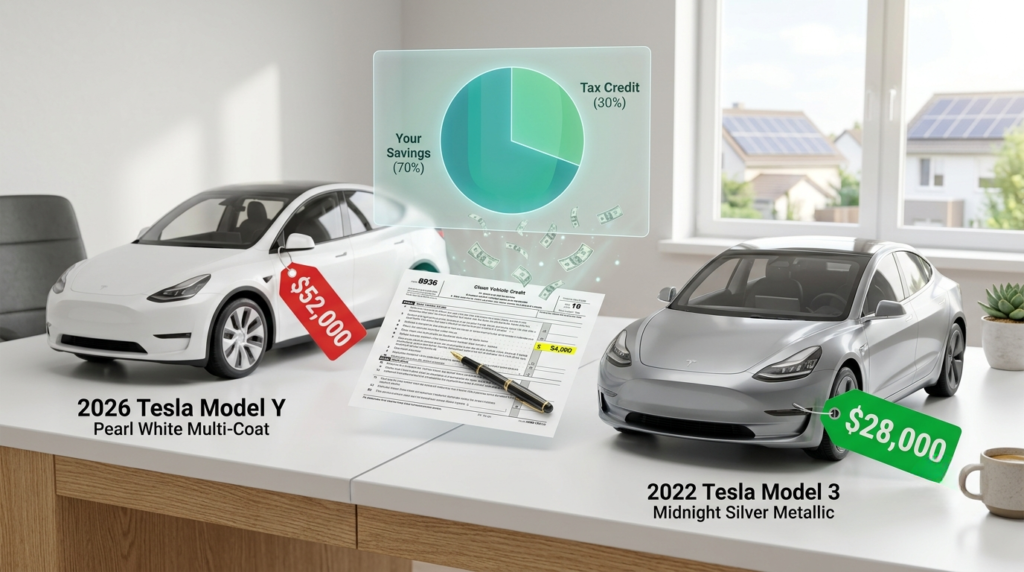
The federal used EV tax credit expired September 30, 2025. However, state and local rebates remain active in California, Colorado, New York, and other states. Check Database of State Incentives for Renewables & Efficiency (DSIRE) for current programs.
Federal Used EV Tax Credit: $4,000 Rules and Eligibility (Expired)
The Inflation Reduction Act offered up to $4,000 (or 30% of sale price, whichever was less) on used EVs priced at $25,000 or less, sold by IRS-registered dealers. Income limits were $150,000 (joint), $112,500 (head of household), and $75,000 (single). The credit was transferable at point of sale. This program ended September 30, 2025.
State and Local Rebates Still Available in 2026
| State | Program | Rebate Amount | Income Cap |
| California | CVRP (Used EV) | Up to $4,000 | $135K single / $200K joint |
| Colorado | EV Tax Credit | Up to $5,000 | None |
| New York | Drive Clean Rebate | Up to $2,000 | None |
| Oregon | Clean Vehicle Rebate | Up to $2,500 | $60K single / $100K joint |
| New Jersey | Charge Up NJ | Up to $4,000 | $50K single / $100K joint |
Programs change quarterly. Verify eligibility at DSIRE.
Common Mistakes That Disqualify Your Claim
Even when the federal credit was active, buyers lost claims by: (1) purchasing from unregistered dealers, (2) buying a vehicle that already had the credit claimed post-August 2022, (3) exceeding income limits in both current and prior tax years, and (4) failing to file Form 8936 with the VIN. For current state rebates, missing documentation and incorrect income reporting remain the top disqualifiers.
7 Costly Mistakes to Avoid When Buying a Used EV
The seven costliest mistakes are: (1) ignoring battery health for low mileage, (2) buying without home charging, (3) overlooking software versions and recalls, (4) skipping the 12V battery check, (5) choosing obsolete CHAdeMO charging, (6) not pricing insurance first, and (7) failing to confirm warranty transfer.
1: Ignoring Battery Health in Favor of Low Mileage
A 30,000-mile EV with 82% SOH is a worse buy than a 100,000-mile EV at 95% SOH. Always prioritize SOH over odometer readings. Request the battery report before any other negotiation.
2: Buying Without a Home Charging Solution
Without home charging, you rely on public infrastructure at $0.30–$0.60/kWh versus $0.12–$0.15/kWh at home. This erodes the EV cost advantage. Confirm Level 2 (240V) installation feasibility before buying.
3: Overlooking Software Version and Open Recalls
EVs are computers on wheels. Outdated software can cause infotainment freezes, charging errors, or safety issues. Check the manufacturer’s recall database by VIN. For Teslas, press the “T” logo to view the current software version to ensure it’s 2024.20 or later.
4: Skipping the 12V Auxiliary Battery Check
The 12V battery powers door locks, lights, and computer systems. It fails without warning on some EVs (early VW ID models are notorious). A dead 12V can brick a fully charged EV. Check age and voltage during inspection.
5: Choosing CHAdeMO Over CCS in 2026
The Nissan Leaf uses CHAdeMO for DC fast charging. Most new public chargers support only CCS (North America) or CCS2 (Europe). CHAdeMO networks are shrinking. If you depend on public fast charging, avoid CHAdeMO-only vehicles unless you have confirmed local infrastructure.
6: Forgetting to Price Insurance Before Signing
EVs cost 15–25% more to insure than gas equivalents due to expensive battery repairs and limited repair shops. Get quotes for your specific model and ZIP code before purchase. Some insurers offer EV discounts.
7: Not Confirming Warranty Transfer by VIN
Battery warranties transfer to second owners, but terms vary. Some manufacturers require service at franchised dealers for claims. Get warranty terms in writing for the specific VIN before signing.
Used EV Financing, Insurance, and Hidden Costs
Used EVs finance like any used car, but expect 0.5–1.5% higher APR than gas cars due to depreciation risk. Insurance runs 15–25% higher. Hidden costs include EV-specific tires ($150–$300 more per set), software subscriptions, and charging adapter purchases.
1: EV-Specific Loan Rates and Lender Options
Most lenders treat used EVs like any used car, but some credit unions offer green vehicle discounts. As of 2026, used EV APRs range from 5.5% to 8.5% for buyers with 700+ credit scores. Shop credit unions, online lenders, and manufacturer financing (Tesla, Ford, Hyundai all offer used EV loans).
2: Why Used EV Insurance Costs More
Higher repair costs drive insurance premiums. A minor fender bender can require $5,000–$15,000 in battery pack diagnostics. Limited certified repair shops create bottlenecks. Mitigate costs by: choosing higher deductibles, bundling policies, and selecting models with strong safety ratings (Tesla Model 3, Hyundai Ioniq 5).
3: Hidden Costs: Tires, Software Subscriptions, Charging Adapters
- EV tires: Heavier vehicles wear tires faster. Budget $600–$1,000 per set versus $400–$700 for gas cars.
- Software subscriptions: Some features (Tesla Premium Connectivity, BMW ConnectedDrive) require ongoing payments.
- Charging adapters: If your EV uses a non-standard connector, adapters cost $50–$300.
Best Used EV Models for 2026: Ranked by Value
The best value used EVs in 2026 are: (1) Tesla Model 3 for overall value, (2) Hyundai Kona Electric for warranty, (3) VW ID.3/ID.4 for tech, (4) Chevrolet Bolt EV for budget buyers under $15K, and (5) Nissan Leaf for city commuters.
Tesla Model 3 (2020–2022): Best Overall Value
The Model 3 dominates the used EV market for good reason: 93–95% SOH retention, over-the-air software updates, access to the Supercharger network, and strong resale value. 2020–2022 Long Range models offer 310+ miles of original range and now sell for $25,000–$30,000. Watch for: panel gap issues, MCU1 vs. MCU2 infotainment, and FSD subscription transferability.
Hyundai Kona Electric: Best Warranty Coverage
Hyundai’s 10-year/100,000-mile battery warranty (transferable to second owners) is unmatched. The 64kWh Kona delivers 258 miles of EPA range and typically retains 92–95% SOH. 2020–2022 models now sell for $20,000–$25,000. The Kona’s compact crossover format suits families and commuters alike.
Volkswagen ID.3/ID.4: Best Tech for the Price
VW’s MEB platform offers solid range, CCS2 fast charging, and practical interiors. The ID.4 crossover provides 250+ miles of range and now starts at $22,000 used. Early 2020–2021 models had software issues verifying version 3.0+ before buying. The ID.3 hatchback is Europe-only but offers Golf-like usability.
Chevrolet Bolt EV: Best Budget Option Under $15K
The Bolt EV is the undisputed king of cheap used EVs. 2020–2022 models with 259 miles of EPA range now sell for $12,000–$16,000. GM resolved battery recall issues to verify the recall was completed via NHTSA. The Bolt uses CCS fast charging and offers hatchback practicality. For pure value, nothing beats it.
Nissan Leaf: Best City Commuter (With Caveats)
The Leaf remains the cheapest entry point at $10,000–$15,000 for 2018–2020 40kWh models. But passive air cooling accelerates degradation, and CHAdeMO fast charging is becoming obsolete. Buy only if: you have home charging, drive under 150 miles daily, and live in a temperate climate. The 62kWh e+ (2019+) is the better choice if budget allows.
Used EV FAQ: Your Top Questions Answered
1: Is it safe to buy a used EV with 100,000+ miles?
Yes if battery SOH is above 85%. Mileage matters less on EVs than on gas cars. A 100,000-mile EV with a healthy battery and remaining warranty can be a smart buy. Always verify SOH and warranty status before purchasing.
2: How long do used EV batteries last?
Most EV batteries last 8–15 years with gradual degradation. Federal law requires 8-year/100,000-mile minimum warranties. Real-world data shows 1–2% annual capacity loss under normal use. A 5-year-old EV typically retains 85–92% capacity.
3: Can I get a tax credit on a used EV in 2026?
The federal $4,000 used EV tax credit expired September 30, 2025. However, state rebates remain active in California, Colorado, New York, Oregon, and New Jersey. Check DSIRE.org for current programs in your state.
4: What’s the cheapest reliable used EV?
The Chevrolet Bolt EV (2020–2022) offers the best reliability-to-price ratio at $12,000–$16,000 used. Verify the battery recall was completed. The Nissan Leaf 40kWh is cheaper ($10,000–$15,000) but has faster degradation due to passive cooling.
5: Do used EVs need special maintenance?
No EVs need less maintenance than gas cars. No oil changes, spark plugs, or timing belts. Required maintenance: tire rotation, brake fluid checks, cabin air filter replacement, and 12V battery monitoring. Annual costs: $150–$400 versus $600–$1,200 for gas cars.
6: Can all EVs use Tesla Superchargers now?
Most new EVs (2024+) can access Tesla Superchargers via the Magic Dock or NACS adapter. Older used EVs with CCS ports may need a $250–$450 NACS adapter. Check your model’s compatibility before relying on Supercharger access.
7: Is a used EV worth it without home charging?
Only if you have reliable workplace charging or live in an area with dense public infrastructure. Without home charging, electricity costs rise to $0.30–$0.60/kWh at public stations, eroding the EV cost advantage. Home charging at $0.12–$0.15/kWh is essential for maximum savings.
8: How do I check for open recalls on a used EV?
Enter the VIN at NHTSA.gov/recalls. EV-specific recalls often involve battery modules, charging systems, or software. Verify all recalls are completed before purchase, some require dealer service and cannot be done independently.
2026 Used EV Market Trends: What Buyers Need to Know
2026 is a buyer’s market due to a massive off-lease wave, improved battery diagnostics, and expanding charging infrastructure. Prices are down 15–20% from 2024, and selection has never been better.
The Off-Lease Wave: Why 2026 Is a Buyer’s Market
Three-year leases signed in 2022–2023 are flooding the market. These vehicles typically have 20,000–40,000 miles, full service histories, and batteries at 90%+ SOH. Supply exceeds demand in most markets, giving buyers negotiating power.
Battery Technology Advances Making Older EVs More Viable
Solid-state and silicon-anode batteries are still years from mass production. Current lithium-ion packs in 2020–2022 EVs are proven, well-understood, and supported by mature diagnostic tools. Buying a used EV today means buying into stable, repairable technology.
Charging Infrastructure Expansion and What It Means for Used EV Owners
The U.S. now has 75,000+ public charging stations, with CCS and NACS networks expanding rapidly. Even older used EVs with 200-mile ranges are practical for most drivers. The infrastructure gap that plagued early EV adopters has largely closed.
Your Used EV Buying Checklist and Tools
Download our printable checklist covering battery health verification, warranty confirmation, charging compatibility, software updates, insurance quotes, and financing pre-approval.
Pre-Inspection Checklist
Before visiting any seller, confirm:
- [ ] Battery SOH report available
- [ ] VIN checked for open recalls (NHTSA.gov)
- [ ] Warranty transfer terms in writing
- [ ] Charging connector type (CCS preferred)
- [ ] Software version current
- [ ] Insurance quote obtained
- [ ] Home charging feasibility confirmed
Recommended OBD2 Apps and Diagnostic Tools
| Tool/App | Best For | Cost |
| ScanMyTesla | Tesla battery diagnostics | Free–$20 |
| LeafSpy | Nissan Leaf SOH readings | $20 |
| Car Scanner Pro | VW ID/Skoda Enyaq | $5–$15 |
| Torque Pro + scripts | Hyundai/Kia | Free–$10 |
| OBDLink MX+ (hardware) | Universal EV diagnostics | $120 |
How to Use Modern Vehicles’ EV Search and Comparison Tools
Modern Vehicles aggregates used EV listings with battery health filters, incentive calculators, and financing pre-approval. Compare models side-by-side, filter by SOH thresholds, and see total cost of ownership estimates before contacting sellers.
Key Takeaways: Buying a Used EV with Confidence
- Battery SOH beats mileage every time. A 100,000-mile EV at 95% SOH outperforms a 30,000-mile EV at 80% SOH.
- 2026 is the best buyer’s market yet. Off-lease inventory, lower prices, and proven battery tech make this the ideal time to buy.
- Verify warranty transfer by VIN. Don’t assume you will get it in writing.
- Home charging is non-negotiable for savings. Public charging costs 2–4× more per kWh.
- Get an independent inspection. $100–$300 now saves thousands later.
- State rebates still exist. Even without the federal credit, California, Colorado, and others offer thousands in incentives.
- Choose CCS over CHAdeMO. Charging infrastructure is consolidating around CCS/NACS.
Find Your Perfect Used EV: Start Your Search Today
Modern Vehicles helps you find certified used EVs with verified battery health reports, transparent pricing, and incentive calculators. Compare models, check SOH, and get pre-approved financing all in one place.
How Modern Vehicles Simplifies Your Used EV Search
Modern Vehicles is the only platform that filters used EV listings by battery State of Health, not just price and mileage. Every listing includes SOH data, warranty transfer status, and a total cost of ownership estimate. No more guessing, just verified, transparent information.
Compare Models, Check Incentives, and Get Pre-Approved
Use our side-by-side comparison tool to evaluate up to three used EVs simultaneously. Check state and local incentive eligibility with our updated rebate database. Apply for financing pre-approval in minutes and shop with confidence. [Start your used EV search now →]
Conclusion
Buying a used EV in 2026 is one of the smartest automotive decisions you can make but only if you verify what matters. Battery health, not mileage, determines value. Warranty transfer, not sticker price, determines peace of mind. And home charging, not public infrastructure, determines long-term savings.
The market has never been more favorable. Off-lease inventory is plentiful, prices have stabilized at historic lows, and diagnostic tools make battery verification accessible to any buyer. The seven mistakes in this guide cost unprepared shoppers thousands. The five steps to battery health checking take 30 minutes and save exponentially more.
Ready to find your used EV? Modern Vehicles puts verified battery data, incentive calculators, and financing tools at your fingertips. Compare models, check SOH thresholds, and drive home with confidence. [Start your search today →]



0 Comments