A battery electric truck (BEV) is a commercial or consumer vehicle powered entirely by an electric drivetrain replacing the internal combustion engine with an electric motor, lithium-ion battery pack, and power inverter. Unlike hybrids, BEVs produce zero tailpipe emissions and rely on regenerative braking to recover 20–40% of energy during deceleration.
Key Facts at a Glance:
- Best Overall: 2026 Rivian R1T (420 miles, $74,885+)
- Best Value: 2026 Ford F-150 Lightning (320 miles, $52,375+)
- Best Range: 2026 Chevrolet Silverado EV (493 miles, $55,395+)
- Maintenance Savings: 30–50% less than diesel
- Energy Cost: $0.04–$0.05/mile vs. $0.15–$0.25/mile for diesel
- TCO Payback: 2–6 years depending on truck class and mileage
Introduction: Why Electric Trucks Matter Now
The electric truck market has shifted from experimental to essential. In 2026, fleet managers and individual buyers face a new reality: regulatory deadlines are tightening, zero-emission zones are expanding across Europe and California, and the total cost of ownership (TCO) for battery electric trucks has reached parity with diesel in many use cases. The EY–Eurelectric Fleet Forward report projects up to €246 billion in cumulative operating cost savings across European corporate fleets by 2030.
Yet confusion persists. Are electric trucks worth it for your specific duty cycle? Which model delivers the best range under real-world conditions? How much does charging infrastructure actually cost? And what about converting existing diesel fleets instead of buying new?
This guide answers every question with data, not marketing fluff. We cover electric pickup trucks for consumers, electric semi trucks for fleets, conversion kits for budget-conscious operators, and the charging infrastructure that makes it all work. Whether you’re a fleet manager planning electrification or a buyer comparing the Rivian R1T against the Ford F-150 Lightning, you’ll find independent, current analysis here.
What Are Electric Trucks? Definition & How They Work
A battery electric truck (BEV) replaces the diesel or gasoline engine with an electric motor, high-voltage battery pack (typically 400–900 kWh for heavy-duty), and power inverter. The drivetrain has roughly 20 moving parts versus 2,000+ in a conventional engine, eliminating oil changes, transmission service, and exhaust aftertreatment.
Battery Electric Truck (BEV) vs. Hybrid vs. Hydrogen
Three zero-emission technologies compete in the commercial truck space:
| Technology | Power Source | Best For | Availability |
| BEV (Battery Electric) | Grid-charged battery | Urban, regional, return-to-base routes | Widely available 2026 |
| Hybrid Electric | Battery + small engine | Transitional fleets, range-anxious operators | Limited models |
| Hydrogen Fuel Cell | H₂ fuel cell | Long-haul, extreme climates | Pilot stage |
BEVs dominate in 2026 because charging infrastructure is scaling faster than hydrogen distribution, and battery costs have dropped 89% since 2008. For most operators, BEV is the only commercially viable zero-emission option today.
Key Components: Electric Drivetrain, Battery Pack & Regenerative Braking
The electric drivetrain consists of four core elements:
- Traction Motor(s): 100–500+ kW electric motors deliver instant torque. Light trucks use single motors; heavy Class 8 semis use dual or triple motor configurations.
- Lithium-Ion Battery Pack: 400–800V architectures using LFP (lithium iron phosphate) or NMC (nickel manganese cobalt) cells. LFP offers longer cycle life; NMC provides higher energy density.
- Power Inverter: Converts DC battery power to AC for the motor, managing torque delivery and regenerative braking.
- Vehicle Control Unit (VCU): The “brain” that integrates with existing ABS, ESP, and ADAS systems through CAN/LIN networks.
Regenerative braking captures kinetic energy during deceleration, feeding it back to the battery. In stop-and-go urban operation, this recovers 20–40% of energy and dramatically extends brake pad life.
How Electric Trucks Differ from Diesel Trucks
| Factor | Electric Truck | Diesel Truck |
| Moving parts | ~20 | 2,000+ |
| Maintenance cost | $0.04/mile | $0.08–$0.12/mile |
| Energy efficiency | >75% | 35–40% |
| Noise level | Near-silent | 80+ dB |
| Torque delivery | Instant, maximum at 0 RPM | Builds with RPM |
| Fuel/energy cost | $0.03–$0.06/mile | $0.15–$0.25/mile |
The efficiency advantage is stark: electric motors convert over 75% of energy into motion, while diesel engines waste approximately 65% as heat and friction.
Best Electric Pickup Trucks of 2026: Ranked & Tested
The 2026 Rivian R1T remains the best overall electric pickup with a 10/10 rating, 420 miles of range, and unique features like the cross-truck gear tunnel. The Ford F-150 Lightning offers the best value at $52,375 with proven F-150 practicality. The Chevrolet Silverado EV leads on range at 493 miles.
2026 Rivian R1T Best Overall Electric Pickup
The Rivian R1T earns top marks for combining innovation with capability. Its cross-truck storage tunnel, a pass-through compartment running width-wise behind the cab provides secure storage no competitor offers. The Quad-Motor version delivers 1,025 horsepower and hits 60 mph in 2.5 seconds, making it the quickest production pickup available.
- Price: $74,885–$121,885
- Range: Up to 420 miles (Max battery)
- Towing: 11,000 lbs
- Payload: 1,764 lbs
- Rating: 10/10 (Car and Driver)
The R1T’s air suspension adapts ride height for off-roading, highway efficiency, or easy entry. For 2026, Rivian updated the electrical architecture, improving reliability and over-the-air update capability.
2026 Ford F-150 Lightning Best Value EV Truck
The Lightning translates America’s best-selling truck to electric without sacrificing familiarity. It looks like a standard F-150, uses the same cab and bed dimensions, and offers ProPower Onboard a built-in generator delivering up to 9.6 kW to power tools, campsites, or even your home during outages.
- Price: $52,375–$87,590
- Range: 240–320 miles
- Towing: Up to 10,000 lbs
- Payload: Up to 2,235 lbs
The Lightning shares almost everything with gas F-150s except the powertrain, making it the easiest transition for traditional truck buyers. However, towing cuts range by 30–50%, a critical planning factor covered in the next section.
2026 Chevrolet Silverado EV Best Range Electric Truck
Chevy’s electric pickup offers the longest EPA range in the segment. The Work Truck (WT) variant achieves 493 miles, enough for most regional delivery routes without mid-day charging. The RST trim adds 760 horsepower and Super Cruise hands-free driving.
- Price: $55,395–$108,445
- Range: Up to 493 miles (WT)
- Towing: Up to 12,500 lbs
- Payload: Up to 1,440 lbs
The new Trail Boss trim addresses earlier off-road criticism with lifted suspension and 35-inch tires. The mid-gate design allows hauling items over 10 feet long with the tailgate down.
2026 Tesla Cybertruck vs. GMC Hummer EV Power & Controversy
These two polarizing options prioritize performance over conventional utility:
| Model | Price | Range | Power | Key Feature |
| Tesla Cybertruck | $82,235+ | 325 miles | 834 hp (Beast) | Stainless steel exoskeleton |
| GMC Hummer EV | $99,895+ | 363 miles | 1,000 hp | CrabWalk 4-wheel steering |
The Cybertruck’s angular design divides opinion but delivers surprising on-road comfort. The Hummer EV is the heaviest pickup on sale at nearly 10,000 lbs, making it the least efficient electric truck available. Both suit buyers prioritizing statement-making over payload maximization.
Electric Pickup Truck Comparison Table
| Model | Starting Price | Max Range | Max Towing | Payload | C/D Rating |
| Rivian R1T | $74,885 | 420 mi | 11,000 lbs | 1,764 lbs | 10/10 |
| Ford F-150 Lightning | $52,375 | 320 mi | 10,000 lbs | 2,235 lbs | 9/10 |
| Chevy Silverado EV | $55,395 | 493 mi | 12,500 lbs | 1,440 lbs | 8.5/10 |
| GMC Sierra EV | $64,995 | 478 mi | 10,500 lbs | 1,500 lbs | 8/10 |
| Tesla Cybertruck | $82,235 | 325 mi | 11,000 lbs | 2,500 lbs | 8/10 |
| GMC Hummer EV | $99,895 | 363 mi | 12,000 lbs | 1,300 lbs | 7/10 |
Electric Truck Range, Towing & Payload: Real-World Numbers
EPA-rated range for electric pickups spans 240–493 miles. However, real-world range drops 15–25% in cold weather and 30–50% when towing. Payload capacity ranges from 1,300–2,500 lbs for pickups, with battery weight reducing capacity versus equivalent diesel models.
EPA vs. Real-World Electric Truck Range
EPA ratings assume ideal conditions: 70°F, moderate speeds, no cargo. Reality differs:
- Cold weather (-10°C / 14°F): Range drops 15–25% due to battery chemistry and cabin heating demand
- Highway cruising at 75+ mph: Aerodynamic drag increases energy consumption 10–15%
- Stop-and-go urban driving: Regenerative braking can improve efficiency versus EPA estimates
For fleet planning, use winter worst-case range as your baseline. A truck rated for 300 miles may deliver only 225 miles in January with a full load.
Electric Truck Towing Capacity & Range Penalty
All electric pickups can tow but range collapses under load:
| Truck | Max Towing | Range While Towing (est.) | Penalty |
| Ford F-150 Lightning | 10,000 lbs | ~160 miles | -50% |
| Rivian R1T | 11,000 lbs | ~210 miles | -50% |
| Chevy Silverado EV | 12,500 lbs | ~250 miles | -49% |
The penalty is consistent across brands because aerodynamic drag increases exponentially with trailer size. Plan charging stops every 120–150 miles when towing. For commercial fleets, this may require 5–10% vehicle oversizing to maintain schedule compliance.
Payload Capacity: How Battery Weight Affects Hauling
Battery packs add significant weight. A 131 kWh pack (Ford Lightning extended range) weighs approximately 1,800 lbs. This reduces available payload versus a gas F-150.
Legal workaround: In the US, electric trucks receive a 2,000 lb GVW allowance permitting operation at 82,000 lbs instead of 80,000 lbs for Class 8 vehicles.
The EU is standardizing a 44-tonne allowance for BEVs versus 40 tonnes for diesel. These allowances partially offset battery weight penalties.
Electric Semi Trucks & Commercial Vehicles: The Fleet-Ready Guide
Class 8 electric semis from Tesla, Volvo, and Freightliner offer 230–500 miles of range and 45,000–48,000 lb payloads. They’re best suited for regional haul, port drayage, and dedicated corridors with planned charging not yet for irregular long-haul.
Best Electric Semi Trucks of 2026: Tesla Semi vs. Volvo VNR vs. Freightliner Cascadia
| Model | Battery | Range | Est. Price | Best Use Case |
| Tesla Semi (Long Range) | ~900 kWh | 500 miles | $260,000–$320,000 | High-volume regional, dedicated routes |
| Volvo VNR Electric | 450–600 kWh | 250–440 km | $260,000–$330,000 | Urban freight, hub-and-spoke |
| Freightliner eCascadia | 400–550 kWh | 230–400 km | $250,000–$320,000 | Port drayage, regional distribution |
The Tesla Semi leads on range with 500 miles and 1.2 MW charging capability, adding hundreds of miles during a 45-minute driver break. Real-world trials with DHL showed energy consumption as low as 1.06 kWh/km and over 800 km of range.
Volvo’s VNR Electric prioritizes driver comfort and established service networks. The Freightliner eCascadia leverages the dominant Cascadia platform, making it the lowest-risk transition for existing Freightliner operators.
Electric Box Truck & Electric Dump Truck Options
Medium-duty electric trucks are further along in commercial deployment:
- Electric box trucks: BrightDrop Zevo 600, Ford E-Transit, Mercedes eSprinter 100–200 km urban range, ideal for last-mile delivery
- Electric dump trucks: Volvo FE Electric, Renault E-Tech D Wide construction and mining applications with high torque requirements
Electric Refuse Trucks: Stop-and-Go Efficiency Champions
Refuse collection is arguably the best electric truck application. The stop-and-go duty cycle maximizes regenerative braking energy recovery, and return-to-depot charging eliminates range anxiety. Early adopters report 50%+ fuel savings and dramatically reduced brake maintenance.
Electric Truck Conversion: Turn Your Diesel Fleet Zero-Emission
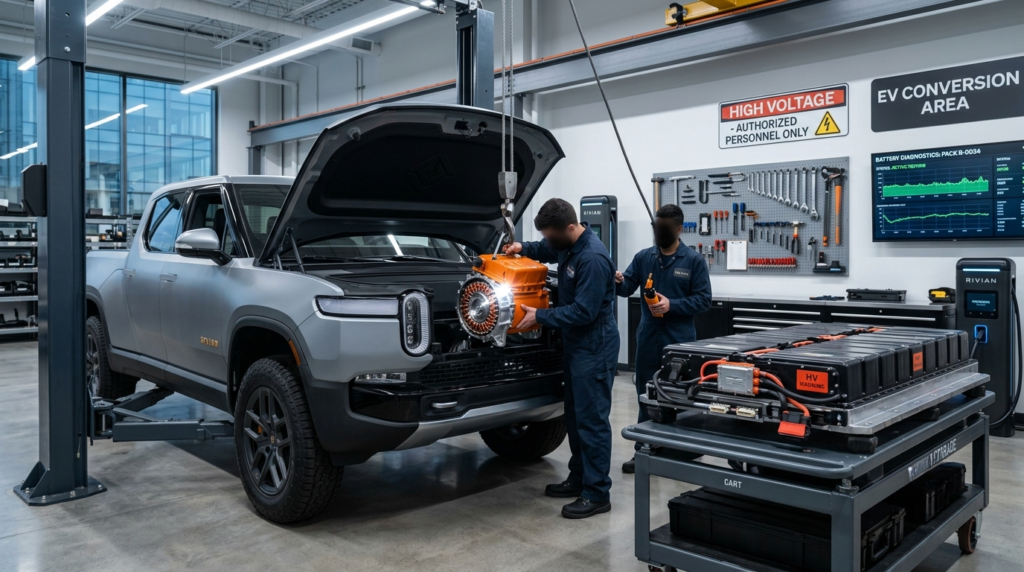
Converting existing diesel trucks to electric costs $8,000–$200,000 depending on vehicle class 30–60% less than buying new. The process replaces the engine, exhaust, and fuel system with an electric motor, battery pack, and vehicle control unit while preserving the chassis and body.
How Electric Truck Conversion Works: The Technical Process
The conversion process follows five stages:
- Dismantle: Remove engine, exhaust, fuel tanks, and sometimes the gearbox
- Install motor: Add traction motor (120–500+ kW) or integrated e-axle
- Add batteries: Install LFP or NMC pack sized to duty cycle (40–500+ kWh)
- Integrate controls: Install VCU, BMS, and inverter; emulate signals for ABS/ESP/ADAS compatibility
- Test & certify: Validate thermal management, charging interfaces, and safety systems
Signal emulation is critical; it simulates engine RPM, oil pressure, and alternator output so existing dashboard and safety systems function without error codes.
Electric Truck Conversion Kit Costs by Vehicle Class
| Class | Vehicle Type | Kit Cost | Battery | Motor Power | Best For |
| Class 1–2 | Pickups, vans | $8,000–$25,000 | 80–120 kWh | 120–200 kW | Urban delivery, municipal |
| Class 3–6 | Box trucks, delivery | $100,000–$150,000 | 150–200 kWh | 200–250 kW | Regional distribution |
| Class 7–8 | Semi tractors | $100,000–$200,000 | 300+ kWh | 350–500+ kW | Drayage, dedicated haul |
When Conversion Beats Buying New: The TCO Breakdown
Conversion makes financial sense when:
- The existing chassis has 10–15 years of structural life remaining
- Compliance deadlines (California ACF, EU low-emission zones) approach faster than new vehicle delivery timelines
- Custom battery sizing or power output is needed beyond OEM catalog options
- Budget constraints make the $50K–$100K+ new EV premium unaffordable
California’s CARB offers rebates up to $90,000 per converted heavy-duty truck, making the payback period attractive for in-state operators.
EV Charging Infrastructure for Trucks: Depot, Destination & On-the-Move
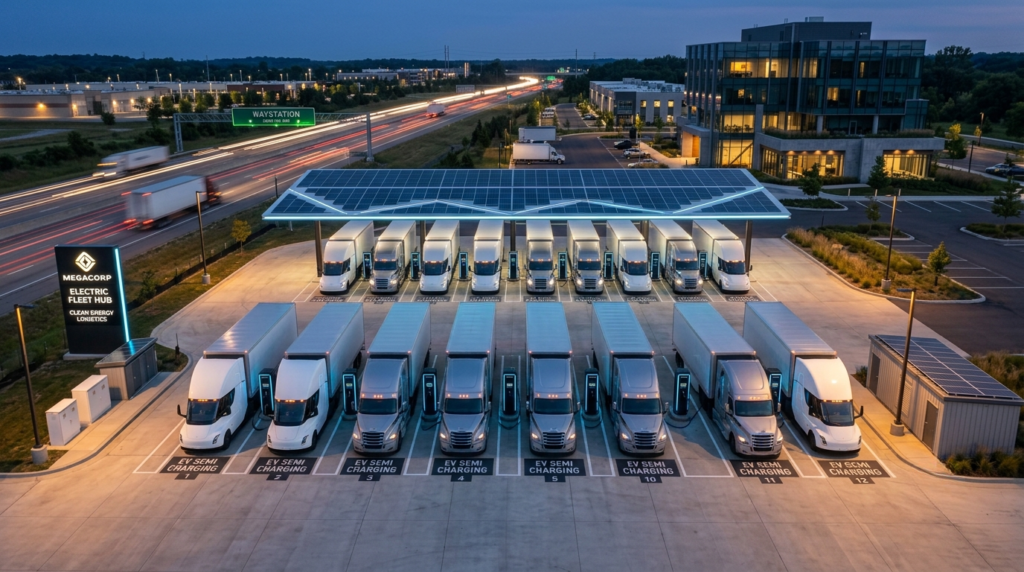
Electric truck charging uses three strategies: overnight depot charging (11–22 kW AC), destination charging at warehouses (50–150 kW DC), and on-the-move megawatt charging (1+ MW) during mandatory 45-minute driver breaks.
Fleet Depot Charging: Dynamic Load Balancing & Cost Optimization
Depot charging is the foundation of fleet electrification. Key considerations:
- Level 2 (11–22 kW AC): Sufficient for overnight charging of vehicles with predictable daily routes under 200 miles
- DC fast charging (50–150 kW): Needed for larger batteries or shorter charging windows
- Dynamic load balancing: Distributes available grid capacity across chargers in real time, preventing simultaneous peak draws that trigger demand charges exceeding the electricity cost itself
Demand charges can account for over 70% of monthly electricity bills if unmanaged. Smart charging software that staggers vehicle charging can reduce this by 50%+.
Megawatt Charging System (MCS): The Long-Haul Solution
MCS represents the breakthrough for electric long-haul trucking:
- Peak power: Up to 1.2 MW
- Voltage range: 200–1,250 VDC
- Current: 1,500 A
- Result: Hundreds of miles added during a 45-minute legal driver break
Kempower’s Mega Satellite system and ABB’s heavy-duty solutions are deployed across European logistics hubs and US interstate corridors.
Public vs. Private Charging Networks for Commercial Fleets
| Factor | Private Depot | Public Network | Hybrid |
| Cost per kWh | Lowest (off-peak rates) | Highest (demand + margin) | Moderate |
| Reliability | High (controlled) | Variable | High |
| Upfront investment | $50K–$500K+ | $0 | $30K–$200K |
| Best for | Return-to-base fleets | Long-haul, irregular routes | Mixed operations |
Electric Truck Maintenance Cost vs. Diesel: The 30–50% Savings Breakdown
Electric trucks cost 30–50% less to maintain than diesel equivalents. EVs have roughly 20 moving drivetrain parts versus 2,000+ in diesel engines. Eliminated services include oil changes, transmission fluid, DPF/SCR aftertreatment, and most brake replacements.
What’s Missing? No Oil, No Transmission, No Exhaust System
Diesel truck maintenance includes recurring costs that EVs eliminate entirely:
- Oil changes: Every 10,000–25,000 miles at $150–$400 each
- Transmission service: Fluid and filter every 50,000–100,000 miles
- DPF/SCR aftertreatment: Regeneration issues, DEF refills, sensor failures
- Exhaust system: Rust, leaks, and replacement
Annual maintenance for a diesel Class 8 truck runs approximately $0.08–$0.12 per mile. Electric equivalents average $0.04 per mile, a 50% reduction that compounds across fleet scale.
Regenerative Braking: How It Cuts Brake Wear by 60%+
Regenerative braking captures deceleration energy and feeds it to the battery, reducing reliance on friction brakes. In urban stop-and-go operation:
- Brake pad life extends 2–3x
- Rotor replacement intervals double or triple
- Brake dust emissions near zero
For refuse trucks and delivery vans making 200+ stops daily, this alone saves thousands annually in brake maintenance.
Battery Health Monitoring: The New Maintenance Priority
While EVs eliminate mechanical maintenance, they add battery oversight:
- State of Health (SOH) tracking: Monitor capacity degradation over time
- Thermal management: Ensure cooling systems maintain 20–40°C battery temperature
- Warranty compliance: Most manufacturers cover 8 years/100K+ miles at 70–80% capacity retention
Fleet management platforms should track SOH per vehicle from day one; this data directly impacts resale value and replacement planning.
Electric Truck Leasing, Rental & Financing: Get on the Road Faster
Leasing eliminates the $10K–$100K+ electric truck purchase premium. Monthly payments run $800–$2,500 depending on class. Commercial EV rentals are available from national chains and regional providers. Federal tax credits up to $40,000 apply to leased vehicles.
Electric Truck Leasing vs. Buying: Which Saves More?
| Factor | Buying | Leasing |
| Upfront cost | $50K–$300K+ | $0–$5,000 down |
| Monthly cost | $0 (after purchase) | $800–$2,500 |
| Tax credit eligibility | Full $40K | Passed through to lessee |
| Residual risk | Buyer bears depreciation | Lessor assumes risk |
| Flexibility | Own asset long-term | Upgrade as technology improves |
Leasing is optimal for operators uncertain about long-term EV suitability or expecting rapid technology improvement. Buying wins for high-mileage operators who maximize TCO savings over 5+ years.
Where to Rent Electric Trucks Near You
Rental options are expanding:
- National chains: Enterprise, Penske adding EV truck fleets
- Regional providers: Specialized commercial EV rental companies in major metros
- Peer-to-peer platforms: Turo-style services for light-duty electric pickups
For short-term needs (events, seasonal demand, trial periods), rental avoids capital commitment while providing real-world operational data.
Are Electric Trucks Worth It? TCO, Incentives & Payback Analysis
Yes for most commercial and fleet applications. Electric trucks achieve TCO parity with diesel in 2–6 years depending on vehicle class and annual mileage. Energy costs are 60–80% lower, maintenance 30–50% lower, and federal incentives reach $40,000 per commercial vehicle.
Total Cost of Ownership (TCO): Electric vs. Diesel Per Mile
The TCO comparison reveals why electrification is accelerating:
| Cost Category | Electric | Diesel | Savings |
| Energy/Fuel | $0.03–$0.06/mi | $0.15–$0.25/mi | 60–80% |
| Maintenance | $0.04/mi | $0.08–$0.12/mi | 30–50% |
| Insurance | ~$180/mo | ~$140/mo | -28% |
| Purchase (after incentives) | $10K–$30K premium | Baseline | Varies |
At 100,000 miles annually, a Class 8 electric truck saves approximately $30,000 per year in fuel and maintenance alone.
Electric Vehicle Incentives & Tax Credits in 2026
| Program | Amount | Eligibility | Deadline |
| Federal IRA (Commercial Clean Vehicle) | Up to $40,000 | Class 4+ commercial vehicles | Ongoing (status may shift) |
| California HVIP | Up to $60,000 | Heavy-duty qualifying vehicles | Fund-limited |
| Section 30C Charging Infrastructure | 6–30% of cost | Commercial charging ports | June 30, 2026 |
| EU Toll Exemptions | Full exemption | Zero-emission heavy vehicles | Through June 2031 |
The EU exemption is particularly valuable; a truck driving 116,000 km annually on toll roads saves over €150,000 across five years in Germany alone.
Payback Period by Truck Class: From 2 Years to 6 Years
| Class | Annual Mileage | Annual Savings | Payback Period |
| Class 4–5 (Medium-duty) | 50K–80K mi | $8K–$15K | 2–4 years |
| Class 6–7 (Medium-heavy) | 80K–100K mi | $15K–$25K | 3–5 years |
| Class 8 (Heavy-duty) | 100K+ mi | $25K–$40K | 4–6 years |
High-mileage urban routes with depot charging achieve the fastest payback. Long-haul sleeper applications remain challenging due to charging time constraints.
4 Costly Mistakes to Avoid When Buying or Leasing Electric Trucks
The most expensive errors include: underestimating towing range penalty (30–50% loss), ignoring charging infrastructure costs ($50K–$500K+), missing incentive deadlines, choosing wrong truck class for duty cycle, neglecting battery warranty terms, overlooking demand charges, and failing to certify high-voltage technicians.
Mistake #1: Underestimating the Towing Range Penalty
Every electric pickup loses 30–50% of range when towing. A 300-mile truck becomes a 150–200-mile truck with a loaded trailer. Plan charging infrastructure and route schedules around worst-case winter towing range, not EPA ratings.
Mistake #2: Ignoring Charging Infrastructure Costs
Depot charging requires electrical upgrades that can cost $50,000–$500,000+ depending on existing grid capacity. Factor this into year-one cash flow, not just vehicle procurement. Utility “make-ready” programs may cover 30–80% of infrastructure costs.
Mistake #3: Missing Federal & State Incentive Deadlines
The Section 30C charging infrastructure tax credit expires June 30, 2026 for property placed in service. California HVIP funds are allocated on a first-come basis. Delaying procurement risks leaving tens of thousands of dollars on the table.
Mistake #4: Choosing the Wrong Truck for Your Duty Cycle
Urban delivery requires different specs than regional haul:
- Urban/last-mile: Smaller battery (80–150 kWh), 11 kW AC charging sufficient
- Regional distribution: Medium battery (200–400 kWh), 50–150 kW DC charging
- Long-haul: Largest battery (500+ kWh), MCS capability required
Oversizing batteries wastes capital; undersizing creates operational failures.
Electric Truck Technology Trends: What’s Coming in 2027–2030
Three technologies will reshape electric trucking by 2030: battery swapping (under 10 minutes), solid-state batteries (2x energy density), and vehicle-to-grid (V2G) revenue generation. Battery cost parity with diesel is projected by 2030–2035.
Battery Swapping vs. Charging: The China Model
Battery swapping eliminates charging downtime entirely. CATL plans 900 swapping stations by 2026 in China, and German startups E-Haul and Big Automation are piloting European networks.
A 500 kWh battery swap takes under 10 minutes faster than diesel refueling.
Challenges include battery standardization across manufacturers and swap station capital costs. For fleet operators with uniform vehicle models, swapping could eliminate range anxiety entirely.
Solid-State Batteries: Doubling Range Without Doubling Weight
Solid-state batteries replace liquid electrolytes with solid ceramics, enabling:
- 2x energy density (same weight, double range)
- Faster charging (10–80% in 10–15 minutes)
- Longer cycle life (3,000+ cycles vs. 1,500 for lithium-ion)
Toyota and QuantumScape target commercialization by 2027–2028. When deployed in trucks, a 500-mile semi could become a 1,000-mile semi without payload penalty.
Vehicle-to-Grid (V2G): Turning Your Fleet Into a Power Plant
Bidirectional charging allows electric trucks to feed energy back to the grid during peak demand periods. Fleet operators can:
- Sell peak power at premium rates
- Reduce demand charges by discharging during utility peak periods
- Provide backup power to facilities during outages
Early pilots show fleets generating $2,000–$5,000 per vehicle annually in grid services revenue offsetting a significant portion of energy costs.
FAQ: Electric Trucks Answered
How long does it take to charge an electric truck?
Light-duty (pickups): 11–22 kW AC overnight (8–12 hours) or 150 kW DC (30–45 minutes for 10–80%). Heavy-duty (semis): 1.2 MW MCS adds hundreds of miles in 45 minutes. Depot charging is typically overnight; public charging depends on station power.
Can electric trucks really tow heavy loads?
Yes. The Chevy Silverado EV weighs 12,500 lbs and the GMC Hummer EV weighs 12,000 lbs. However, towing reduces range 30–50%. Plan charging stops every 120–150 miles when towing near maximum capacity.
Do electric trucks have transmissions?
Most electric trucks use single-speed reduction gears, not multi-speed transmissions. The electric motor’s wide torque band eliminates the need for gear changes. Some heavy-duty conversions retain OEM transmissions for gradeability, but direct-drive is becoming standard.
How long do electric truck batteries last?
Manufacturer warranties typically cover 8 years or 100,000+ miles with 70–80% capacity retention. Real-world degradation is 2–3% annually under normal conditions. Thermal management and avoiding 100% charge/discharge cycles extend lifespan significantly.
Are electric truck batteries recyclable?
Yes. Lithium-ion batteries are 95%+ recyclable. Manufacturers including Tesla, Rivian, and Volvo have established recycling partnerships. Second-life applications (stationary energy storage) extend utility before final recycling.
What is the cheapest electric truck available?
The 2026 Ford F-150 Lightning Pro starts at $52,375 the lowest-priced full-size electric pickup. For commercial use, converted light-duty trucks start at $8,000 (conversion kit cost), though this excludes labor and certification.
Can I install a home charger for a commercial electric truck?
Light-duty electric pickups charge on standard Level 2 home chargers (240V, 40A). Medium and heavy-duty trucks require commercial three-phase power (480V) and professional installation. Consult a licensed electrician for load calculations and panel upgrades.
Do electric trucks work in cold weather?
Yes, with range reduction of 15–25%. Pre-conditioning the cabin while plugged in preserves battery capacity. Some models include battery thermal management systems that maintain optimal temperature. Winter tires are recommended for regions below -10°C.
Ready to Electrify? Your Next Steps
Start with a route analysis matching your daily miles to truck range. Use our comparison tools to identify models fitting your duty cycle. Calculate TCO with current incentives. Consider leasing to minimize upfront capital. Plan charging infrastructure 6–12 months before vehicle delivery.
Electric trucks have crossed from early-adopter novelty to operational necessity. Regulatory deadlines, TCO parity, and charging infrastructure maturity make 2026 the inflection point for most fleets. The question is no longer whether to electrify, but how to structure the transition for maximum return.
Start your electrification journey today: Compare electric truck models, calculate your fleet’s TCO, and explore leasing options at Modern Vehicles.
Trusted Reference
According to the International Council on Clean Transportation (ICCT), battery-electric and diesel trucks reach TCO parity earlier in high-annual-mileage use cases with some European cities achieving parity by 2022 for delivery trucks traveling 60,000 km annually.



0 Comments