Are Used Electric Cars Worth Buying in 2026?
Yes, used electric cars are one of the smartest vehicle purchases in 2026. Depreciation has slashed prices by 30–55% across major brands, with models like the Tesla Model 3, Nissan Leaf, and Chevrolet Bolt now available at half their original cost. A healthy used EV typically saves $1,000–$2,000 annually in fuel and maintenance compared to a gas equivalent. The key is verifying battery health before purchase, as the battery pack, not the odometer, determines real-world value.
- Best budget pick: 2017–2019 Nissan Leaf SV from $7,500
- Best reliability: 2019–2022 Tesla Model 3 battery warranty intact
- Best value under $10K: 2017–2019 Chevrolet Bolt 238-mile range
- Avoid: First-gen Nissan Leaf (2011–2017) with air-cooled batteries
What Are Used Electric Cars and Why Buy One in 2026?
Used electric cars are pre-owned battery-electric vehicles (BEVs) sold on the secondary market, typically 2–5 years old with 20,000–60,000 miles. Unlike used gas cars where mileage predicts wear, used EVs are judged primarily by battery condition and software support.
The depreciation opportunity is unprecedented. Polestar, Volkswagen, and Hyundai EVs have lost 35–50% of value in just two years, while Tesla Model 3 and Model Y units have depreciated roughly 56% after three years. This means a 2022 Tesla Model 3 Long Range that cost $55,000 new now sells for approximately $25,000 a $30,000 discount absorbed by the first owner.
The total cost of ownership heavily favors used EVs. Home charging costs roughly $540 annually for 15,000 miles versus $1,520+ for gasoline. Annual maintenance runs $150–$400 compared to $600–$1,200 for combustion engines, with no oil changes, timing belts, or DPF filters to replace.
How to Check Used Electric Car Battery Health Before You Buy
Battery health, not mileage, is the single most important inspection point on any used EV. A three-year-old EV with 60,000 miles and a healthy battery is a better buy than the same car with 30,000 miles and degraded cells.
Understanding State of Health (SOH) and Safe Thresholds
State of Health (SOH) measures remaining battery capacity as a percentage of original. Most modern EVs lose 1–2% annually under normal use. A healthy three- to four-year-old EV should show 85–92% SOH. Below 80% warrants investigation; below 75% is a red flag for most buyers.
Using OBD-II Scanners and EV Diagnostic Apps
An OBD-II scanner with EV-specific software is the most reliable DIY tool. The OBDLink CX adapter paired with Car Scanner Pro reads battery management system (BMS) data including:
- Cell voltage balance: Deviation should stay under 0.02V at rest. Over 0.10V signals potential failure.
- Isolation resistance: Must remain above 900 kΩ (typically 1,000–3,000 kΩ).
- Accumulated DC fast charging energy: High ratios of DC vs. AC charging correlate with faster degradation.
Why Dealer “100% Battery Health” Claims Are Misleading
Forum data from thousands of EV owners reveals a critical flaw: many manufacturer BMS algorithms report 100% SOH even on degraded batteries to avoid warranty claims during the coverage period. A dealer showing “100% battery health” on a three-year-old EV should be treated as a starting point, not proof. Always verify with an independent OBD-II reading or third-party inspection.
The Real-World Range Test Most Buyers Skip
Charge the vehicle to 100% and compare the displayed range against the original EPA rating. A car originally rated at 250 miles showing 220 miles at full charge sits at roughly 88% SOH healthy. Showing 180 miles means roughly 72% SOH investigate before signing.
7 Used Electric Cars to Avoid (and Why)
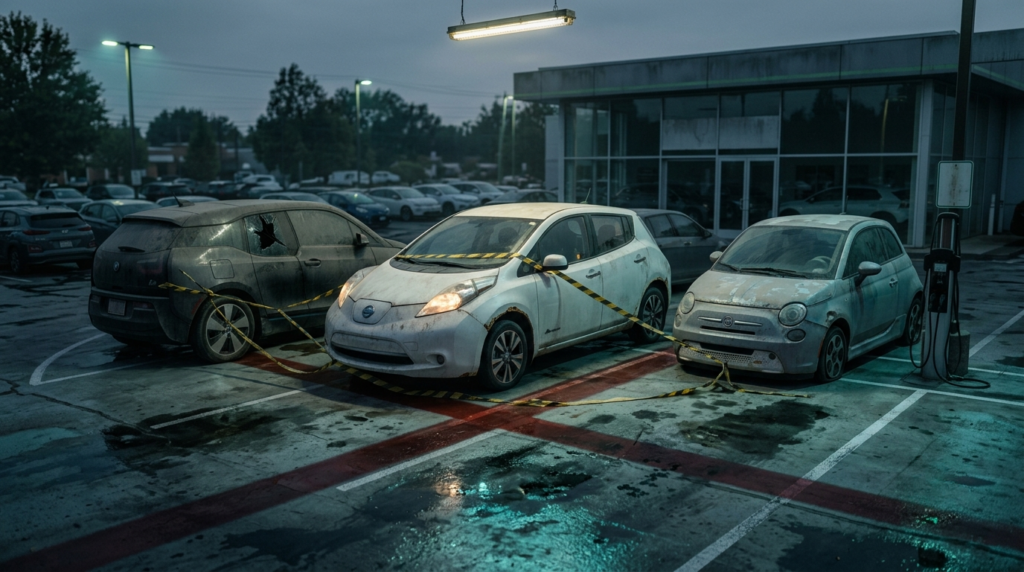
Not every cheap used EV is a bargain. These models carry risks that outweigh their low prices:
1. First-Generation Nissan Leaf (2011–2017)
Air-cooled batteries in early Leafs suffer catastrophic degradation in hot climates. Many 2015 models now show 60–70% SOH with ranges below 70 miles. The 30 kWh “upgrade” versions (2016–2017) fare slightly better but still underperform liquid-cooled competitors.
2. Early BMW i3 (60 Ah, 2014–2016)
The 22 kWh battery delivers roughly 80 miles of real-world range insufficient for most American commutes. The 94 Ah (33 kWh) versions are marginal. Only the 120 Ah (42.2 kWh) models from 2019+ are viable.
3. High-Mileage Tesla Model S (2012–2016)
Out-of-warranty Model S units face potential $15,000–$20,000 battery replacement costs. Early air suspension and door handle failures add to ownership risk.
4. Any EV with a Salvage or Rebuilt Title
Salvage-title EVs often have compromised high-voltage systems. Insurance is difficult to obtain, and manufacturer warranties are voided. The savings rarely justify the safety and financial risk.
5. Fiat 500e (2013–2019)
Tiny battery, limited range (~84 miles), and Chrysler’s withdrawal from the model leave minimal service support. Parts availability is shrinking.
6. Mitsubishi i-MiEV (2012–2017)
With only 62 miles of EPA range and a primitive battery system, the i-MiEV is obsolete. Replacement parts are nearly impossible to source.
7. Early VW e-Golf (2015–2016)
The 24.2 kWh battery and slow 50 kW DC charging make the early e-Golf impractical for modern use. The 35.8 kWh models (2017–2019) are acceptable but still limited.
Best Used Electric Cars Under $10,000 in 2026
| Model | Year Range | Typical Price | EPA Range | Battery Type | Key Consideration |
| Nissan Leaf SV/SL | 2017–2019 | $7,500–$10,000 | 150–226 mi | 40 kWh liquid-cooled | Verify 40 kWh, not 30 kWh |
| BMW i3 (120 Ah) | 2019–2021 | $8,500–$12,000 | 153 mi | 42.2 kWh | Carbon fiber body, unique tires |
| Chevrolet Bolt EV | 2017–2019 | $9,000–$13,000 | 238 mi | 60 kWh liquid-cooled | Battery recall must be completed |
| Hyundai Ioniq Electric | 2019–2021 | $9,500–$14,000 | 170 mi | 38.3 kWh | Excellent efficiency, limited fast charging |
| Kia Soul EV | 2020–2021 | $10,000–$15,000 | 243 mi | 64 kWh | Shared Bolt battery, better warranty |
The 2017–2019 Chevrolet Bolt offers the most range per dollar at this price point. However, to ensure the battery recall replacement has been completed GM replaced defective battery packs free of charge through 2024.
Used Electric Car Financing: What Lenders Look For
Financing a used EV differs from traditional auto loans because depreciation curves are steeper. A vehicle that lost 50% of value in three years creates loan-to-value (LTV) challenges most lenders account for with higher down payment requirements.
How Depreciation Affects Loan Terms
With steep depreciation, lenders often require 15–20% down on used EVs versus 10% for gas cars. Credit unions typically offer the best rates, some as low as 5.49% APR for 60-month terms on 2020+ EVs with clean titles and verified battery health.
Credit Union vs. Dealer Financing
Credit unions beat dealer financing on used EVs by an average of 1.5–2.5 percentage points. Dealer captive finance arms (Ford Credit, Hyundai Capital) sometimes offer promotional rates on CPO EVs, but these usually require buying from franchised dealers at premium prices.
Leasing a Used EV
Used EV leasing is rare but growing through platforms like LeasePlan and Arval. Monthly payments on a three-year used EV lease typically run 30–40% below new EV leases, though mileage caps and wear charges apply.
Most Reliable Used Electric Cars: Expert Rankings for 2026
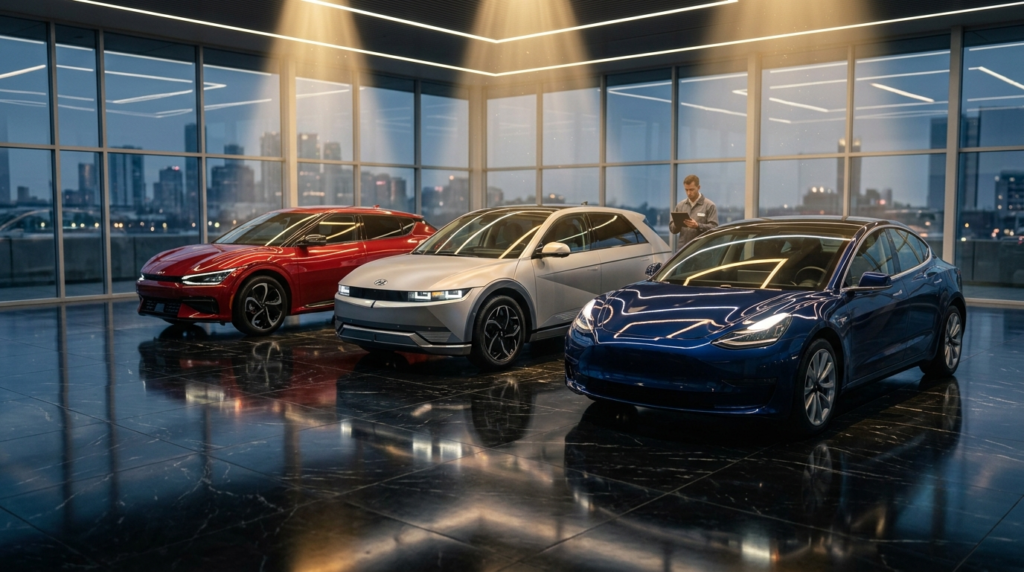
Tesla Model 3 (2019–2023)
The Model 3 combines over-the-air software updates, minimal maintenance, and the largest fast-charging network. Real-world reliability data from 100,000+ vehicles shows drivetrain issues are rare after 2019. Battery warranty covers 8 years/120,000 miles with 70% capacity guarantee.
Hyundai Ioniq 5 (2022–2024)
Hyundai’s E-GMP platform delivers 800V fast charging (10–80% in 18 minutes) and a 5-year/60,000-mile bumper-to-bumper warranty. The 77.4 kWh battery has shown minimal degradation in early ownership data.
Kia EV6 (2022–2024)
Sharing the Ioniq 5’s platform, the EV6 adds sportier styling and slightly better efficiency. Kia’s 10-year/100,000-mile powertrain warranty is among the best in the industry and transfers to second owners.
5 Critical Mistakes First-Time Used EV Buyers Make
Mistake #1: Ignoring Battery Health for a “Great Price”
A $6,000 Leaf with 65% SOH is not a deal, it’s a $6,000 headache. Always verify battery condition before negotiating price.
Mistake #2: Buying Without Confirming Warranty Transfer
Federal law mandates 8-year/100,000-mile battery warranties, but transferability varies. Call the manufacturer’s customer service with the VIN to confirm remaining coverage before purchase.
Mistake #3: Skipping the Pre-Purchase EV Inspection
A standard mechanic cannot evaluate high-voltage systems. Seek an inspector with EV-specific diagnostic equipment the $200–$400 fee often pays for itself in negotiating leverage.
Mistake #4: Not Checking Home Charging Compatibility
Verify your electrical panel can support Level 2 (240V) charging. Installation costs range from $300 (existing 240V outlet) to $2,500 (panel upgrade + new circuit).
Mistake #5: Falling for “100% Battery Health” Claims
As covered above, dealer battery reports often inflate SOH. Independent verification is non-negotiable on any used EV purchase over $10,000.
Used EV Tax Credits and State Rebates: What’s Available in 2026
The federal used EV tax credit expired September 30, 2025. The previously-owned clean vehicle credit (IRS Section 25E), worth up to $4,000, no longer applies to purchases after that date. However, state and utility programs still deliver meaningful savings:
| State/Program | Rebate Amount | Income Cap | Key Requirement |
| California Clean Cars 4 All | Up to $9,500 | 300% FPL | Must retire 2007+ gas car |
| SCE Pre-Owned EV Rebate | Up to $4,000 | Income-qualified | Must be SCE customer |
| Colorado Vehicle Exchange | Up to $6,000 | Income-qualified | Trade-in required |
| Oregon Charge Ahead | Up to $5,000 | 400% FPL | Currently suspended |
| Massachusetts MOR-EV | Varies | Income-qualified | At participating dealers |
| Pennsylvania AFV Rebate | Up to $2,500 | None | Under $45,000 purchase price |
California offers the deepest stack: combine Clean Cars 4 All with utility rebates (PG&E, SCE, LADWP) and local air district incentives for total savings exceeding $10,000 on qualifying purchases.
EV Battery Warranty Transfer: What Second Owners Must Know
All EV manufacturers must warranty battery packs for at least 8 years or 100,000 miles under federal regulations. However, coverage details vary significantly:
- Tesla: 8 years/120,000 miles (Model 3/Y) with 70% capacity guarantee. Transfers automatically.
- Hyundai/Kia: 10 years/100,000 miles powertrain. Battery warranty transfers to the second owner.
- Chevrolet: 8 years/100,000 miles. Bolt battery recall extended coverage for replaced packs.
- Nissan: 8 years/100,000 miles. Leaf warranty covers capacity below 9 bars (roughly 70%).
Always verify by VIN. Call the manufacturer’s EV customer line with the VIN to receive a written warranty status report before finalizing any purchase.
Used EV Market Trends: Why 2026 Is the Best Time to Buy
Three converging factors make 2026 an exceptional entry point:
- Depreciation peaked. Polestar, VW, and Hyundai models lost 35–50% in two years. Three-year-old Teslas have shed 56% of original value. The first owner absorbed the worst of the curve.
- The lease return wave. Thousands of 2022–2023 leased EVs are returning to dealer lots with 20,000–40,000 miles, certified warranties intact, and prices 40–55% below MSRP.
- New EV price wars. Aggressive new EV incentives (0% APR, $10,000+ rebates) are crushing used EV resale values further, great news for buyers, terrible for sellers.
Where to Find the Best Used Electric Car Deals Right Now
Online marketplaces (Carvana, CarGurus, TrueCar) offer the largest inventory and transparent pricing but charge delivery fees. Certified dealers provide warranty-backed peace of mind at a $1,500–$3,000 premium.
Timing matters. January–March sees the highest inventory as lease returns peak. November–December brings year-end dealer incentives. Avoid tax refund season (March–April) when demand spikes and prices rise 5–10%.
Frequently Asked Questions About Used Electric Cars
Do used electric cars qualify for a tax credit?
No. The federal used EV tax credit expired September 30, 2025. State and utility rebates remain available in California, Colorado, Massachusetts, Pennsylvania, and others.
What is the best used electric car to buy?
The 2019–2022 Tesla Model 3 offers the best balance of range, reliability, charging network, and warranty coverage. For budget buyers, the 2017–2019 Chevrolet Bolt delivers 238 miles of range under $10,000.
Are used EVs worth it?
Yes if you verify battery health and have home charging. A healthy used EV saves $1,000–$2,000 annually in fuel and maintenance versus a gas car, with purchase prices now 30–55% below original MSRP.
How do I check battery health on a used EV?
Use an OBD-II scanner with EV-specific software (OBDLink CX + Car Scanner Pro) to read SOH, cell voltage balance, and isolation resistance. Compare displayed full-charge range against original EPA ratings.
What used EVs should I avoid?
Avoid first-generation Nissan Leafs (2011–2017) with air-cooled batteries, early BMW i3 60 Ah models, high-mileage out-of-warranty Tesla Model S units, and any EV with a salvage or rebuilt title.
How much does a used Tesla Model 3 cost?
As of mid-2026, 2019–2021 Model 3 Standard Range units range from $18,000–$25,000. Long Range models run $22,000–$32,000 depending on mileage and battery condition.
Is it safe to buy a used electric car?
Yes, with proper inspection. Verify battery health via OBD-II scan, confirm warranty transfer by VIN, and obtain a pre-purchase inspection from an EV-qualified mechanic.
What is the cheapest reliable used EV?
The 2017–2019 Nissan Leaf SV with the 40 kWh battery starts around $7,500 and delivers 150 miles of range. Avoid the 30 kWh “S” trim with the smaller pack.
Do used EVs still have battery warranty?
Most do. Federal law requires 8-year/100,000-mile minimum battery warranties that typically transfer to second owners. Always verify by VIN with the manufacturer before purchase.
How long do EV batteries last?
Modern EV batteries typically last 10–15 years with 1–2% annual degradation. Most retain 70%+ capacity well beyond 100,000 miles under normal use.
Conclusion: Your Next Step
Used electric cars in 2026 represent one of the best value propositions in automotive history but only for informed buyers. The difference between a smart purchase and an expensive mistake comes down to one factor: battery verification.
Before visiting any dealer, download an OBD-II app, research your state’s rebate programs, and set a firm budget that includes home charging installation. The market is flooded with inventory. The patient, prepared buyer wins.
Ready to find your perfect used EV? Browse verified listings with battery health reports, compare financing options, and calculate your total cost of ownership all in one place.


0 Comments