A PHEV (Plug-In Hybrid Electric Vehicle) is a car that combines an electric motor with a petrol engine and can be recharged by plugging into an external power source. Unlike standard hybrids (HEVs), PHEVs drive 80–120 km on pure electric power before the engine takes over, making them ideal for daily commutes on electricity and long trips on fuel. In 2026, PHEVs represent the fastest-growing electrified segment, bridging the gap between hybrids and fully
electric cars.
Key PHEV Facts at a Glance:
- Stands for: Plug-In Hybrid Electric Vehicle
- Electric range: 80–120 km (2026 average)
- Battery size: 18–25 kWh
- Charging: Level 1 (home outlet) or Level 2 (wall charger)
- Best for: Drivers with home charging who want EV benefits without range anxiety
Introduction
Choosing between a hybrid, plug-in hybrid, or fully electric car feels overwhelming. Every manufacturer claims their technology is “the best of both worlds,” yet the reality depends entirely on how you drive, where you charge, and what you prioritize fuel savings, purchase price, or environmental impact.
Most guides stop at surface-level definitions. They tell you a PHEV “plugs in” and leave you guessing whether it’s worth the premium over a standard hybrid or the complexity compared to a fully electric car. This guide is different. We break down the PHEV definition with technical precision, expose the hidden costs most buyers overlook, and arm you with data from 2026 real-world studies including the “lazy plugging” penalty that can make a PHEV more expensive to run than a regular hybrid.
Whether you’re comparing a Toyota RAV4 PHEV, a BYD Sealion 6, or weighing PHEV against BEV for your next purchase, this 2026 guide gives you the complete picture. Let’s start with the fundamentals.
What Is a PHEV? The Complete Definition
A PHEV is a vehicle with two power sources an electric motor powered by a rechargeable battery and an internal combustion engine fueled by petrol or diesel. What distinguishes it from a standard hybrid (HEV) is the external charging port: you plug it into a wall outlet or charging station to replenish the battery. This enables significant electric-only driving (80–120 km in 2026 models) before the engine ever starts.
PHEV Meaning Explained in Simple Terms
PHEV stands for Plug-In Hybrid Electric Vehicle. Think of it as an electric car with a petrol backup generator. For short trips commuting, school runs, grocery shopping you drive purely on electricity. For longer journeys, the petrol engine fires up seamlessly, eliminating the “range anxiety” that stops many buyers from choosing a fully electric car.
The key distinction from a standard hybrid is the plug. HEVs recharge only through regenerative braking and the engine. PHEVs recharge that way plus via external power, giving them a much larger battery and meaningful electric range.
How PHEV Differs from HEV and BEV
| Feature | HEV (Hybrid) | PHEV (Plug-In Hybrid) | BEV (Fully Electric) |
| Battery | 1–1.5 kWh | 18–25 kWh | 60–100 kWh |
| Electric range | 1–2 km (low speed) | 80–120 km | 450–700 km |
| External charging | No | Yes (L1/L2) | Yes (L2/L3) |
| Fuel required | Petrol only | Petrol + electricity | Electricity only |
| Complexity | High | Very high | Low |
| 2026 TCO (5-year) | $59,600 | $64,800 | $59,300 |
Source: 2026 Energy Solutions TCO analysis
The SAE J2841 Utility Factor Standard
Here’s what competitors miss: Utility Factor (UF) is the standardized metric that determines how much of your driving a PHEV actually does on electricity. Defined by SAE J2841, UF calculates the ratio of miles traveled in charge-depleting (electric) mode versus total miles. For a PHEV with 50 miles of electric range, the standard predicts ~75% of driving can be electric if you charge daily.
Why this matters: Real-world data shows 40% of fleet PHEVs are never plugged in, collapsing their utility factor and making them less efficient than standard hybrids. Understanding UF before you buy prevents a costly mistake.
How Does a PHEV Work? Step-by-Step Powertrain Guide
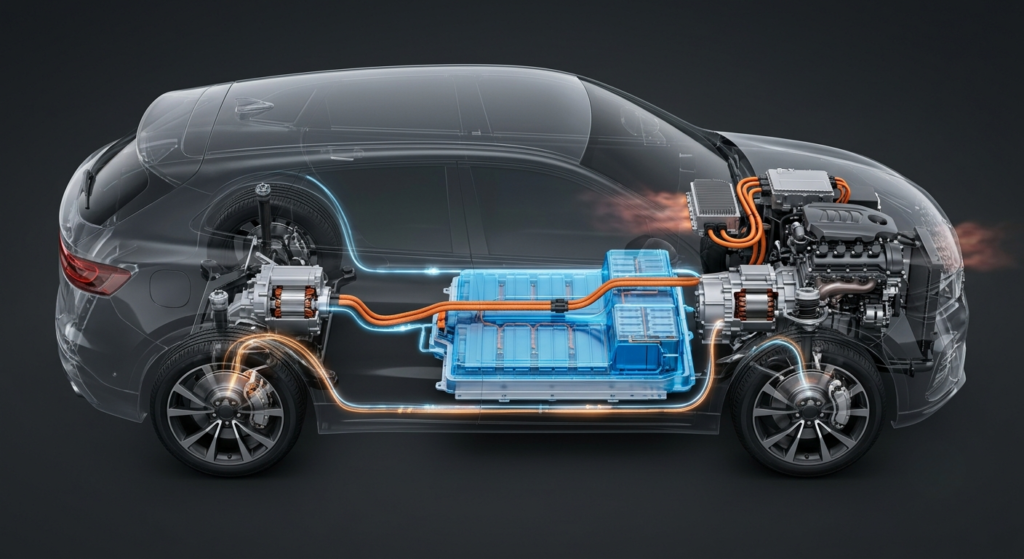
A PHEV operates in two distinct modes. Charge-depleting (CD) mode uses battery power first, driving the wheels via the electric motor for 80–120 km. Once the battery drops to a minimum threshold, the vehicle switches to charge-sustaining (CS) mode, where the petrol engine powers the car and maintains battery charge. The driver never manually switches modes the vehicle’s power electronics controller manages transitions automatically.
Charge-Depleting (CD) Mode: Electric-First Driving
In CD mode, the PHEV behaves like a fully electric car. The traction battery pack supplies power to the electric motor, which drives the wheels. The petrol engine remains off, producing zero tailpipe emissions. This mode covers most daily commutes; the average Australian drives 37 km per day, well within the 80–120 km electric range of 2026 PHEVs.
Key point: CD mode fuel consumption is near zero for most PHEVs under standard conditions. However, demanding driving (high speed, steep hills, cold weather) may trigger brief engine assistance even in CD mode, a design called “blended operation.”
Charge-Sustaining (CS) Mode: Hybrid Operation
Once the battery depletes to its minimum state of charge, the PHEV enters CS mode. The internal combustion engine becomes the primary power source, while the battery acts as a buffer assisting during acceleration and storing regenerative braking energy. This is functionally identical to how a standard hybrid operates.
The critical difference: A PHEV in CS mode is lugging around 300 kg of extra battery and motor hardware that a standard HEV doesn’t carry. If you rarely charge, this “dead weight” makes the PHEV less efficient than the HEV.
Regenerative Braking and Energy Recovery
Every PHEV captures energy normally lost during braking. When you decelerate, the electric motor reverses function to become a generator, converting kinetic energy into electricity stored in the battery. This extends brake life to approximately 150,000 km and recovers 10–25% of driving energy in stop-start traffic.
PHEV Charging Levels and Times (2026)
| Charging Level | Power | Typical Time (0–100%) | Best For |
| Level 1 | 2.3 kW (standard outlet) | 8–12 hours | Overnight home charging |
| Level 2 | 7–22 kW (wall charger) | 2–4 hours | Home/workplace charging |
| DC Fast | 40 kW+ (select models) | 20–30 min (30–80%) | BYD Shark 6, Sealion series |
Note: Most PHEVs use Level 1/2 only, but 2026 BYD models support DC fast charging—a growing trend.
PHEV Key Components and Architecture
A PHEV contains five core components: (1) a lithium-ion traction battery pack (18–25 kWh), (2) an electric traction motor, (3) an internal combustion engine, (4) an onboard charger that converts AC to DC for battery charging, and (5) a regenerative braking system. The power electronics controller manages energy flow between these components, automatically optimizing for efficiency and performance.
Battery Pack: Capacity and Range Evolution
The 2026 PHEV battery standard has shifted dramatically. Where early PHEVs offered 20–40 km of electric range, 2026 models from BYD, Toyota, and Mercedes now deliver 100 km+ on a single charge. This leap is driven by:
- Lithium iron phosphate (LFP) chemistry in budget models (safer, longer cycle life)
- Nickel-manganese-cobalt (NCM) in premium models (higher energy density)
- Pack-level costs averaging $108/kWh in 2025, though PHEV packs cost ~3× more per kWh than BEV packs due to higher power requirements
Electric Motor and Internal Combustion Engine
PHEVs use two primary powertrain architectures:
- Parallel systems (Toyota, most brands): Engine and motor can both drive wheels, either separately or together. Maximum power combines both sources.
- Series systems (Nissan e-Power, some BMW): Engine acts purely as a generator; wheels are always driven by the electric motor. Simpler but less efficient at highway speeds.
Onboard Charger and Power Electronics
The onboard charger converts AC electricity from your home outlet into DC power for the battery. It also communicates with charging equipment to monitor voltage, current, temperature, and state of charge. Higher-spec PHEVs include 6.6 kW onboard chargers (vs. 3.3 kW standard), cutting Level 2 charging time in half.
PHEV vs Hybrid (HEV): Which Saves More Money?
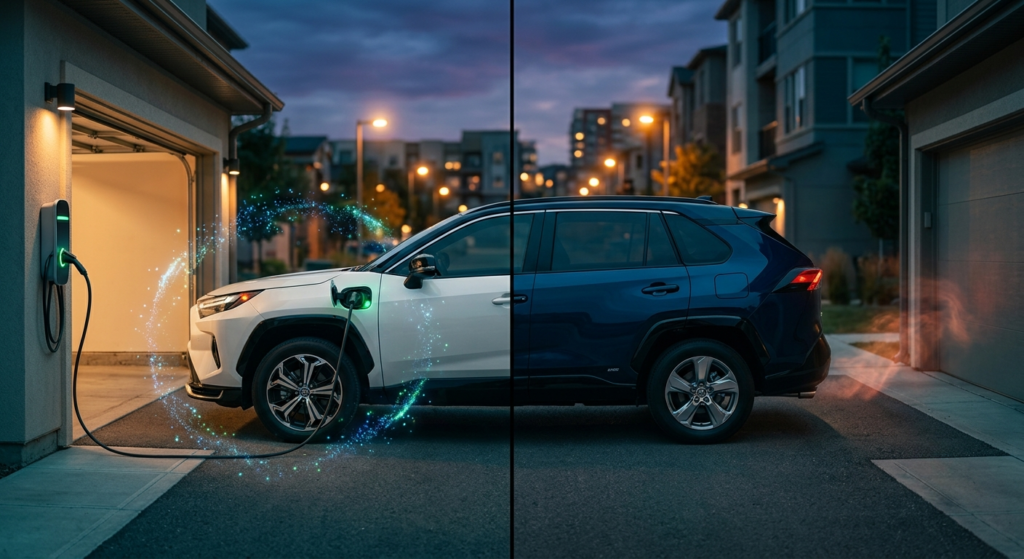
A standard hybrid (HEV) typically wins on total cost of ownership unless you charge a PHEV daily. Over 5 years, a mid-size SUV HEV costs ~$59,600 vs. $64,800 for a PHEV. The PHEV only breaks even if you maximize electric driving and claim available tax incentives. Without consistent charging, the PHEV’s “dead weight” penalty makes it less efficient than the HEV.
Fuel Economy Comparison: Real-World Data
| Scenario | HEV (Toyota RAV4 Hybrid) | PHEV (Toyota RAV4 Prime) |
| Charged daily, short trips | 40 MPG | 100+ MPGe |
| Never charged (CS mode) | 40 MPG | 28 MPG |
| Mixed driving | 40 MPG | 50–60 MPG equivalent |
The “lazy plugging” penalty: Real-world fleet data shows 40% of corporate PHEVs are never plugged in. When driven as uncharged hybrids, PHEVs achieve worse fuel economy than standard HEVs due to carrying 300 kg of extra battery weight.
Purchase Price and Total Cost of Ownership
| Cost Category | HEV | PHEV (Daily Charged) | BEV |
| Purchase price | $34,000 | $39,500 | $38,000 |
| Fuel/energy (5 yr) | $8,200 | $4,100 | $3,200 |
| Maintenance | $4,500 | $4,200 | $1,800 |
| Depreciation (loss) | $12,900 (38%) | $17,000 (43%) | $16,300 (43%) |
| TOTAL TCO | $59,600 | $64,800 | $59,300 |
Source: Energy Solutions 2026 TCO analysis, mid-size SUV class, 100,000 km over 5 years
When HEV Makes More Sense Than PHEV
Buy a standard hybrid instead of a PHEV if:
- You cannot charge at home or work
- You drive extremely long distances regularly (>25,000 km/year)
- You prioritize resale value (HEVs retain 60–65% vs. PHEVs’ 45–50% after 3 years)
- You want zero behavioral change no plugging in, no charging infrastructure needed
PHEV vs BEV: The 2026 Total Cost Breakdown
BEVs now match or beat PHEVs on total cost of ownership in 2026. With entry-level BEVs reaching price parity with ICE vehicles ($26,000–$30,000) and public charging infrastructure tripling since 2023, the PHEV’s “bridge” argument is weakening. BEVs win on maintenance (4 service visits vs. 9 over 5 years) and fuel costs, while PHEVs retain an edge only for buyers without reliable home charging or those taking frequent 1000 km+ road trips.
H3 #5.1: Battery Size and Electric Range Face-Off
| Metric | PHEV (2026) | BEV (2026) |
| Battery capacity | 18–25 kWh | 60–100 kWh |
| Electric range | 80–120 km | 450–700 km |
| Charging speed | L1/L2 (some DC) | L2/L3 DC fast |
| Cold weather penalty | 20–30% range loss | 15–20% range loss |
Charging Infrastructure Requirements
BEVs require Level 2 home charging at minimum for convenient ownership. PHEVs can survive on Level 1 (standard outlet) due to smaller batteries, making them viable for apartment dwellers without dedicated EV infrastructure. However, this convenience comes at an efficiency cost Level 1 charging is slower and less efficient than Level 2.
Maintenance and Reliability Over 5 Years
- BEV: 4 service visits (cabin filter, brake fluid, tires, coolant)
- HEV: 8 visits (oil changes ×5, transmission, spark plugs, filters)
- PHEV: 9 visits (all HEV maintenance + high-voltage system checks)
PHEVs combine the complexity of both systems, requiring maintenance for the engine and the electric powertrain.
Best PHEV Cars and SUVs in 2026: Top Models Ranked
The best PHEV in 2026 depends on your priorities. For reliability and resale, the Toyota RAV4 PHEV leads. For value and electric range, the BYD Sealion 6 dominates at $42,990 AUD with 140 km of electric range. For towing and utility, the BYD Shark 6 and Ford Ranger PHEV offer 3500 kg capacity. Chinese brands now lead the affordable PHEV segment.
Toyota RAV4 PHEV: The Reliability King
The RAV4 PHEV (Prime in some markets) remains the benchmark for dependability. With 84 km of electric range, proven Toyota hybrid integration, and the strongest 3-year residual value (60–65%) in the PHEV class, it’s the safest long-term bet. However, the $9,600 premium over the standard RAV4 Hybrid demands careful TCO calculation.
BYD Sealion 6: Best Value PHEV SUV
Named Australia’s Best Affordable PHEV SUV in the 2026 CarExpert Choice Awards, the Sealion 6 offers:
- 140 km electric range (NEDC)
- $42,990 AUD starting price
- 4.7–5.8 L/100km fuel consumption (battery depleted)
- Front- and all-wheel drive options
- DC fast charging support (40 kW)
BYD’s DM-i hybrid system uses four modes: pure electric, series, parallel, and direct drive optimizing for every driving condition.
Other Notable PHEVs: Ford, Mazda, GWM
| Model | Electric Range | Key Strength |
| Ford Ranger PHEV | ~70 km | 3500 kg towing, work utility |
| Mazda CX-60 PHEV | ~60 km | Premium interior, driving dynamics |
| GWM Haval H6 PHEV | ~80 km | Budget-friendly, feature-rich |
| Mitsubishi Outlander PHEV | ~70 km | 7-seat capacity, proven platform |
5 Critical PHEV Mistakes Buyers Make (And How to Avoid Them)
The biggest PHEV mistakes are: (1) buying without home charging access, (2) failing to plug in daily, (3) ignoring depreciation risk, (4) choosing a poorly integrated “chimera” PHEV design, and (5) misunderstanding utility factor. Avoiding these requires honest assessment of your charging situation, driving patterns, and long-term ownership goals before purchase.
Mistake #1 Buying Without Home Charging Access
PHEVs require consistent charging to deliver value. Without home or workplace charging, you’re paying a premium for a heavy battery you never use. Studies show PHEVs without regular charging cost more to operate than standard hybrids due to carrying dead weight.
Mistake #2 Ignoring the “Lazy Plugging” Penalty
Fleet data reveals 40% of corporate PHEVs are never plugged in. The result? Fuel economy drops to 28 MPG worse than the 40 MPG of a standard Toyota hybrid. The penalty is severe: you’re driving an overweight, underperforming hybrid. Only buy a PHEV if you have the discipline to plug in every single night.
Mistake #3 Overlooking Depreciation Risk
PHEVs depreciate faster than HEVs. After 3 years:
- HEV: 60–65% residual value
- PHEV: 45–50% residual value
Buyers fear the complexity of dual systems. “Is the engine good? Is the battery good?” Double the points of failure create resale anxiety. If you plan to sell within 5 years, the HEV protects your investment better.
Mistake #4 Choosing the Wrong PHEV Architecture
Not all PHEVs are created equal. European “chimera” PHEVs (BMW 225xe, many VW Group models) bolt an electric motor onto a standard petrol platform without deep integration. When the battery depletes, they behave like heavy petrol cars, not efficient hybrids.
Toyota-style integrated PHEVs (Prius Prime, RAV4 Prime) use the electric motor as a core part of the powertrain, maintaining efficiency even in CS mode. Always research whether your chosen PHEV is a true integrated hybrid or a “compliance car” design.
Mistake #5 Misunderstanding Utility Factor
Utility Factor determines what percentage of your driving is actually electric. SAE J2841 predicts 75% for a 50-mile PHEV but only if you charge daily and drive typical distances.
Real-world UF often falls to 30–50% due to infrequent charging and longer trips. Calculate your personal UF before buying: if your daily commute exceeds the PHEV’s electric range, your fuel savings evaporate.
PHEV Charging Guide: Home, Work, and Public
PHEVs charge via Level 1 (standard home outlet, 8–12 hours), Level 2 (dedicated wall charger, 2–4 hours), or DC fast charging (select 2026 models like BYD, 20–30 minutes). Most owners use overnight Level 1 charging, which is sufficient for the smaller PHEV battery. Level 2 is recommended for faster turnaround and improved efficiency.
Level 1 Charging: Standard Outlet Basics
Plug into any 240V outlet using the cable provided with your PHEV. No installation required. Delivers ~2.3 kW, adding 10–15 km of range per hour. Overnight charging (8–12 hours) fully replenishes most PHEV batteries. Ideal for owners with predictable daily routines and short commutes.
Level 2 Charging: Wall-Mounted Solutions
A 7 kW home wall charger cuts charging time to 2–4 hours. Costs $500–$1,500 installed. Recommended for:
- Drivers with longer commutes
- Those who make multiple trips daily
- Maximizing off-peak electricity rates
Public Charging and DC Fast Charging for PHEVs
Most PHEVs lack DC fast charging ports, but 2026 BYD models (Shark 6, Sealion series) support 40 kW DC charging reaching 80% in 20 minutes. This is a game-changer for PHEV usability, enabling opportunity charging during shopping or work trips. Check your chosen model’s charging specification carefully; not all PHEVs are created equal here.
PHEV Maintenance: What to Expect and Cost
PHEVs require more maintenance than BEVs but slightly less than conventional cars if driven primarily on electric power. Expect 9 service visits over 5 years (vs. 8 for HEVs, 4 for BEVs). Key items include oil changes, transmission service, high-voltage system checks, and brake inspections. Regenerative braking extends brake life to ~150,000 km. Lifetime maintenance costs average $0.03/mile for frequently-charged PHEVs vs. $0.06/mile for petrol cars.
Routine Service Schedule vs Hybrid and BEV
| Service Item | PHEV | HEV | BEV |
| Oil changes | Every 10,000 km | Every 10,000 km | None |
| Transmission fluid | Every 60,000 km | Every 60,000 km | None |
| Spark plugs | Every 100,000 km | Every 100,000 km | None |
| High-voltage check | Annual | Annual | Annual |
| Brake service | Every 150,000 km | Every 100,000 km | Every 150,000 km |
Battery Health and Warranty Coverage
Most manufacturers cover PHEV batteries for 8 years or 160,000 km. Battery degradation is typically 2–3% per year under normal use. By year 8, expect ~80% of original capacity remaining still sufficient for daily electric commuting.
Brake Longevity Thanks to Regenerative Braking
Regenerative braking captures deceleration energy and reduces mechanical brake use by 50–70%. PHEV brake pads often last 150,000+ km compared to 50,000–80,000 km in conventional cars. This is one area where PHEVs definitively beat petrol vehicles.
PHEV FAQ: 10 Questions Answered
This FAQ addresses the most common PHEV questions, from basic definitions to ownership practicalities. Each answer is concise, data-backed, and designed to resolve the specific doubts that prevent buyers from making informed decisions.
1: What does PHEV stand for?
PHEV stands for Plug-In Hybrid Electric Vehicle a car with both an electric motor and a petrol engine that can be recharged by plugging into an external power source.
2: Do PHEVs need to be charged every night?
Not necessarily, but charging nightly maximizes electric driving and fuel savings. If you don’t charge regularly, the PHEV operates as an inefficient heavy hybrid, defeating its purpose.
3: Can a PHEV run without charging?
Yes. The petrol engine powers the vehicle when the battery is depleted. However, uncharged PHEVs achieve worse fuel economy than standard hybrids due to carrying extra battery weight.
4: How long do PHEV batteries last?
PHEV batteries typically last 8–10 years with 2–3% annual degradation. Most manufacturers warranty batteries for 8 years/160,000 km.
5: Is a PHEV worth it in 2026?
A PHEV is worth it if you have home charging, drive 80–120 km daily, and take occasional long trips. Without home charging or with very long daily commutes, a standard hybrid or BEV is usually the better financial choice.
6: What is the difference between PHEV and plug-in hybrid?
There is no difference PHEV is simply the acronym for Plug-In Hybrid (or Plug-In Hybrid Electric Vehicle). Both terms describe the same technology.
7: Do PHEVs qualify for tax credits?
In the U.S., the $7,500 federal tax credit expired in September 2025. Regional incentives vary. In Europe, PHEV subsidies are tapering off as policy shifts toward full electrification. Check your local jurisdiction for current programs.
8: Can PHEVs use DC fast chargers?
Most PHEVs cannot. However, 2026 BYD models (Sealion 6, Shark 6) support DC fast charging up to 40 kW. Always verify charging specifications before purchase if public fast charging is important to you.
9: What is a good electric range for a PHEV?
In 2026, 80–120 km is the standard range for quality PHEVs. Models below 60 km are becoming obsolete. BYD leads with 140 km in the Sealion 6.
10: Are PHEVs being phased out?
The EU plans stricter utility factor regulations in 2027, making PHEV compliance harder. However, PHEVs remain popular in markets with limited charging infrastructure. They’re a transitional technology, not a permanent solution, but will remain viable through the late 2020s.
Advanced PHEV Concepts: Utility Factor and Real-World Performance
Utility Factor (UF) is the percentage of miles a PHEV drives on electricity versus fuel. SAE J2841 standardizes UF calculations using national travel survey data. For a PHEV with 80 km range, UF predicts ~65% electric driving assuming daily charging. Real-world UF often drops to 30–50% due to infrequent charging and longer trips, which is why the EU is tightening UF regulations for 2027.
Understanding SAE J2841 Utility Factor Curves
SAE J2841 defines UF as a function of all-electric range. The curve shows:
- 20 km range: ~30% electric driving
- 50 km range: ~55% electric driving
- 80 km range: ~65% electric driving
- 120 km range: ~75% electric driving
These figures assume daily overnight charging. The 2017 National Household Travel Survey data (used in current UF curves) shows most daily trips are under 50 km, making even modest-range PHEVs theoretically effective.
Real-World vs. Lab: Why the Gap Matters
The gap between lab UF and reality is widening:
- Lab assumption: Daily charging, typical trip distances
- Reality: 40% of fleet PHEVs never charge; many owners take long weekend trips exceeding electric range
- Result: Real-world emissions are 2–4× higher than lab estimates for poorly utilized PHEVs
This discrepancy drove the EU to mandate on-board monitoring (2021) and plan stricter UF values for 2027, effectively accelerating PHEV phase-out in Europe.
How to Calculate Your Personal Utility Factor
Estimate your UF in three steps:
- Log your daily driving distance for one week
- Compare to PHEV electric range (e.g., 100 km)
- Apply charging discipline if you charge nightly, days under 100 km count as 100% electric
Example: You drive 40 km daily, charge nightly, take one 500 km road trip monthly.
- Daily electric: 40 km × 30 days = 1,200 km (100% electric)
- Road trip: 500 km × 1 = 500 km (~20% electric, 80% fuel)
- Personal UF: 1,200 / 1,700 = 71%
If your UF falls below 50%, a standard hybrid likely makes more financial sense.
The Future of PHEVs: 2026 Trends and Beyond
PHEVs are evolving toward extended-range designs (100 km+ electric range) with DC fast charging support. However, regulatory pressure is mounting—the EU’s 2027 utility factor rules will make PHEV compliance harder, pushing automakers toward BEVs. In markets with limited charging infrastructure, PHEVs will remain relevant through 2030 as a pragmatic bridge technology.
Extended-Range PHEVs: 100km+ Becoming Standard
The biggest 2026 shift is range. BYD’s DM-i 5.0 platform, Toyota’s next-gen Prime systems, and Mercedes’ updated PHEV lineup all target 100–150 km of electric range. This covers 95% of daily commutes globally, making the “bridge” argument more compelling if owners actually charge.
EU Regulations and the 2027 Utility Factor Shift
Starting 2027, the EU will apply stricter real-world utility factors to all new PHEVs. Under these rules, PHEVs will show higher estimated emissions, making CO2 compliance harder. Automakers must either improve real-world electric usage or transition to BEVs faster. This signals the beginning of PHEV decline in Europe.
Vehicle-to-Load (V2L) in PHEVs
Some 2026 PHEVs offer V2L capability, using the battery to power external devices. PHEV V2L is limited (1.5 kW typical) compared to BEVs (3.6–9.6 kW) due to smaller batteries, but it’s sufficient for camping equipment, power tools, or emergency home backup for a few hours.
Key Takeaways: Is a PHEV Right for You?
A PHEV is right for you if you have home charging, drive 80–120 km daily, and want electric commuting with petrol backup for long trips. It’s wrong for you if you lack charging access, drive extreme distances daily, or prioritize resale value and simplicity. In 2026, the PHEV sits in a narrowing niche better than HEV for charged short trips, less compelling than BEV for committed EV adopters.
Decision Checklist:
- Home or workplace charging available
- Daily commute under 100 km
- Occasional long trips (500 km+)
- Willing to plug in nightly
- Not planning to sell within 3 years
If you checked 4+ boxes, a PHEV fits your lifestyle. If not, consider a standard hybrid or BEV.
Conclusion
The PHEV definition is simple a car that drives on electricity for short trips and petrol for long ones. The decision to buy one is not.
In 2026, PHEVs occupy a shrinking but valid niche. They offer genuine fuel savings and electric driving pleasure if you charge daily and match the technology to your lifestyle. The data is unambiguous: uncharged PHEVs are financial losers, while well-utilized PHEVs can cut fuel costs by 50% or more.
Before you sign on the dotted line, calculate your personal Utility Factor. If your daily driving fits within the PHEV’s electric range and you have reliable charging, models like the BYD Sealion 6 or Toyota RAV4 Prime deliver real value. If not, the simpler hybrid or the fully electric path likely serves you better.
Modern Vehicles is committed to cutting through the marketing noise with data-driven guides. Bookmark this page and our quarterly updates ensure you always have the latest PHEV data, model reviews, and regulatory changes. Your next car decision deserves nothing less than the full picture.



0 Comments