The car logo with a red cross and this green snake, it uh, basically belongs to Alfa Romeo , the Italian automaker that began in Milan, Italy, in 1910. You know when you stare at the badge and it kinda feels split, like it is showing two thoughts in one go, not fully calm and sorted. One side shows a red cross on a clean white background, the Cross of Saint George. That cross is also the official civic emblem for the city of Milan , so it’s not just decoration, it’s kinda official too.
On the other side there’s a green serpent, people usually call it the Biscione . This snake is a heraldic sign connected to the House of Visconti , the medieval ruling family that controlled Milan from the 13th century onward. Inside the snake’s mouth you see a figure that s often described as a Saracen, like a historical “we won” vibe from old battles , or at least that’s the usual story that comes up. The whole badge gets called the scudetto , which in Italian means “little shield” , and it has been in use continuously for over 114 years.
When it comes to big name car brands, honestly not many use the same exact red cross plus green snake combination. Nowadays Alfa Romeo models with this badge include the Giulia, Stelvio, Tonale, and Junior. And yep, Alfa Romeo is currently owned by Stellantis .
You’ve Seen It, now here’s what it actually means
Maybe you spotted it in traffic. Maybe someone asked you at dinner and you had no answer. Maybe you saw it in a film and couldn’t shake the image, a circular badge split into two halves, one side showing a bold red cross, the other a vivid green serpent sort of coiled around what looks like a human figure
It’s striking. It’s unusual and, somehow, it feels like it’s not like any other car badge out there
That emblem belongs to Alfa Romeo, the Italian automobile maker founded in Milan in 1910. And way, far from being a random design choice, every tiny element on that badge comes carrying over seven centuries of history, city pride, and medieval myths
This is the whole story
Which car has a cross and snake logo like, you know what I mean?
The one with that red cross plus the green snake emblem is Alfa Romeo, the Italian luxury auto maker based out of Milan Italy. The brand has kept this heraldic sign pretty much as is since it started back in 1910, so it’s among the oldest brand identities that stayed unchanged across the whole automobile industry.
And yeah, no other big manufacturer really uses the same exact combination. Not Ferrari. Not Maserati. Not Lamborghini. The cross-and-snake pairing is basically, exclusively Alfa Romeo’s.
The badge itself is called the scudetto— Italian for “little shield” and it’s split into two separate sections, with each section taking from a different slice of Milan history.
Breaking Down the Badge: what each symbol, sort of, actually represents
The red cross on the left side
That red cross sitting on a white background is called Croce di San Giorgio, the Cross of Saint George. It isn’t a religious emblem, and it doesn’t tie into the international Red Cross organization at all. Instead, it’s the official civic symbol of the Municipality of Milan, one of those older heraldic marks the city has, used on Milan’s coat of arms for centuries, literally.
When Alfa Romeo’s founders put this cross into their badge they weren’t doing it by accident. It’s a careful claim that the brand is rooted in Milan. Not only made there, but also historically connected to that place. Like a kind of local heritage, rather than a casual detail.
You’ll notice the cross is placed on the left side of the badge. In heraldic tradition that left position works like the main identifier, the “first name” of the shield, basically.
The Green Snake on the Right Side
On the right side of the badge there’s this big green serpent, it’s called the Biscione (pronounced bish-OH-nay) and you can see a human figure coming out from its open mouth. This emblem, basically , is tied to the House of Visconti , the ruling dynasty that controlled Milan and the neighboring Lombardy area in the medieval era, with roots that go back to something like the 13th century, give or take.
The Visconti family used the Biscione on their coat of arms, as a signal of power, authority, and conquest. The person inside the serpent’s mouth is often identified, in historical readings, as a Saracen— that word used in medieval European heraldry for opponents met during the Crusades. So the whole picture leans heavily toward military triumph: the strong serpent of Milan swallowing its enemies, or at least that’s how it’s usually framed.
Over the years, some sources have described that figure not as a Saracen but as a child instead, and yeah, that debate never really fully settles. Also, Alfa Romeo’s official messaging hasn’t ever pinned down a single identity for the figure, and many modern brand interpretations talk about it more like a sign of rebirth, renewal, you know, the natural cycle of life.
Why These Two Symbols Together?
The usual story is that in 1910, an Alfa Romeo worker named Romano Cattaneo was the first person to propose putting these two Milan symbols together into one badge. Supposedly he spotted them side by side on a gate or sign near Piazza Castello in Milan. It’s one of the city’s most historic squares, and it’s been linked, historically, with the Visconti family and later also the Sforza dynasties.
So when you pair Milan’s civic cross with the Visconti serpent, the result is this pretty rare kind of brand design: a logo that works both as a public civic declaration and as a noble heraldic statement. In other words it feels like we are Milan, and we carry the whole weight of that past.
The Visconti Dynasty: Why a Medieval Serpent ended up on a modern car
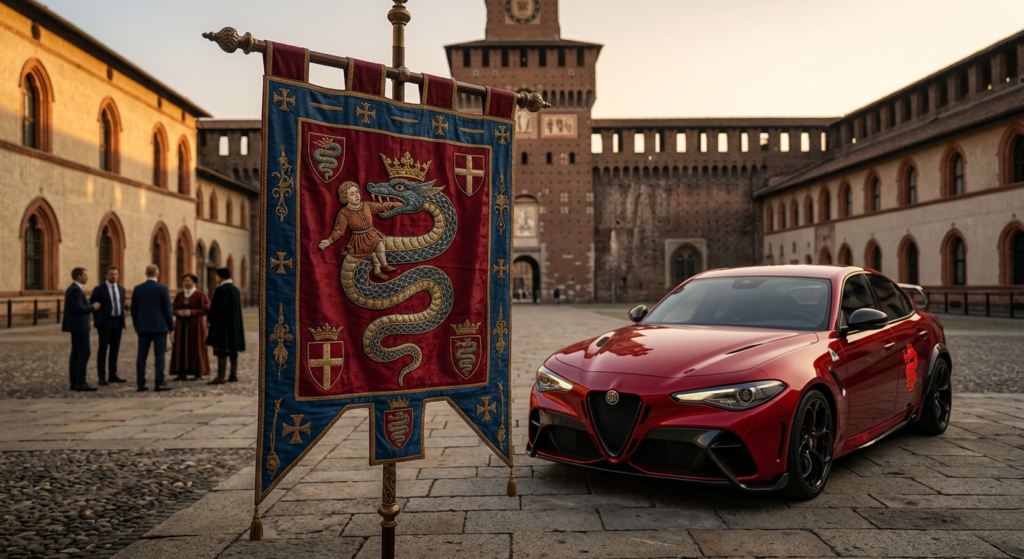
So, understanding the Biscione properly takes, like, a quick detour into Lombard history.
The House of Visconti rose to power in Milan during the late 12th century and then sort of dominated the region for close to two hundred years. At their peak they controlled a large portion of northern Italy. And their emblem— the big serpent devouring a figure— showed up on city gates, church facades, armor, and public monuments across Lombardy, more often than you’d expect, seriously.
Then later, when the Visconti dynasty finally slipped and power moved to the Sforza family, the Biscione didn’t just vanish. It was kept more as a sign of Milanese identity, not only as dynastic muscle. By the time Alfa Romeo arrived, the serpent had already been stitched into Milan’s visual culture for over six centuries, give or take.
So putting it on an automobile badge wasn’t just decoration, no. It was a claim to belonging, an assertion that this newer industrial company wasn’t some random outsider, but a legit heir to Milan’s legacy.
A short history of the Alfa Romeo badge across 114 years
The cross, and snake emblem never really got dropped, but it has been worked on a few times since 1910.
| Era | Key Change |
| 1910 | First badge introduced. Rectangular shape, both symbols present. The text reads “ALFA — MILANO.” |
| 1915 | Nicola Romeo acquires A.L.F.A. “ROMEO” was added to the badge. Red scalloped border introduced. |
| 1925 | A laurel wreath added after Alfa Romeo wins the inaugural Automobile World Championship — the predecessor to Formula 1. |
| 1946 | Post-war redesign. “MILANO” replaced “ROMEO.” Typography modernized. |
| 1972 | Badge simplified into the cleaner circular form still recognized today. |
| 2000s | Three-dimensional metallic rendering introduced for digital and physical applications. |
| 2015 | Brand refresh ahead of Alfa Romeo’s return to the North American market. |
| 2023 | Flat, two-dimensional logo redesign unveiled — contemporary minimalist update while all core elements are preserved. |
The 2023 redesign drew big interest from auto fans and design circles. Some people liked the clean, modern look. Others just missed the dimensional depth that the older metallic badge carried. Yet what nobody could deny was that the red cross and green serpent stayed right in that same place, as they always had been.
How The Alfa Romeo Badge Compares To Other Car Logos
Most car manufacturers sort of follow one of three design roads: abstract geometry (you know BMW roundel or Audi rings), stylized initials (like Mercedes-Benz, Volkswagen), or one clean animal motif (Ferrari prancing horse, Lamborghini charging bull).
Now Alfa Romeo does something kinda, different. Its badge is heraldic, which basically means it pulls straight from that European tradition of coats of arms. It isnt just one idea either. There are two distinct symbolic parts, each with its own historical roots, put together into one overall picture.
| Brand | Logo Element | Origin Country | Style |
| Alfa Romeo | Red cross + green serpent (Biscione) | Italy | Heraldic shield |
| Ferrari | Prancing horse (Cavallino Rampante) | Italy | Shield on yellow |
| Lamborghini | Charging bull | Italy | Shield |
| Porsche | Horse + antlers + red/black stripes | Germany | Full coat of arms |
| Dodge | Ram’s head | USA | Badge |
| Shelby | Coiled cobra | USA | Oval |
| AC Cars | Serpent | UK | Oval |
The nearest “same vibe” comparisons for heraldic complexity are Porsche and Ferrari . Porsche is also tied to a real coat of arms, while Ferrari’s horse first showed up on the personal aircraft of World War I flying ace Francesco Baracca, and then his mother later passed that symbol along to Enzo Ferrari.
But here’s the thing even with Porsche the shield stays a single unified composition. Alfa Romeo’s badge is genuinely bipartite — two separate heraldic systems, combined, almost deliberately.
The cars that carry the badge today
Like, basically almost every Alfa Romeo vehicle you can buy right now shows that cross and snake emblem, and yeah the lineup kind of reflects the whole plan the brand is chasing: re establish itself as a real European luxury rival again. After a long stretch of being mostly missing from a few key markets you know.
Current production models:
- Alfa Romeo Giulia — an executive sport sedan, it’s out there going head to head with the BMW 3 Series and the Mercedes-Benz C-Class. You can spec it with a 2.9L twin turbo V6, and that’s extra true on the Quadrifoglio level.
- Alfa Romeo Stelvio — a compact luxury SUV, honestly it feels more animated and more driver focused than a lot of the other stuff in the segment even if people don’t always say it out loud.
- Alfa Romeo Tonale — a plug in hybrid compact SUV. It’s probably the brand’s most attainable option, the “start here” choice for many.
- Alfa Romeo Junior — a subcompact electric and hybrid model that arrived in 2024. It’s aiming at younger city buyers, the folks who want something that feels fresher, and a bit less traditional.
Landmark historical models:
- Alfa Romeo Spider (Duetto) — the open top roadster, it got global attention once it showed up in The Graduate (1967)
- Alfa Romeo 8C Competizione — a limited run supercar, and sure it became a collector’s treasure almost right away.
- Alfa Romeo 33 Stradale — the brand’s wild modern hypercar. It was unveiled in 2023 and produced in super tiny numbers.
- Alfa Romeo 158/159 Alfetta — the racing weapon that really rolled over early Formula 1 in the late 1940s, and then kept doing work into the early 1950s too. Legends like Juan Manuel Fangio and Giuseppe Farina drove it, and others of course.
Common Misconceptions Worth Clearing Up
“ The red cross is a medical symbol.” Well no. The Red Cross group does use something that looks similar, but Alfa Romeo’s cross came first, long before that humanitarian organization became widely known for using the emblem in its branding. Alfa Romeo’s cross is actually Milan’s civic mark—the Cross of Saint George—and it has no medical meaning attached.
“ The snake is eating a child.” That image has been described, in older heraldic storytelling, as a Saracen rival in the Visconti heraldic tradition. The “child” explanation shows up in some local tales and in certain earlier depictions, but it isn’t the main, scholarly interpretation. Alfa Romeo does not officially label the figure as a child.
“ This logo belongs to another Italian brand.” People swap things around, but Ferrari uses a horse, Maserati uses a trident, and Lamborghini uses a bull. The red cross together with the green serpent is associated exclusively with Alfa Romeo.
“ The 2023 redesign removed the snake.” It didn’t really. What changed is the look: the rendering moved from a more three-dimensional effect to a flatter style. The Biscione serpent and the Cross of Saint George are both still included in the current version.
How to Spot a Fake Alfa Romeo Badge
Fake Alfa Romeo badges, often marketed as replacement parts or accessories, can look pretty close at first… but the colors usually give them away. Real Alfa Romeo badges always show a consistent setup like this, more or less, every time:
- A true red cross (not orange , burgundy or dark maroon)
- A green serpent (not blue , black or teal)
- A white background behind the cross
- A red background behind the serpent
- A neat symmetrical circular border
If even one of those little pieces is off , for example the shade leans slightly, or the backgrounds don’t match, then the badge is probably not genuine. And yeah, it matters, because resale value can drop, plus the car won’t be keeping its original look and spec the way it should.
FAQs
Q: What car has a red cross and green snake logo?
It’s the Alfa Romeo, yep. That Italian luxury brand kept that kinda weird mix , since like 1910 or so. The red cross shows Milan’s civic sign, and the green snake is the Biscione , which is tied to that medieval House of Visconti.
Q: What is the green snake in the Alfa Romeo logo called?
The green snake is called the Biscione. It’s basically a heraldic emblem, historically tied with the House of Visconti, the governing line in Milan during late medieval times. And “Biscione” is kinda like “big grass snake” in Italian too.
Q: Is the red cross on the Alfa Romeo badge a religious symbol?
No, not really. The red cross is the Croce di San Giorgio, also called the Cross of Saint George. It’s the official heraldic mark for the Municipality of Milan. So it’s civic, not religious, not some humanitarian message or anything.
Q: What is the human figure inside the Alfa Romeo snake?
In the older Visconti heraldic version, the figure is a Saracen, meaning a portrayed enemy that was defeated in battle. Some sources even say it could be a child, but Alfa Romeo doesn’t give an official label for it. Lots of newer views treat it like part of a nature cycle story, instead.
Q: Did Alfa Romeo change its logo in 2023?
Yes, they did. In 2023 Alfa Romeo introduced a revised logo with a flatter, more two-dimensional look. They ditched the older, more metallic three-dimensional style, but the center vibe stays put: the red cross and the Biscione are still the same.
Q: What other car brands use a snake in their logo?
A few actually. Shelby leans into a coiled cobra style, AC Cars uses a snake motif, and the Dodge Viper name basically went with a viper snake angle. Alfa Romeo still feels different, since it pairs the serpent with a civic cross, like a two-part heraldic layout.
Q: What is the Alfa Romeo badge officially called?
Most people call the whole thing the scudetto, meaning “little shield” in Italian. The snake part is the Biscione, and the cross part is the Croce di San Giorgio. Together, that’s what most drivers just call the Alfa Romeo emblem.
Q: Who designed the original Alfa Romeo logo?
Romano Cattaneo is the name you see most often attached to it. He was an Alfa Romeo employee, and the usual story is that he drew ideas from symbols he saw around Piazza Castello in Milan back around 1910. He isn’t super highlighted in mainstream car coverage, but brand history writeups mention his role.
Q: Where can I find an Alfa Romeo dealership?
Alfa Romeo has a dealer network across Europe, North America, the Middle East, Australia and more. Usually these dealers show up alongside other Stellantis brands, and Stellantis is the parent group that includes Jeep, Fiat, Peugeot, and others. The official Alfa Romeo site offers a dealer locator where you can search by region.
Conclusion
The cross-and-snake car logo is not just a badge, it’s more like a compressed archive, seven centuries of Milanese history, noble heraldry, civic identity, and some automotive ambition all folded into a circle small enough to fit, ya know, right in your palm.
Alfa Romeo didn’t exactly create those symbols. They inherited them from the streets and the gates, plus the city’s coat of arms that helped shape everything. And over 114 years, through world wars, different ownerships, design revisions and shifting markets, they have never removed the red cross or the green serpent not even once.
That kind of continuity is rare in most industries. In automotive branding, it’s almost unheard of, like, really.
So whether you saw the badge in traffic and you needed an answer right there, or you’re actually thinking about an Alfa Romeo and want to grasp what the brand stands for before you step into a showroom, now you do. The logo isn’t decoration. It’s a declaration.



0 Comments