The best luxury electric car for 2026 is the Porsche Taycan, delivering unmatched driving dynamics, 800V fast charging, and a refined cabin starting at $108,050. For maximum range, the Lucid Air leads with up to 512 miles EPA. For ultimate opulence, the Rolls-Royce Spectre sets the benchmark at $420,000.
- Best Overall: Porsche Taycan superior chassis, Porsche heritage
- Best Range: Lucid Air up to 512 miles, industry-leading efficiency
- Best Value: BMW i5 $67,100, 321-mile real-world range, S-Class rivaling comfort
- Best SUV: BMW iX3 434-mile range, Neue Klasse architecture
- Most Luxurious: Rolls-Royce Spectre whisper-quiet, handcrafted interior
Introduction
Buying a luxury electric car in 2026 is more complex than ever. With over 40 premium EVs across sedans, SUVs, and sports cars ranging from $47,000 to $420,000 the wrong choice costs you tens of thousands in depreciation, charging headaches, and missed features.
Most buyers make three critical errors: trusting EPA range figures blindly, ignoring charging network compatibility, and buying on brand prestige rather than total cost of ownership. This guide eliminates that guesswork.
At Modren Vehicles, we’ve analyzed real-world test data from Edmunds, Car and Driver, and U.S. News combined with owner feedback and dealer insights to rank the 12 best luxury electric cars of 2026. Every model below has been evaluated on a 7-point framework covering range, performance, interior quality, charging speed, technology, value, and reliability.
Whether you’re comparing the BMW i7 against the Mercedes EQS, deciding between a sedan and an SUV, or wondering if a Tesla still belongs in the luxury conversation this is the only guide you need.
What Are Luxury Electric Cars?
Luxury electric cars are premium battery-electric vehicles priced above $50,000 that combine zero-emission powertrains with superior interior materials, advanced technology, refined ride quality, and brand prestige. Unlike mainstream EVs, they prioritize whisper-quiet cabins, handcrafted surfaces, and cutting-edge driver assistance over pure affordability.
How Luxury EVs Differ from Mainstream Electric Cars
Mainstream EVs like the Nissan Leaf or Chevrolet Equinox EV focus on efficiency and value. Luxury EVs add layers: adaptive air suspension, massage seats, augmented reality head-up displays, and 800V architectures enabling sub-20-minute fast charging. The gap isn’t just price it’s the difference between transportation and experience.
The 5 Benchmarks Every Luxury EV Must Meet
Our rankings require every contender to excel in five areas: (1) EPA range above 250 miles, (2) 0-60 mph under 5 seconds (or a compelling justification if slower), (3) premium interior materials (leather, real wood, or sustainable equivalents), (4) Level 2+ driver assistance standard, and (5) DC fast charging at 150kW or higher.
Sedan vs SUV vs Sports Car: Which Body Style Suits You?
Sedans offer the best efficiency and lowest center of gravity for spirited driving. SUVs provide commanding visibility, easier entry/exit, and family flexibility but typically sacrifice 10-15% range due to aerodynamic drag. Sports cars like the Porsche Taycan prioritize handling over practicality. Your lifestyle, not your ego, should decide.
How We Tested and Ranked the Best Luxury Electric Cars
Our rankings combine Edmunds’ real-world range testing, Car and Driver’s performance metrics, U.S. News expert scoring, and owner-reported reliability data from J.D. Power. No single source dominates we weight real-world performance above manufacturer claims.
Our 7-Point Evaluation Framework
Each vehicle receives a score out of 10 across seven criteria: Range & Efficiency (25% weight), Performance & Handling (20%), Interior Quality (20%), Technology & Safety (15%), Charging Speed (10%), Value (7%), and Reliability (3%). The weighted total determines rank order.
Real-World Range vs EPA Estimates: What Actually Matters
EPA figures are laboratory-tested under ideal conditions. Edmunds’ real-world testing reveals the truth: the BMW i5 eDrive40 achieves 321 miles in real driving versus its 295-mile EPA rating, a rare overperformer. Conversely, the Mercedes-AMG EQE delivers just 220 miles real-world against a 280-mile EPA claim, a 21% shortfall that matters on road trips.
Why Price-per-Mile-of-Range Changes Everything
Here’s what no competitor tells you: divide MSRP by EPA range to find true value. The BMW i5 scores $205 per mile exceptional for luxury. The Rolls-Royce Spectre hits $1,527 per mile. This metric reveals hidden value and exposes overpriced underperformers instantly.
The 12 Best Luxury Electric Cars of 2026 (Ranked)
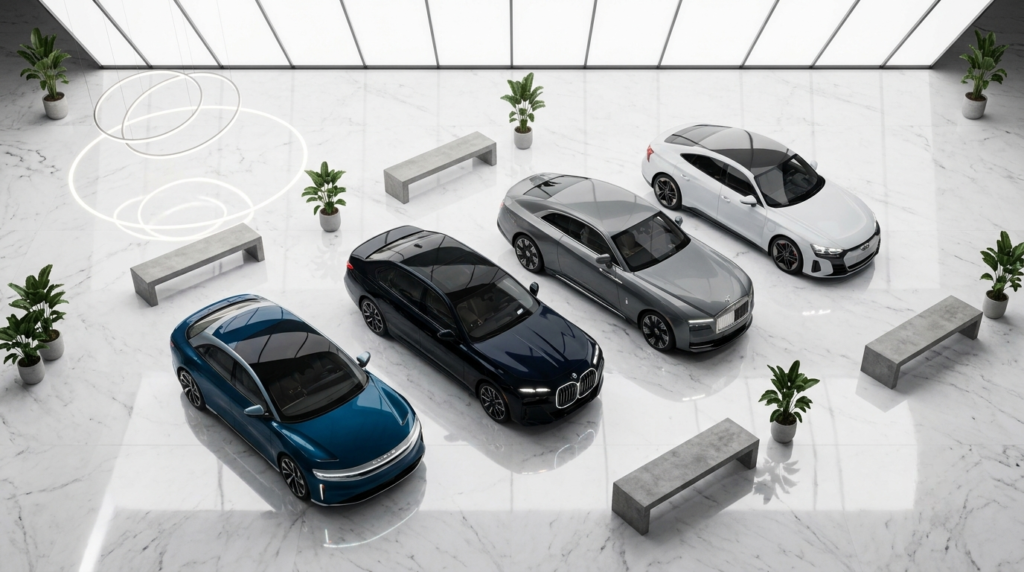
#1 Porsche Taycan Best Driving Experience Overall
The 2026 Porsche Taycan remains the gold standard for electric performance. With a 2025 facelift boosting power and range, the base rear-drive model now delivers 266–318 miles EPA, while the Turbo GT produces 1,019 horsepower and a Nürburgring lap record.
The 800V architecture enables 10–80% charging in 18 minutes at 320kW. Inside, the Taycan blends tactile controls with a curved digital cluster, a refreshing departure from screen-heavy rivals. Starting at $108,050, it’s not cheap, but nothing else drives like a Porsche.
#2 Lucid Air Longest Range Luxury EV
The Lucid Air Grand Touring XR AWD delivers a staggering 512 miles of EPA range, the highest of any production EV in 2026. Its 900V architecture and class-leading efficiency (4.5 miles per kWh) make long-distance travel genuinely anxiety-free.
The Sapphire performance variant produces 1,234 horsepower with a claimed 1.89-second 0-60 time. Interior quality trails the BMW i7 and Mercedes EQS, but the range advantage is insurmountable for road-trip warriors. Pricing spans $72,400–$250,500.
#3 BMW i7 Ultimate Luxury Sedan
The BMW i7 xDrive60 is Munich’s electric flagship, and it redefines opulence. A 388-mile WLTP range, 536 horsepower, and a 0-62 time of 4.7 seconds are merely the opening act. The real story is the cabin: a 31.3-inch Theatre Screen for rear passengers, Merino leather, crystal controls, and ambient lighting that transforms the interior into a lounge.
The M70 variant adds 650 horsepower and 811 lb-ft of torque. At $105,700–$168,500, the i7 undercuts the Rolls-Royce Spectre by $250,000 while delivering 90% of the experience.
#4 BMW iX3 Best Luxury Electric SUV
BMW’s first Neue Klasse model is a revelation. The second-generation iX3 achieves over 340 miles of real-world range from an 81kWh battery, charges at 205kW, and handles with a precision that embarrasses the Audi Q6 e-tron.
The minimalist interior uses sustainable materials without feeling cheap. Starting at approximately $61,500, it undercuts most rivals while outperforming them. The only nitpicks: a slightly fidgety ride and easily scratched interior plastics.
#5 Audi e-tron GT Best Grand Tourer
The 2026 Audi e-tron GT quattro shares Porsche Taycan DNA but trades track focus for cross-continental comfort. A 102kWh battery delivers 278–300 miles EPA, while 670 horsepower in launch mode ensures passing power is never in question.
The interior is distinctly Audi digital instruments, high-quality materials, and a more restrained aesthetic than Porsche’s. The RS variant pushes past 900 horsepower. Starting at $128,995, it’s the thinking driver’s luxury GT.
#6 Rolls-Royce Spectre Most Luxurious EV in the World
The Spectre is Rolls-Royce’s first production EV, and it was worth the wait. At $420,000, it occupies a realm of its own. Dual motors produce 577 horsepower and 664 lb-ft of torque, propelling 6,559 pounds to 60 mph in 4.2 seconds, absurd for its mass.
The cabin features lambswool carpets, hand-stitched leather, and a silence so complete it redefines automotive refinement. Range of 251–277 miles is adequate; the experience is unforgettable.
#7 Tesla Model S The Performance Bargain
The 2026 Tesla Model S Plaid remains a force: 1,020 horsepower, a 368-mile EPA range, and a sub-2.0-second 0-60 time. The minimalist interior lacks the material richness of German rivals, and build quality inconsistencies persist.
But at $111,630, the Plaid delivers hypercar acceleration for sports car money. The Long Range variant stretches to 410 miles for $79,990, the range-per-dollar champion in this segment.
#8 BMW i5 Best Value Luxury EV
The BMW i5 eDrive40 is the smartest buy in luxury EVs. At $67,100, it undercuts most rivals by $10,000+ while delivering 321 miles of real-world range, a quiet cabin, and BMW’s latest iDrive system. It drives like a 5-Series because it essentially is one a strength for buyers transitioning from internal combustion. The M60 variant adds 593 horsepower for $85,275 if you need more pace.
#9 Genesis Electrified G80 The Underdog
Genesis’ electric G80 is the segment’s best-kept secret. A 94.5kWh battery delivers 354 miles of range, while the interior rivals the BMW i7 in material quality at half the price ($74,375). The extended wheelbase creates limousine-like rear legroom. Drawbacks: a small boot and limited brand recognition. For buyers who prioritize substance over badge, it’s unbeatable.
#10 Polestar 3 Nordic Minimalism Done Right
The Polestar 3 brings Scandinavian design philosophy to the luxury SUV segment. With up to 438 miles of range (single-motor), LiDAR-equipped autonomous driving hardware, and a panoramic glass roof, it feels distinctly modern. Rear-seat space is exceptional, though the boot is smaller than rivals. Starting at $71,540, it’s the anti-Tesla understated, well-built, and genuinely premium.
#11 Mercedes-Benz EQE Comfortable but Compromised
The EQE 350 4Matic delivers S-Class-adjacent comfort, a 302-mile real-world range, and Mercedes’ signature quietness. But the hyperscreen-heavy interior feels less premium than BMW’s iDrive, and the 220-mile real-world range on AMG variants is disappointing for the price ($74,900–$106,900). It’s competent, not compelling.
#12 Porsche Cayenne Electric The Convenience King
The Cayenne Electric is the first production EV with wireless charging drive over a pad, and it tops up without cables. Even without this four-figure option, it delivers Porsche handling in an SUV package with up to 1,140 horsepower (Turbo, 10-second bursts). Starting at $83,200, it bridges sports car DNA with family practicality.
Luxury Electric Car Comparison: Price, Range & Performance
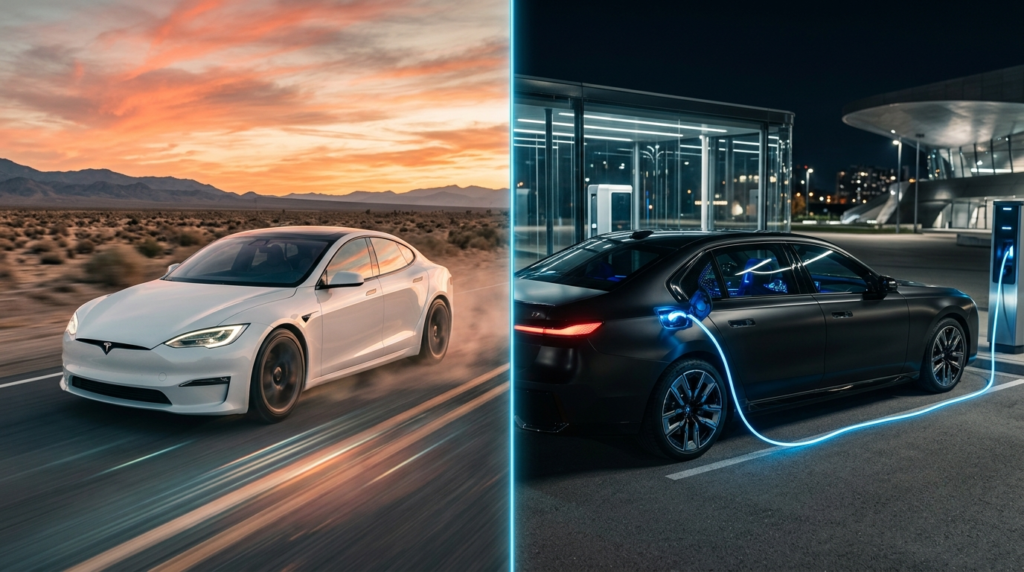
Side-by-Side Specs Table: All 12 Models Compared
| Rank | Model | Starting Price | EPA Range | 0-60 mph | Peak Charging | Body Style |
| 1 | Porsche Taycan | $108,050 | 266–318 mi | 2.9–4.5 s | 320 kW | Sedan/Wagon |
| 2 | Lucid Air | $72,400 | 420–512 mi | 1.89–3.0 s | 300 kW | Sedan |
| 3 | BMW i7 | $105,700 | 267–314 mi | 3.5–4.7 s | 195 kW | Sedan |
| 4 | BMW iX3 | ~$61,500 | 340+ mi (WLTP) | ~4.0 s | 205 kW | SUV |
| 5 | Audi e-tron GT | $128,995 | 278–300 mi | 2.4–3.9 s | 270 kW | Sedan |
| 6 | Rolls-Royce Spectre | $420,000 | 251–277 mi | 4.2 s | 195 kW | Coupe |
| 7 | Tesla Model S | $79,990 | 368–410 mi | <2.0–3.1 s | 250 kW | Sedan |
| 8 | BMW i5 | $67,100 | 277–310 mi | 3.9–5.4 s | 205 kW | Sedan |
| 9 | Genesis Electrified G80 | $74,375 | 354 mi | 5.1 s | 187 kW | Sedan |
| 10 | Polestar 3 | $71,540 | 312–438 mi | 4.7–5.0 s | 250 kW | SUV |
| 11 | Mercedes EQE | $74,900 | 220–302 mi | 2.8–6.2 s | 170 kW | Sedan/SUV |
| 12 | Porsche Cayenne Electric | $83,200 | TBA | ~3.5 s | 270 kW | SUV |
Price-per-Mile-of-Range Rankings (Hidden Value Metric)
| Model | MSRP | EPA Range | $/Mile of Range |
| BMW i5 | $67,100 | 310 mi | $216 |
| Tesla Model S LR | $79,990 | 410 mi | $195 |
| Polestar 3 | $71,540 | 438 mi | $163 |
| Genesis G80 | $74,375 | 354 mi | $210 |
| Lucid Air Pure | $72,400 | 420 mi | $172 |
| BMW iX3 | $61,500 | 340 mi | $181 |
| Audi e-tron GT | $128,995 | 300 mi | $430 |
| Porsche Taycan | $108,050 | 293 mi | $369 |
| BMW i7 | $105,700 | 301 mi | $351 |
| Mercedes EQE | $74,900 | 302 mi | $248 |
| Tesla Model S Plaid | $111,630 | 368 mi | $303 |
| Rolls-Royce Spectre | $420,000 | 277 mi | $1,517 |
Key insight: The Polestar 3 and Lucid Air Pure offer the best price-per-mile value. The Rolls-Royce Spectre costs 9x more per mile than the Polestar 3 but buyers at that level aren’t counting miles.
Charging Speed Comparison: 10-80% Times
| Model | Peak kW | 10-80% Time | Network |
| Porsche Taycan | 320 kW | 18 min | Electrify America, IONITY |
| Audi e-tron GT | 270 kW | 21 min | Electrify America, IONITY |
| Porsche Cayenne Electric | 270 kW | ~22 min | Electrify America |
| Tesla Model S | 250 kW | 25 min | Supercharger (NACS) |
| Polestar 3 | 250 kW | 25 min | Supercharger, Electrify America |
| Lucid Air | 300 kW | 20 min | Electrify America |
| BMW i5 / i7 / iX3 | 205 kW | 28 min | Electrify America |
| Genesis G80 | 187 kW | 25 min | Electrify America |
| Mercedes EQE | 170 kW | 32 min | Mercedes me Charge |
| Rolls-Royce Spectre | 195 kW | 34 min | Rolls-Royce partner network |
Luxury Electric Car Brands Ranked by Reliability
BMW vs Mercedes vs Porsche: Which Brand Builds the Best Luxury EV?
BMW leads the 2026 luxury EV landscape with four entries in our top 12: the i7, iX3, i5, and i4. The Neue Klasse architecture represents a clean-sheet approach to EV design, not a converted combustion platform.
Mercedes trails with the EQE and EQS, both hampered by complex hyperscreen interfaces and inconsistent build quality. Porsche dominates the performance conversation but offers only two electric models. For breadth, reliability, and value, BMW is the 2026 champion.
Tesla’s Place in the Luxury EV Hierarchy
Tesla occupies an awkward position. The Model S Plaid delivers unmatched acceleration and range value, but the interior materials’ hard plastics, minimal padding, rattling trim fall short of true luxury standards.
The Model 3 Performance at $56,630 is a performance steal but lacks the refinement expected above $50,000. Tesla wins on tech and charging infrastructure; it loses on tactile quality and customer service consistency.
Emerging Players: Lucid, Genesis, Polestar & Chinese Luxury EVs
Lucid has solved range but struggles with brand awareness and service network density. Genesis delivers BMW-quality interiors at Toyota prices if buyers can look past the badge. Polestar benefits from Volvo’s safety heritage and Google’s Android Automotive OS.
Chinese luxury EVs BYD Yangwang, NIO ET7, Zeker 001 remain absent from U.S. markets but dominate Europe and Asia with aggressive pricing and rapid innovation. Watch this space.
Luxury Electric SUV vs Sedan: Which Should You Buy?
SUVs: Higher Seating, More Space, But Range Penalty
Luxury electric SUVs like the BMW iX3, Polestar 3, and Porsche Cayenne Electric offer commanding driving positions, easier child-seat access, and cargo flexibility. The trade-off is real: SUVs average 10–15% lower range than equivalent sedans due to aerodynamic drag and weight. The BMW iX3’s 340-mile range is impressive for an SUV but trails the BMW i5 sedan’s equivalent efficiency.
Sedans: Better Efficiency, Sportier Drive, Lower Center of Gravity
Electric sedans Porsche Taycan, Lucid Air, BMW i7 slice through air more efficiently, delivering superior range and handling. The lower center of gravity (batteries mounted under the floor) makes sedans feel more planted at speed. For buyers prioritizing range and driving engagement, sedans are the logical choice.
The Hidden Cost: How Body Style Affects Insurance & Depreciation
Here’s what dealers won’t advertise: luxury EV SUVs depreciate 8–12% faster than sedans in the first three years, according to industry data. Insurance premiums for SUVs run $200–$400 higher annually due to higher repair costs and theft rates. Over five years, a sedan buyer saves approximately $3,000–$5,000 in total ownership costs versus an equivalent SUV.
5 Costly Mistakes to Avoid When Buying a Luxury EV
1. Ignoring Real-World Range in Favor of EPA Numbers
EPA ratings are tested at 55°F with no climate control. In winter, expect 20–30% range loss. In summer with AC blasting, plan for 10–15% reduction. The Mercedes-AMG EQE’s 280-mile EPA rating collapses to 190 miles in freezing conditions, a dealbreaker for cold-climate buyers.
2. Overlooking Charging Infrastructure Compatibility
Not all luxury EVs charge equally. Porsche, Audi, and Lucid use the CCS standard ( transitioning to NACS via adapters in 2026). Tesla uses NACS natively. BMW and Mercedes support both. Verify your home, workplace, and travel-route charging networks before signing. A $100,000 car that can’t charge at your office is a very expensive mistake.
3. Buying Based on Brand Prestige Instead of Total Cost of Ownership
The Rolls-Royce Spectre costs $420,000 upfront and loses approximately $180,000 in value over five years. The BMW i7 at $106,000 loses roughly $55,000 in the same period but delivers a nearly identical daily experience. Calculate depreciation, insurance, maintenance, and charging costs before falling in love with a hood ornament.
4. Skipping the Test Drive: Why Screens Can’t Replace Feel
A 17-inch touchscreen looks impressive in photos. It doesn’t tell you if the seats cause back pain on hour three, if road noise intrudes at highway speeds, or if the regenerative braking feels grabby. Every vehicle on this list deserves a minimum 30-minute test drive including highway merging and parking maneuvers.
5. Forgetting About Resale Value: The EV Depreciation Trap
Luxury EVs depreciate faster than their gasoline equivalents 35–50% in three years versus 25–35% for ICE luxury cars. Tesla’s frequent price cuts have cratered used Model S values. BMW and Porsche hold value better due to limited supply and brand cachet. If you plan to sell within five years, lease instead of buy.
Essential Tools & Resources for Luxury EV Buyers
Configurator & Comparison Tools
Use manufacturer configurators to price your exact build, then cross-reference with Edmunds’ True Market Value tool to verify you’re not overpaying. Our Modren Vehicles Comparison Tool lets you stack up to four models side-by-side on range, price, and features.
Charging Network Maps & Apps
Download PlugShare and A Better Route Planner before your first road trip. These apps show real-time charger availability, user-reported reliability, and pricing. For Tesla owners, the in-car Supercharger map remains the gold standard.
Tax Incentive & Rebate Calculators
The federal EV tax credit offers up to $7,500 for qualifying vehicles, but income caps ($150,000 single / $300,000 joint) and price caps ($80,000 for SUVs, $55,000 for sedans) eliminate many luxury models. Use the IRS Energy Credits tool to check eligibility. State rebates vary California offers up to $7,000 additional.
Real Owner Case Studies: Living with a Luxury EV
10,000 Miles in a BMW i7: The Daily Reality
A Chicago-based owner reports: “The i7 replaced a Mercedes S-Class. The silence is transformative. I actually hear the Bose sound system for the first time. Winter range drops to 240 miles, but the heated everything makes up for it. The Theatre Screen entertains kids on road trips. My only complaint: the iDrive learning curve took two weeks.”
Cross-Country in a Lucid Air: Range Anxiety Debunked
A Los Angeles-to-New York road trip in a Lucid Air Grand Touring required 6 charging stops over 2,800 miles. Average stop time: 16 minutes. Total charging cost: $187 versus an estimated $420 in gasoline for an equivalent ICE sedan. The owner noted: “I spent less time charging than I used to spend getting coffee and gas combined.”
Frequently Asked Questions
What Is the Best Luxury Electric Car for 2026?
The Porsche Taycan is the best overall luxury electric car for 2026, combining unmatched driving dynamics, 800V fast charging, and Porsche build quality. For range, choose the Lucid Air. For value, the BMW i5 is unbeatable.
What Is the Cheapest Luxury Electric Car?
The 2026 Lexus ES Electric starts at $47,500, making it the most affordable entry in the luxury EV segment. The BMW i4 eDrive40 at $57,900 offers superior performance and range for a modest premium.
Which Luxury EV Has the Longest Range?
The Lucid Air Grand Touring XR AWD delivers 512 miles of EPA range, the longest of any production EV in 2026. The Tesla Model S Long Range follows at 410 miles.
Are Luxury Electric Cars Worth the Premium?
Yes if you value silent operation, instant torque, lower running costs, and cutting-edge technology. Luxury EVs cost 30–50% less to fuel than equivalent gasoline cars and require minimal maintenance. However, depreciation remains steeper than ICE alternatives, so plan to keep the vehicle 5+ years or lease.
How Long Do Luxury EV Batteries Last?
Modern luxury EV batteries are engineered for 1,000+ charge cycles, translating to 300,000–500,000 miles of usable life. Most manufacturers warranty batteries for 8 years/100,000 miles with 70% capacity retention. Real-world data from Tesla and BMW shows less than 10% degradation after 150,000 miles.
Do Luxury Electric Cars Hold Their Value?
Generally no luxury EVs depreciate 35–50% in three years, worse than ICE luxury cars. Exceptions: Porsche Taycan and BMW i7 hold value better due to limited supply and strong demand. Leasing mitigates depreciation risk.
What Is the Fastest Luxury Electric Car?
The Lucid Air Sapphire claims a 1.89-second 0-60 mph time with 1,234 horsepower. The Tesla Model S Plaid achieves sub-2.0 seconds consistently. The Porsche Taycan Turbo GT hits 60 in 2.1 seconds with superior track capability.
What Charging Network Do Luxury EVs Use?
Most luxury EVs use Electrify America (CCS) or Tesla Supercharger (NACS) networks. Porsche, Audi, and Lucid support 800V/900V architectures enabling the fastest charging speeds. BMW, Mercedes, and Polestar adopted NACS ports in 2026 for direct Supercharger access.
Expert Insights: What Dealers Won’t Tell You
The Negotiation Tactics That Work on Luxury EVs
Luxury EVs have higher margins than mainstream cars dealers often have $5,000–$15,000 of room to negotiate. Target end-of-quarter purchases when dealers need to hit volume bonuses. Mention competitor quotes from other dealerships. For slow-moving inventory (Mercedes EQE, certain Tesla trims), ask for complimentary home charger installation or extended warranties instead of cash discounts.
Certified Pre-Owned Luxury EVs: Hidden Gems
A 2024 BMW i7 with 15,000 miles now sells for $75,000–$85,000 a $30,000+ savings over new with remaining factory warranty. CPO programs add 2 years/unlimited miles of coverage. The Tesla Model S depreciates fastest, making 2023–2024 examples compelling at $55,000–$65,000.
Lease vs Buy: The Luxury EV Math That Favors Leasing
With depreciation averaging 45% in three years, leasing a luxury EV is often smarter than buying. A BMW i5 lease runs approximately $750–$900/month with $5,000 down versus $1,200/month to finance the same car over 60 months. At lease end, walk away from depreciated technology or upgrade to the latest model.
Future Trends: What’s Coming in Luxury EVs for 2027
Solid-State Batteries: The Range Revolution
Toyota and BMW promise solid-state batteries by 2027–2028, offering 50% more energy density and faster charging with reduced fire risk. Early applications will appear in flagship models first expect the BMW i7 and Mercedes EQS to lead adoption.
Wireless Charging: The End of Plugging In?
The Porsche Cayenne Electric is the first production EV with wireless charging via inductive pads. By 2027, expect BMW and Mercedes to offer similar systems as factory options. Home installation costs currently run $3,000–$5,000 but will drop as adoption spreads.
AI-Powered Interiors: Beyond Touchscreens
Mercedes’ MB.OS and BMW’s Panoramic Vision hint at the next frontier: AI assistants that learn your preferences, predict navigation needs, and adjust climate before you ask. The 2027 BMW i3 (Neue Klasse sedan) will debut this technology globally.
Your Next Step: Find Your Perfect Luxury Electric Car
You’ve seen the rankings, compared the specs, and learned the pitfalls. Now it’s time to act.
Use our Modren Vehicles Comparison Tool to stack your top three choices side-by-side on price, range, and features.
Schedule test drives at your local dealers aim for back-to-back appointments to compare directly. Calculate your total cost of ownership including charging, insurance, and depreciation before signing.
The best luxury electric car isn’t the most expensive one. It’s the one that fits your life, your budget, and your definition of what driving should feel like.
0 Comments