The short answer: A hybrid (HEV) uses a small battery charged by regenerative braking and the gas engine no plugging in required. A plug-in hybrid (PHEV) has a much larger battery you charge from a wall outlet, giving you 20–70 miles of electric-only driving before the gas engine takes over. The best choice depends on your access to charging and daily driving distance.
- Hybrid (HEV): Self-charging, no plug needed, consistent 40–50 MPG
- Plug-In Hybrid (PHEV): Plugs in, 20–70 miles EV range, near-zero fuel cost when charged daily
- Key difference: PHEVs need discipline; hybrids work for everyone
Introduction
Choosing between a hybrid and a plug-in hybrid feels overwhelming because the names sound almost identical yet the ownership experience is dramatically different. One requires nothing more than a gas station. The other demands a charging routine. Pick the wrong one, and you could end up paying thousands more for a vehicle that doesn’t fit your lifestyle.
At Modern Vehicles, we’ve analyzed real-world ownership data, EPA test cycles, and market trends to cut through the marketing noise. This guide isn’t a rehash of manufacturer brochures. It’s a decision-making framework built on actual driver behavior, total cost of ownership, and the hidden pitfalls no one talks about like what happens to a PHEV’s fuel economy when you forget to plug it in for a week.
Whether you’re comparing a Toyota RAV4 Hybrid against the RAV4 Prime, or you’re simply trying to understand what “self-charging” actually means, this guide gives you the clarity to choose confidently. By the end, you’ll know exactly which powertrain matches your commute, your budget, and your tolerance for plugging in.
What Is the Difference Between Hybrid and Plug-In Hybrid?
A hybrid (HEV) pairs a gas engine with a small electric motor and battery that self-charges through regenerative braking. It cannot drive on electricity alone for more than a few miles. A plug-in hybrid (PHEV) has a larger battery (10–25 kWh) that you charge from an external outlet, enabling 20–70 miles of pure electric driving before the gas engine engages.
How a Hybrid (HEV) Works Self-Charging Technology Explained
A hybrid electric vehicle uses a parallel hybrid system, the most common design. The gas engine and electric motor work together to power the wheels, with the motor assisting during acceleration and low-speed cruising. The battery is tiny, typically 1–2 kWh and never plugs in.
Instead, regenerative braking captures energy normally lost during deceleration and converts it into electricity. The engine also charges the battery during cruising. This closed-loop system means you simply drive it like a normal car and enjoy 30–50% better fuel economy.
The electric motor can propel the car alone, but only at very low speeds and for extremely short distances usually under a mile.
How a Plug-In Hybrid (PHEV) Works External Charging Required
A plug-in hybrid operates like an electric car first, a hybrid second. Its battery is 10 to 20 times larger than a hybrid’s typically 10–25 kWh and must be charged from an external power source. When fully charged, a PHEV drives in EV mode using only the electric motor, producing zero tailpipe emissions.
Once the battery depletes to a small reserve (about 1 kWh), the gas engine automatically starts and the vehicle behaves like a conventional hybrid. This dual personality is what makes PHEVs versatile but also what makes them dependent on your charging habits. Unlike a full EV, a PHEV never leaves you stranded; the gas engine is always available as backup.
The Battery Size Gap Why It Changes Everything
The battery is the single biggest differentiator. A hybrid’s 1.5 kWh battery is just large enough to assist the engine. A PHEV’s 15 kWh battery can power the vehicle alone for an entire daily commute. But that extra capacity adds 200–400 kg of weight.
When the PHEV battery is depleted, the gas engine must haul that extra mass without electric assistance which is why a PHEV driven without charging often gets worse fuel economy than a regular hybrid. This “dead battery penalty” is the most misunderstood aspect of PHEV ownership and a critical factor in your decision.
Hybrid vs Plug-In Hybrid: Side-by-Side Comparison
Hybrids win on simplicity, lower price, and consistent efficiency. PHEVs win on electric-only driving, emissions reduction, and potential fuel savings but only if you charge them regularly.
| Feature | Hybrid (HEV) | Plug-In Hybrid (PHEV) |
| Battery Size | 1–2 kWh | 10–25 kWh |
| Charging Required | No self-charging | Yes external plug |
| Electric-Only Range | ~0–1 mile (very low speed) | 20–70 miles |
| Fuel Economy (Real World) | 40–55 MPG consistently | Near-infinite MPG if charged; 25–35 MPG if not |
| Upfront Cost Premium | ~$1,500–$3,000 over gas | ~$5,000–$15,000 over gas |
| Tailpipe Emissions | Reduced, but present every trip | Zero on short trips (if charged) |
| Range Anxiety | None | None (gas backup always available) |
| Best For | No home charging, long commutes, road trips | Home charging, short daily commute, eco-conscious |
| Tax Incentives | Limited / none | Often eligible for federal/state credits |
Powertrain Architecture Parallel vs Series-Parallel
Most hybrids use a parallel system where the engine and motor both drive the wheels directly. PHEVs typically use a series-parallel system that can operate in pure electric mode (series), combined mode (parallel), or gas-only mode.
This added complexity gives PHEVs more flexibility but also more potential points of failure. Toyota’s Hybrid Synergy Drive and Honda’s two-motor system are proven parallel designs with over 25 years of refinement. PHEV systems are newer and vary more significantly between manufacturers.
Battery & Charging The Critical Divide
A hybrid battery charges automatically as you drive. A PHEV battery requires intentional plugging. For most PHEVs, a standard 120V household outlet delivers a full charge overnight (10–12 hours). A 240V Level 2 charger cuts that to 2–4 hours. Unlike full EVs, most PHEVs do not support DC fast charging; their batteries are too small to justify the cost. This is actually an advantage: you don’t need expensive charging infrastructure. A garage outlet is often sufficient.
H3.2.3: Fuel Economy & Range Real-World Numbers
EPA ratings show PHEVs with astronomical MPGe figures (80–130+), but these assume regular charging. In the real world, a PHEV owner’s fuel economy varies wildly based on charging discipline.
A diligent charger with a 30-mile commute might use zero gasoline for weeks. A PHEV owner who never plugs in will see 25–35 MPG often worse than a hybrid because of the extra battery weight. Hybrids, by contrast, deliver consistent 40–55 MPG regardless of driving habits.
Plug-In Hybrid Pros and Cons
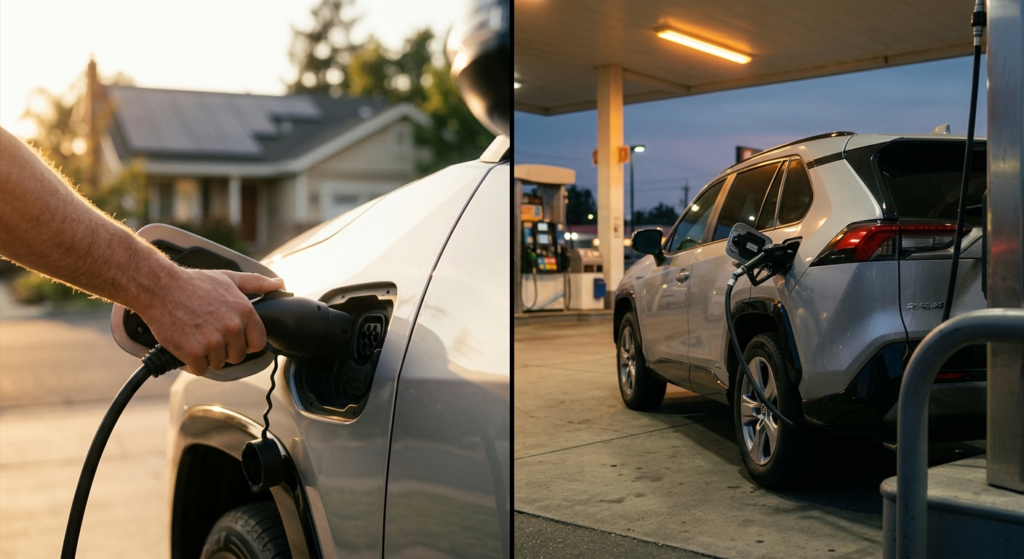
PHEVs offer electric-only commuting, zero range anxiety, and tax incentives but cost more upfront, require charging discipline, and suffer efficiency penalties when the battery is depleted.
Pro Electric-Only Daily Driving
For commuters with round trips under 40 miles, a PHEV functions as a fully electric vehicle. You plug in at night, drive emissions-free to work, and plug in again. Fuel costs drop to near zero. Over a year, this can save $800–$1,500 in gasoline compared to a conventional car.
Pro Unlimited Road-Trip Range With Gas Backup
Unlike a full EV, a PHEV never leaves you searching for a charger on a road trip. When the battery depletes, the gas engine seamlessly takes over. You get the environmental benefits of electric driving during the week and the freedom of gasoline for weekend adventures. This “best of both worlds” flexibility is PHEVs’ strongest selling point.
Pro Potential Tax Credits and Incentives
In the U.S., many PHEVs qualify for federal tax credits up to $7,500 depending on battery size and assembly location. State and local rebates can add thousands more. These incentives can significantly offset the higher purchase price, sometimes making a PHEV cheaper than a hybrid after credits. Note: Tax credit rules changed in 2025–2026; verify current eligibility for specific models.
Con Higher Upfront Purchase Price
PHEVs typically cost $5,000–$15,000 more than their hybrid or gas equivalents. The larger battery, more powerful electric motor, and charging hardware drive up manufacturing costs. Even with tax incentives, the break-even point on fuel savings can take 3–7 years depending on driving habits and electricity rates.
Con Requires Regular Charging to Realize Savings
A PHEV is only economical if you actually plug it in. Without regular charging, you’re paying a premium for a heavier, less efficient hybrid. The psychological commitment to nightly charging is real and if you live in an apartment without dedicated parking, it may be impossible.
Con Heavier Weight = Worse Efficiency When Depleted
When a PHEV’s battery is empty, the gas engine must power a vehicle that weighs 200–400 kg more than a hybrid. Real-world testing shows some PHEVs consume 2–3 liters per 100 km more than their hybrid counterparts in this state. This “dead battery penalty” is rarely advertised but critically important.
Hybrid (HEV) Pros and Cons
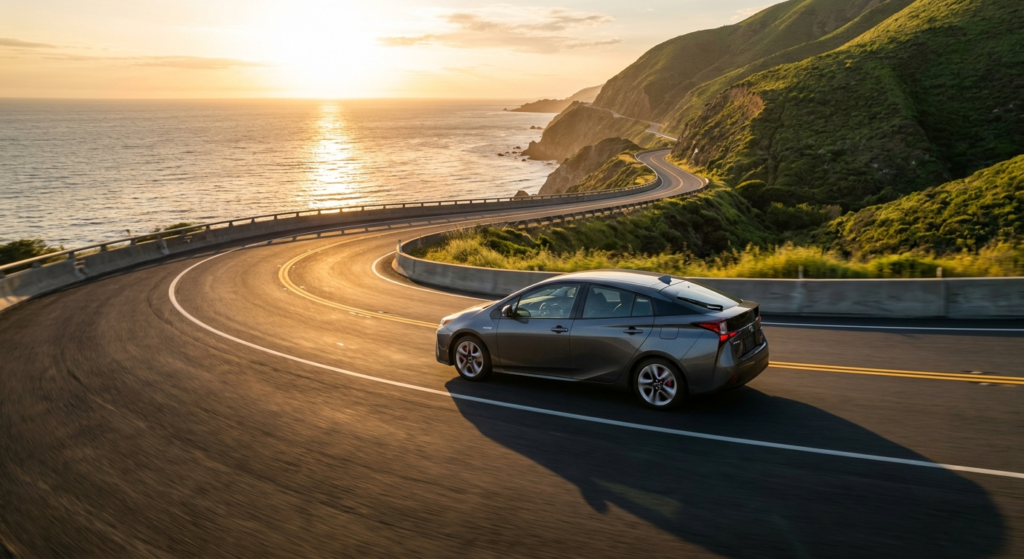
Hybrids offer unmatched convenience, lower purchase prices, and proven reliability but they can’t drive emissions-free and deliver smaller fuel savings than a properly used PHEV.
Pro No Charging Required
The hybrid’s greatest strength is simplicity. You never think about charging. You never install a home charger. You never hunt for public charging stations. You drive it exactly like a gas car and get 40–55 MPG automatically. For apartment dwellers, renters, or anyone without reliable home charging access, this is a game-changer.
Pro Lower Purchase Price
Hybrids typically carry a $1,500–$3,000 premium over gas models far less than PHEVs. Some manufacturers, like Toyota, now offer hybrid powertrains at the same price as gas equivalents. The lower barrier to entry makes hybrids accessible to a broader range of buyers.
Pro Proven Reliability Over 25+ Years
The Toyota Prius launched in 1997. Since then, hybrids have accumulated billions of miles of real-world data. Battery degradation is minimal; most hybrid batteries last 150,000–200,000+ miles with proper care. The technology is mature, the supply chain is robust, and resale values are strong.
Con No Electric-Only Driving Option
A hybrid’s electric motor assists the engine but cannot power the vehicle alone for meaningful distances. Every trip burns some gasoline. Every trip produces tailpipe emissions. If your goal is to eliminate fossil fuel use for daily commuting, a hybrid cannot deliver.
Con Smaller Fuel Savings vs. a Charged PHEV
A hybrid cuts fuel use by 30–50% compared to a gas car. A PHEV, when charged daily, can cut it by 80–100%. Over 5 years, the fuel savings gap between a diligent PHEV owner and a hybrid owner can exceed $2,000–$4,000 though this depends entirely on electricity costs and driving patterns.
Con Still Produces Tailpipe Emissions on Every Trip
Unlike a charged PHEV’s electric-only mode, a hybrid emits CO2 every time it runs. The reduction is significant compared to gas cars, but it’s not zero. For buyers prioritizing environmental impact, this is a meaningful limitation.
Mild Hybrid vs Full Hybrid vs Plug-In Hybrid Explained
Mild hybrids (MHEV) use a small 48V system for minor efficiency gains. Full hybrids (HEV) self-charge and deliver major fuel savings. Plug-in hybrids (PHEV) charge externally and offer electric-only driving. Think of it as good → better → best for efficiency.
Mild Hybrid (MHEV) Minimal Electric Assist
A mild hybrid uses a 48-volt electrical system and a small motor-generator to assist the engine during acceleration and enable smoother start-stop functionality. It cannot drive on electricity alone. Fuel savings are modest, typically 5–15% over a conventional gas car. Mild hybrids are the cheapest to implement and feel nearly identical to normal cars. Examples: Suzuki Swift Hybrid, Audi Q5 MHEV.
Full Hybrid (HEV) Self-Charging Electric Assist
Full hybrids have larger batteries (1–2 kWh) and more powerful motors that can propel the vehicle alone at low speeds. They deliver 30–50% fuel savings without ever plugging in. The Toyota Hybrid System and Honda’s two-motor setup are the gold standards. Examples: Toyota RAV4 Hybrid, Honda CR-V Hybrid, Hyundai Tucson Hybrid.
Plug-In Hybrid (PHEV) Chargeable Electric-First
PHEVs sit between HEVs and full EVs. Their 10–25 kWh batteries enable 20–70 miles of electric-only range. They charge from a wall outlet and automatically switch to hybrid mode when depleted. Examples: Toyota RAV4 Prime, Kia Sorento PHEV, Ford Escape PHEV, Hyundai Tucson PHEV.
Hybrid vs Plug-In Hybrid: Which Is Better for You?
Choose a hybrid if you lack home charging or take frequent long trips. Choose a PHEV if you have home charging and your daily drive is under 40 miles. Your lifestyle, not the technology, should drive the decision.
Choose a Hybrid If You Have No Home Charging Access
If you park on the street, live in an apartment without outlets, or simply don’t want to think about charging, a hybrid is the clear winner. It delivers significant fuel savings with zero lifestyle changes. No extension cords. No charging apps. No range calculations.
Choose a Plug-In Hybrid If Your Commute Is Under 40 Miles
If your daily round trip falls within your chosen PHEV’s electric range and you have a place to charge nightly, a PHEV can function as an EV for 80–90% of your driving. The gas engine becomes an occasional backup rather than your primary power source.
Choose a Hybrid If You Take Frequent Long Road Trips
Highway driving is where hybrids shine. Their gas engines operate efficiently at steady speeds, and regenerative braking is less relevant. A PHEV on a long highway trip without charging stops is just a heavier, less efficient hybrid. For cross-country drivers, the simplicity of a hybrid wins.
Choose a Plug-In Hybrid If You Want Maximum Tax Incentives
Federal and state incentives can make PHEVs surprisingly affordable. In some cases, a PHEV costs less than a hybrid after credits. Check current eligibility programs change frequently and vary by location and manufacturer.
Real-World Cost Analysis Total Cost of Ownership
Over 5 years, a PHEV saves more on fuel IF charged daily, but its higher purchase price and potential depreciation erase some gains. A hybrid offers lower risk and more predictable costs.
Purchase Price Comparison The MSRP Gap in 2026
Using the Toyota RAV4 as a benchmark: the RAV4 Hybrid LE starts around $31,000, while the RAV4 Prime SE starts near $43,000 with a $12,000 gap. Other brands show similar spreads: Honda CR-V Hybrid vs. CR-V PHEV (~$8,000), Hyundai Tucson Hybrid vs. Tucson PHEV (~$7,000). The federal tax credit can reduce the PHEV premium by up to $7,500, but not all models qualify.
Fuel Costs Over 5 Years The Charging Discipline Factor
Assuming 12,000 miles/year and $3.50/gallon gas:
- Hybrid: ~$840/year in fuel = $4,200 over 5 years
- PHEV (charged daily, 80% electric): ~$200/year in fuel + $180/year in electricity = $1,900 over 5 years
- PHEV (never charged): ~$1,200/year in fuel = $6,000 over 5 years
The PHEV’s fuel savings are real but entirely dependent on charging behavior.
Maintenance & Insurance Hidden Cost Differences
Both hybrids and PHEVs require standard engine maintenance (oil changes, filters, spark plugs). PHEVs add battery cooling system checks and potential inverter service. Insurance for PHEVs is typically 5–10% higher due to more expensive repair costs. Battery warranties are similar: 8–10 years / 100,000 miles for both.
Depreciation & Resale Value Which Holds Value Better?
Hybrids have stronger resale values due to proven reliability and broad buyer appeal. PHEV depreciation is steeper in markets where EV adoption is accelerating, buyers increasingly skip the “bridge” technology and go straight to full EVs. In 2026, expect hybrids to retain 55–60% of value after 5 years vs. 45–55% for PHEVs.
Hybrid vs Plug-In Hybrid SUV Best Models Compared
The Toyota RAV4 Hybrid and Honda CR-V Hybrid lead the HEV SUV segment. The Toyota RAV4 Prime and Kia Sorento PHEV top the plug-in category. Towing capacity favors PHEVs due to higher combined torque.
Best Hybrid SUVs in 2026
| Model | MPG (Combined) | Starting Price | Key Strength |
| Toyota RAV4 Hybrid | 39 MPG | ~$31,000 | Reliability, resale value, AWD standard |
| Honda CR-V Hybrid | 40 MPG | ~$34,000 | Spacious interior, refined ride |
| Hyundai Tucson Hybrid | 38 MPG | ~$32,000 | Value, warranty, tech features |
Best Plug-In Hybrid SUVs in 2026
| Model | EV Range | Combined MPGe | Starting Price | Key Strength |
| Toyota RAV4 Prime | 42 miles | 94 MPGe | ~$43,000 | Fastest RAV4, 302 hp, AWD |
| Kia Sorento PHEV | 32 miles | 79 MPGe | ~$50,000 | 3-row seating, 3500 lb towing |
| Ford Escape PHEV | 37 miles | 105 MPGe | ~$40,000 | Best MPGe, compact efficiency |
Towing Capacity Can They Pull Their Weight?
PHEVs generally tow more than hybrids due to higher combined torque from the electric motor. The Kia Sorento PHEV weighs 3,500 lbs, while the RAV4 Hybrid is limited to 1,750 lbs. If towing is a priority, verify ratings carefully; not all PHEVs are rated for heavy loads.
Charging a Plug-In Hybrid What You Need to Know
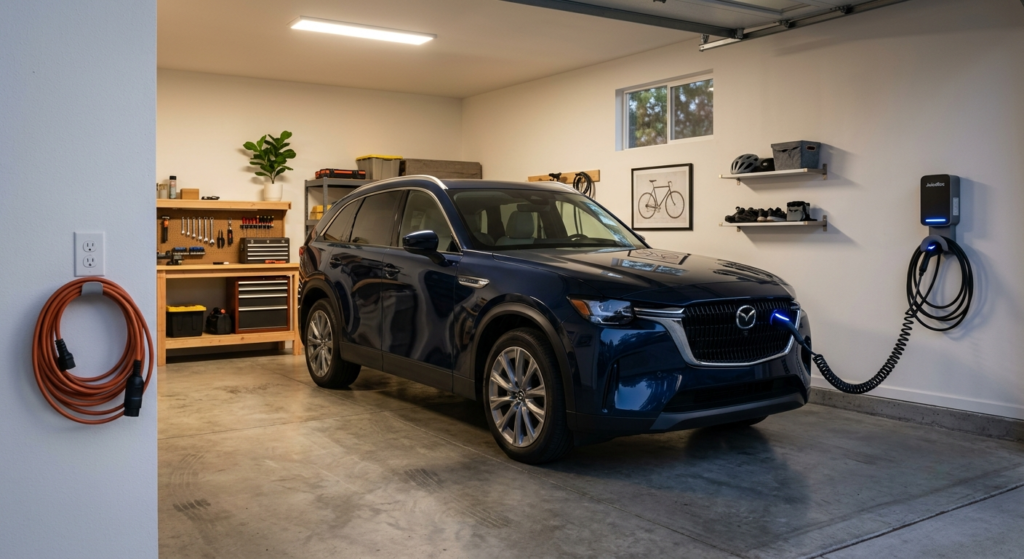
Quick Answer: Most PHEVs charge fully overnight on a standard 120V outlet (10–12 hours). A 240V Level 2 charger cuts this to 2–4 hours but requires installation. DC fast charging is rare in PHEVs and generally unnecessary.
Level 1 Charging Standard Outlet Overnight
Every PHEV ships with a Level 1 charging cord that plugs into a standard 120V household outlet. For a typical 15 kWh battery, this delivers a full charge in 10–12 hours perfect for overnight charging. No installation required. No electrician needed. If you have a garage or dedicated parking with an outlet, Level 1 is often sufficient.
Level 2 Charging Faster but Not Always Necessary
A 240V Level 2 charger fills a PHEV battery in 2–4 hours. Installation costs $500–$2,000 depending on electrical panel capacity and wiring distance. For PHEVs, this investment is optional unlike full EVs where Level 2 is practically mandatory. Consider Level 2 only if you need midday top-ups or have time-of-use electricity rates that reward faster charging.
Public Charging for PHEVs Is It Worth It?
Most PHEVs lack DC fast-charging capability; their batteries are too small to justify the hardware cost. Public Level 2 charging is available but often costs $0.30–$0.50 per kWh, making it more expensive than home charging. For PHEV owners, public charging is a convenience for occasional use, not a daily necessity. The gas engine eliminates any range anxiety that would force you to seek public chargers.
5 Common Mistakes Hybrid and PHEV Buyers Make
The biggest mistakes are buying a PHEV without charging access, ignoring the dead-battery fuel penalty, overestimating daily mileage, letting gas go stale, and focusing only on sticker price.
Mistake #1 Buying a PHEV Without a Reliable Charging Spot
This is the #1 regret among PHEV owners. Without nightly charging, a PHEV becomes an expensive, heavy hybrid with worse fuel economy. Before buying, verify you have consistent access to an outlet where you park. Street parking, shared garages without outlets, or rental properties with restrictions are red flags.
Mistake #2 Ignoring the “Dead Battery” Fuel Penalty
Manufacturers advertise impressive MPGe figures that assume regular charging. In reality, a PHEV driven with a depleted battery can consume 20–40% more fuel than a hybrid on the same route. Always research real-world MPG in hybrid mode, not just the headline EV range number.
Mistake #3 Overestimating Your Daily Mileage Needs
Buyers often choose PHEVs with 40+ miles of EV range “just in case,” paying thousands more for capacity they rarely use. Track your actual daily miles for two weeks. If your commute is 20 miles round trip, a PHEV with 30 miles of range is plenty. Don’t overbuy.
Mistake #4 Forgetting About Gasoline Degradation in PHEVs
If you drive mostly electric, the gas in your tank can sit for months. Gasoline degrades over time typically 3–6 months which can damage fuel systems. Most PHEVs have a “fuel maintenance mode” that forces the engine to run periodically. Don’t ignore these warnings.
Mistake #5 Skipping the Total Cost of Ownership Calculation
Sticker price is just the beginning. Factor in fuel costs, electricity rates, insurance, maintenance, depreciation, and tax incentives over 5–7 years. A PHEV that looks expensive upfront may actually cost less over time or vice versa. Use a TCO calculator before deciding.
Hybrid vs Plug-In Hybrid Efficiency Real-World MPG Breakdown
Hybrids deliver consistent 40–55 MPG regardless of driving habits. PHEVs achieve near-infinite MPG when charged daily but drop to 25–35 MPG when driven on gas only. EPA ratings for PHEVs are misleading without context.
How EPA Ratings Work And Why They Mislead PHEV Buyers
The EPA assigns PHEVs a combined MPGe rating that blends electric and gas driving. This produces eye-popping numbers like 94 MPGe for the RAV4 Prime. But MPGe assumes regular charging. The EPA also provides a separate gas-only MPG rating typically 35–40 MPG which is what you’ll see if you never plug in. Always look at both numbers, not just the headline.
Hybrid MPG Consistent Across All Driving Conditions
Hybrids achieve their best fuel economy in stop-and-go city driving, where regenerative braking recaptures the most energy. Highway MPG is slightly lower but still strong, typically 35–45 MPG at 70 mph. The consistency is their superpower: whether you’re commuting in traffic or cruising cross-country, you know what to expect.
PHEV MPG Incredible When Charged, Mediocre When Not
A charged PHEV with a 30-mile commute uses zero gasoline for weeks. But on a road trip without charging, that same PHEV may achieve only 28–32 MPG worse than many hybrids because of the extra battery weight. Real-world testing from independent sources confirms this “dual personality” is the defining characteristic of PHEV ownership.
FAQ Your Hybrid vs Plug-In Hybrid Questions Answered
Quick Answer: Below are the 8 most common questions searchers ask, answered in 40–60 words each for snippet optimization.
Do Plug-In Hybrids Need to Be Charged Every Day?
Not strictly, but daily charging maximizes their value. A PHEV functions fine as a gas hybrid without charging, but you’ll lose the fuel savings and emissions benefits that justify the higher purchase price. Think of it like a smartphone: it works uncharged, but you’re missing the point.
What Happens When a Plug-In Hybrid Battery Dies?
The vehicle automatically switches to hybrid mode, using the gas engine as the primary power source. The small battery reserve (about 1 kWh) continues to assist via regenerative braking. You won’t be stranded, but fuel economy will drop significantly compared to a regular hybrid.
Are Plug-In Hybrids More Expensive to Insure?
Generally yes 5–15% higher than gas equivalents, and slightly more than hybrids. The complex dual powertrain, expensive battery, and specialized repair requirements drive up premiums. Shop around some insurers offer hybrid discounts that partially offset the increase.
Can a Hybrid Run Without Gas?
No. A full hybrid requires gasoline to operate. While the electric motor can power the car briefly at low speeds, the gas engine is essential for normal driving. A hybrid with an empty fuel tank will not run. This is a key difference from PHEVs, which can run on electricity alone until depleted.
How Long Do Hybrid Batteries Last?
Most hybrid batteries last 150,000–200,000+ miles or 10–15 years. Toyota and Honda offer 10-year / 100,000-mile warranties on hybrid batteries. Real-world data from taxi fleets and high-mileage owners shows minimal degradation even after 300,000+ miles. Replacement costs have fallen to $2,000–$4,000 far less than a decade ago.
Do Plug-In Hybrids Qualify for Tax Credits in 2026?
Many do, but eligibility is complex. The U.S. federal credit offers up to $7,500 for PHEVs with sufficient battery capacity, but final assembly location and battery sourcing requirements apply. State and local incentives vary widely. Check the U.S. Department of Energy’s Alternative Fuels Data Center for current eligibility.
Is a Mild Hybrid Worth It?
Mild hybrids offer modest fuel savings (5–15%) at minimal cost. They’re worth considering if the price premium is small and you want slightly better efficiency without changing driving habits. However, they don’t deliver the dramatic savings of full hybrids or PHEVs. For most buyers, a full hybrid is the better value.
Which Is Better for the Environment Hybrid or PHEV?
A charged PHEV is better for the environment on short trips because it produces zero tailpipe emissions in EV mode. However, a hybrid may have a lower lifetime carbon footprint if the PHEV owner rarely charges and relies on gas. The “well-to-wheel” calculation also depends on your local electricity grid’s cleanliness. For maximum environmental benefit, pair a PHEV with renewable energy charging.
The Future of Hybrids and PHEVs in 2026 and Beyond
Hybrid sales are surging as a practical bridge technology. PHEV sales are plateauing as buyers skip directly to full EVs. Battery costs continue falling, making all electrified vehicles more affordable.
Why PHEV Sales Are Slowing Down
PHEV market share is declining in regions with mature EV infrastructure. Buyers who once saw PHEVs as a “safe stepping stone” now feel comfortable going fully electric. Policy changes like the removal of PHEV tax incentives in some markets are accelerating this shift. In Australia, PHEV sales dropped after the Fringe Benefits Tax exemption ended in April 2025.
Why Hybrids Are More Popular Than Ever
Toyota’s strategy of offering hybrid powertrains across its entire lineup often at no price premium has made hybrids the default choice for fuel-conscious buyers. With no charging infrastructure required and proven reliability, hybrids appeal to mainstream buyers who want efficiency without commitment. In 2026, hybrids account for roughly 17% of new vehicle sales in major markets.
Battery Technology Trends What to Expect
Lithium-ion battery pack prices dropped to approximately $108 per kWh in 2025 and are projected to fall below $100 in 2026. This cost reduction benefits all electrified vehicles. Solid-state batteries promising higher energy density and faster charging may reach production vehicles by 2028–2030, potentially making PHEVs obsolete as full EVs achieve 400+ mile ranges at affordable prices.
Bottom Line Which Should You Choose?
Buy a hybrid for simplicity, reliability, and no lifestyle changes. Buy a PHEV if you have home charging and a short commute and you’re disciplined enough to plug in nightly. Your driving habits matter more than the technology.
The Verdict Three Buyer Profiles, Three Clear Winners
Profile 1: The Practical Commuter You drive 30+ miles daily, lack home charging, and want lower fuel bills with zero hassle. Winner: Hybrid. The Toyota RAV4 Hybrid or Honda CR-V Hybrid are proven, reliable choices.
Profile 2: The Eco-Conscious Urbanite You have a garage with an outlet, your commute is under 30 miles, and you want to minimize emissions. Winner: Plug-In Hybrid. The Toyota RAV4 Prime or Hyundai Tucson PHEV deliver electric-only daily driving with gas backup for road trips.
Profile 3: The Cost-Cautious Buyer You want the lowest total cost of ownership over 5–7 years with minimal risk. Winner: Hybrid. Lower purchase price, stronger resale value, and predictable fuel costs make hybrids the safer financial bet.
Still unsure? Use the Modern Vehicles Comparison Tool to calculate your personalized total cost of ownership based on your actual driving habits, local fuel prices, and electricity rates. [Compare Hybrid vs Plug-In Hybrid Now →]
Conclusion
The hybrid vs plug-in hybrid debate isn’t about which technology is superior, it’s about which technology fits your life. Hybrids reward simplicity and consistency. PHEVs reward discipline and short commutes. Both reduce emissions and fuel costs compared to gas cars, but the magnitude of those savings depends entirely on how you drive.
Before you visit a dealership, answer three questions: Do you have reliable home charging? Is your daily round trip under 40 miles? And are you willing to plug in every night? If yes to all three, a PHEV could save you thousands. If not to any, a hybrid is the smarter, safer choice.
Ready to decide? Explore detailed specs, real-world MPG data, and pricing for every hybrid and plug-in hybrid on the market at Modern Vehicles. [Find Your Perfect Hybrid →]



0 Comments