A plug-in hybrid (PHEV) has a larger battery you charge from an external outlet, giving you 20–60 miles of electric-only driving before the gas engine kicks in. A hybrid (HEV) has a smaller battery that self-charges through regenerative braking and the gas engine, with no plug required.
The core difference comes down to battery size and charging method:
- PHEV: 10–20× larger battery, must plug in, 20–60 miles electric range
- Hybrid: 1–2 kWh battery, self-charging, 1–3 miles electric assist only
- Best for: PHEV = short commutes + home charging; Hybrid = any driver, no lifestyle change
If you charge daily and drive under 40 miles, a PHEV can function like an EV. If you lack home charging or take frequent road trips, a hybrid is the smarter, simpler choice.
Introduction
Buying an electrified vehicle in 2026 shouldn’t require an engineering degree. Yet walk into any dealership and you’ll face a wall of acronyms: HEV, PHEV, MHEV, BEV each promising to save you money and cut emissions, but with very different real-world outcomes.
The confusion is costly. Choose wrong, and you could pay thousands more upfront for a PHEV you never charge, turning it into an overweight, inefficient gas car. Or you could miss out on electric-only commuting and tax credits that would have paid for themselves.
This guide cuts through the noise. We break down the 7 critical differences between PHEVs and hybrids using 2026 data, real-world MPG figures, and total cost of ownership calculations including the hidden costs competitors gloss over. Whether you’re comparing a Toyota RAV4 Hybrid vs Prime, weighing tax credit eligibility, or just trying to understand what “PHEV” actually means, you’ll get a clear, data-backed answer in the next 8 minutes.
What Is the Difference Between PHEV and Hybrid?
A PHEV (Plug-in Hybrid Electric Vehicle) combines a gas engine with a large battery you charge from a wall outlet, enabling 20–60 miles of electric-only driving. A hybrid (HEV) combines a gas engine with a small battery that self-charges through braking and engine power, assisting fuel economy but never driving solely on electricity for more than a few seconds.
What Does PHEV Mean?
PHEV stands for Plug-in Hybrid Electric Vehicle. Unlike a standard hybrid, a PHEV has a charging port, the defining feature that separates it from every other electrified vehicle type. The battery is typically 10 to 20 times larger than a hybrid’s, ranging from 8 kWh to over 20 kWh in 2026 models. This size allows meaningful electric-only range: the 2026 Toyota RAV4 Prime manages 42 miles on electricity alone, while the Lexus RX 450h+ delivers 37 miles. Once depleted, the gas engine seamlessly takes over, and the vehicle operates as a conventional hybrid.
What Is a Hybrid (HEV)?
The One-Line Difference That Matters Most
A hybrid electric vehicle (HEV) uses a small battery (typically 1–2 kWh) paired with an electric motor to assist the gas engine. The battery never plugs in. Instead, regenerative braking captures energy normally lost as heat during deceleration and stores it for later use. The electric motor fills torque gaps during acceleration, lets the engine shut off at stoplights, and can power the car alone at very low speeds but only for a few seconds or a couple of miles at most. Think of it as a very efficient gas car, not a part-time EV.
Hybrids make gas engines more efficient. PHEVs replace gas with electricity for daily driving. That single distinction determines everything: cost, convenience, maintenance, and whether you’ll actually save money.
How PHEV and Hybrid Powertrains Actually Work
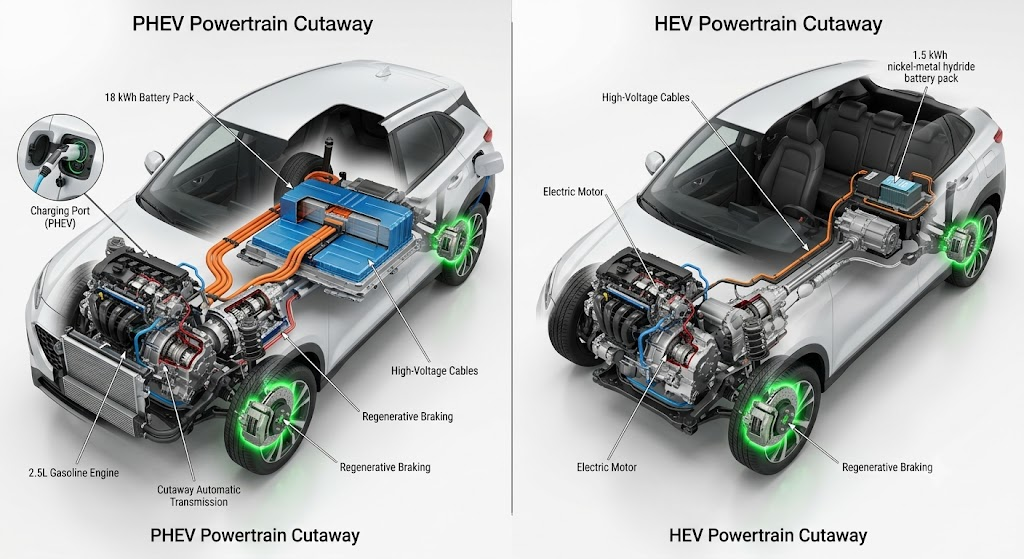
Both use a gas engine + electric motor, but hybrids self-charge a small battery through braking and engine power. PHEVs plug in to charge a large battery from the grid, enabling extended electric-only driving. Both use regenerative braking, but only PHEVs require external charging to function as designed.
Hybrid Battery Technology: Small and Self-Charging
A hybrid’s battery is compact, usually 1.0 to 2.0 kWh and sits beneath the rear seat or in the trunk area. It charges through two methods: regenerative braking (converting kinetic energy to electricity when you slow down) and engine-driven generation (the gas engine spins a generator to top up the battery when cruising). This closed loop means you never plug in, never wait, and never think about charging. The trade-off is minimal electric-only capability: most hybrids can crawl in electric mode for 1–3 miles before the engine fires up.
PHEV Battery Technology: Large and Plug-In Required
PHEV batteries start around 8 kWh and climb past 20 kWh in premium models. This capacity demands external charging; a standard 120V household outlet (Level 1) adds roughly 3–5 miles of range per hour, meaning an overnight charge can restore 30–50 miles. A 240V Level 2 charger cuts that to 2–3 hours for most PHEVs. Crucially, the battery isn’t truly empty when “depleted.” A ~1 kWh reserve remains so the vehicle can still operate as a hybrid using regenerative braking, preserving the “H” in PHEV.
Regenerative Braking: The Feature Both Share
Regenerative braking is the unsung hero of both powertrains. When you lift off the accelerator or press the brake pedal, the electric motor reverses function and becomes a generator, converting the car’s momentum into electricity. This process dramatically reduces brake wear, a hidden cost savings most buyers overlook. In heavy stop-and-go traffic, hybrids and PHEVs can recover significant energy, which is why both excel in urban driving environments.
PHEV vs Hybrid Fuel Economy: Real-World MPG Compared
Hybrids deliver consistent 40–55 MPG regardless of charging habits. PHEVs achieve 50–100+ MPGe when charged daily, but drop to 25–35 MPG when running on gas alone, often worse than their hybrid equivalent due to extra battery weight. Your actual savings depend entirely on how often you plug in.
Hybrid MPG: Consistent Efficiency Without Plugging In
Hybrids deliver reliable, predictable efficiency. The 2026 Toyota Camry Hybrid achieves 51 MPG combined, the Kia Niro Hybrid hits 53 MPG, and the Hyundai Tucson Hybrid manages 38 MPG figures that hold steady across city, highway, and mixed driving. Because there’s no dependency on charging infrastructure, a hybrid’s fuel economy is immune to user behavior. Whether you forget to charge (impossible) or take a 500-mile road trip, the numbers don’t change.
PHEV MPGe: Best When Charged, Worst When Not
PHEV efficiency is bipolar. When charged daily and driven within electric range, a Toyota Prius Prime achieves 127 MPGe exceptional. But once the battery depletes, the same vehicle drops to 54 MPG in hybrid mode. The RAV4 Prime falls from 94 MPGe to 38 MPG. These gas-only figures are often lower than the hybrid version of the same vehicle because the PHEV carries hundreds of pounds of extra battery weight with no electric offset.
The “Never Charge” Penalty: Why PHEVs Become Gas Guzzlers
Here’s the gap competitors ignore: if you buy a PHEV and never charge it, you’re driving an overweight, underperforming hybrid. Edmunds testing found that a depleted PHEV can be less efficient than its hybrid sibling due to lugging around a dead battery. Consumer Reports data confirms PHEVs only make financial sense when driven primarily on electricity. If you lack home charging discipline, a hybrid is objectively the better choice.
Upfront Cost vs. Long-Term Savings: Which Pays Off?
Hybrids cost $1,500–$5,000 more than gas equivalents. PHEVs cost $5,000–$15,000 more than hybrids. While PHEVs may qualify for state incentives, the federal $7,500 tax credit expired September 2025. Over 5 years, a hybrid typically wins on total cost of ownership unless you drive 80%+ on electricity and have cheap home charging.
Purchase Price Gap: How Much More Is a PHEV?
The price premium is substantial. A 2026 Toyota Prius Hybrid starts around $28,000; the Prius Prime (PHEV) starts at $33,000, a $5,000+ gap. The RAV4 Hybrid starts at $31,900; the RAV4 Prime jumps to $48,000+ a $16,000+ difference. These gaps shrink with higher trims but never disappear. Most PHEVs are only offered in upper trims, further inflating the entry price.
Tax Credits and Incentives: What Still Applies in 2026
The federal $7,500 EV tax credit expired for PHEVs on September 30, 2025. However, state and local incentives remain active in many regions. California’s Clean Vehicle Rebate Program offers $1,000–$2,500 for eligible PHEVs. Some utility companies provide $500–$1,500 rebates for home charger installation. Always check Energy.gov’s incentive database for current programs in your ZIP code.
Total Cost of Ownership: 5-Year Breakdown
| Cost Factor | Hybrid (5 Years) | PHEV (5 Years, Charged Daily) | PHEV (5 Years, Never Charged) |
| Purchase Premium | +$3,000 | +$10,000 | +$10,000 |
| Fuel/Electricity | $5,500 | $2,800 | $6,200 |
| Maintenance | $3,200 | $3,800 | $3,800 |
| Insurance (est.) | $6,500 | $7,200 | $7,200 |
| 5-Year Total | $18,200 | $23,800 | $27,200 |
Assumes 12,000 miles/year, $3.50/gallon gas, 15¢/kWh electricity. PHEV charged daily = 70% electric miles.
The verdict: A PHEV only beats a hybrid financially if you maximize electric driving and capture incentives. Otherwise, the hybrid’s lower purchase price and consistent efficiency win.
7 PHEV vs Hybrid Pros and Cons (Side-by-Side)
PHEVs offer electric commuting and tax incentives but cost more, weigh more, and require charging discipline. Hybrids deliver proven reliability and lower upfront cost but can’t drive emission-free. Your lifestyle, not the spec sheet, should decide.
PHEV Pros: Electric Commuting + Gas Backup
- Zero-emission daily driving: 20–60 miles of electric range covers most commutes
- Gas backup: Unlimited road trip range without charging anxiety
- Potential incentives: State rebates and utility credits still available
- Performance boost: Electric torque + gas power = quicker acceleration
- Home solar synergy: Charge from rooftop solar for near-zero fuel cost
H PHEV Cons: Weight, Complexity, and the “Charge Discipline” Problem
- Higher purchase price: $5,000–$15,000 premium over hybrid equivalents
- Requires daily charging: Benefits collapse without consistent plugging
- Heavier weight: Extra battery mass reduces handling and increases tire wear
- Higher complexity: Two full powertrains = more potential failure points
- No DC fast charging: Most PHEVs can’t use road-trip fast chargers
Hybrid Pros: Simplicity, Reliability, No Lifestyle Change
- Lower upfront cost: Smallest electrification premium
- Zero behavior change: Fill up and go no charging, no apps, no planning
- Proven reliability: Consumer Reports shows hybrids have 15% fewer problems than gas cars
- Consistent efficiency: MPG doesn’t depend on your charging habits
- Lower insurance: Simpler powertrain = cheaper repairs
Hybrid Cons: No Electric-Only Driving, Limited Emissions Reduction
- Always burns gas: No zero-emission capability, even for short trips
- Modest efficiency gains: 40–55 MPG is good, but not transformative
- No plug-in incentives: Ineligible for most EV tax credits and rebates
- Engine always runs: Gas engine cycles on frequently, even in traffic
PHEV vs Hybrid for Your Lifestyle: The Decision Framework
Choose a hybrid if you lack home charging, drive long distances, or want minimal complexity. Choose a PHEV if you have a driveway/garage, commute under 40 miles daily, and can charge every night. Apartment dwellers and road-trip warriors should almost always pick hybrids.
Choose a Hybrid If: No Home Charging, Long Commutes, Frequent Road Trips
- No driveway or garage: Street parking makes nightly charging impractical
- Commute exceeds 50 miles: Beyond most PHEV electric range = gas-only operation
- Frequent long trips: Hybrids maintain efficiency at highway speeds; PHEVs lose their advantage
- Budget-conscious: Lower purchase price and no charger installation cost
- Simplicity-first mindset: You want a car, not a power management project
Choose a PHEV If: Short Daily Drive, Home Charging, Tax Credit Eligible
- Daily drive under 40 miles: Fits within most PHEV electric range
- Home charging available: Level 1 overnight charging is sufficient
- Solar panels installed: Near-free charging amplifies savings
- HOV lane access needed: Some states grant carpool lane access to PHEVs
- EV-curious but cautious: PHEV is a low-risk trial of electric driving
The Apartment Dweller’s Dilemma: Why Hybrids Win Without a Driveway
This is the most overlooked buyer segment. Reddit forums and owner groups consistently report that PHEV owners without home charging rarely plug in. Public Level 2 chargers are inconvenient for daily use, and relying on gas-only operation in a PHEV is financially self-defeating. If you park on the street, in a lot without outlets, or share a garage without dedicated charging, a hybrid is objectively the better choice. You’ll save money upfront, avoid charge anxiety, and get better real-world efficiency.
PHEV vs Hybrid SUV: Model Comparison (RAV4, Prius, Escape)
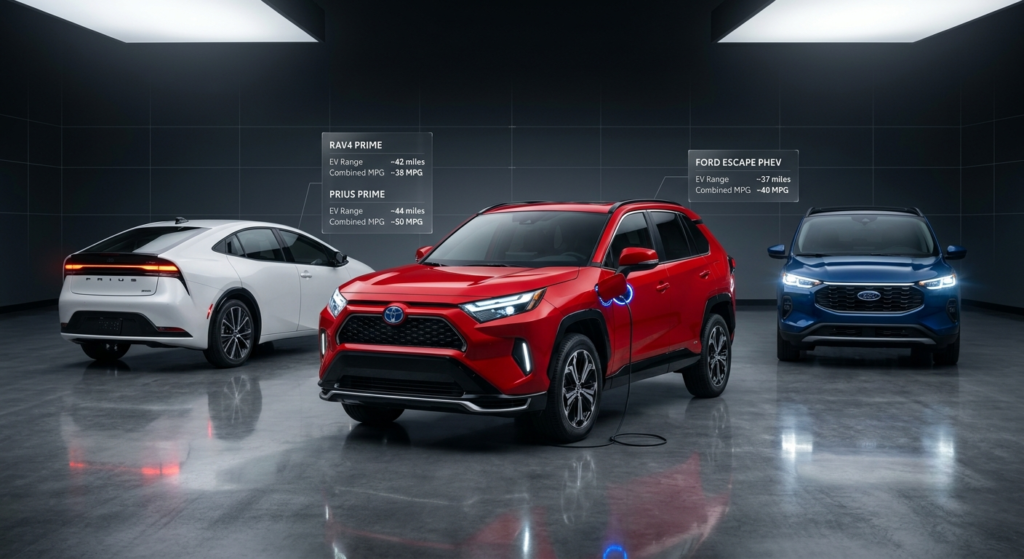
The Toyota RAV4 Hybrid ($31,900, 44 MPG) undercuts the RAV4 Prime ($48,000+, 38 MPG gas-only) by $16,000+ while delivering better highway efficiency. The Prius Prime offers 127 MPGe but costs $5,000+ more than the Prius Hybrid. The Ford Escape PHEV splits the difference with 37 miles of electric range.
Toyota RAV4 Hybrid vs RAV4 Prime (PHEV)
| Feature | 2026 RAV4 Hybrid | 2026 RAV4 Prime (PHEV) |
| Starting MSRP | $31,900 | $48,000+ |
| Combined MPG | 44 MPG | 38 MPG (gas) / 94 MPGe |
| Electric Range | N/A | 42 miles |
| Horsepower | 236 HP | 324 HP |
| Cargo Space | Maximum | Reduced (larger battery) |
| Federal Tax Credit | None | Expired (Sept 2025) |
Winner: RAV4 Hybrid for value and practicality. RAV4 Prime only wins if you need the power and charge religiously.
Toyota Prius Hybrid vs Prius Prime
| Feature | 2026 Prius Hybrid | 2026 Prius Prime (PHEV) |
| Starting MSRP | ~$28,000 | ~$33,000 |
| Combined MPG | 57 MPG | 54 MPG (gas) / 127 MPGe |
| Electric Range | N/A | 44 miles |
| 0-60 MPH | 7.1 sec | 6.7 sec |
Winner: Prius Prime has the smallest price gap and highest MPGe. Best PHEV value proposition if you charge daily.
Ford Escape Hybrid vs Escape PHEV
| Feature | 2026 Escape Hybrid | 2026 Escape PHEV |
| Starting MSRP | ~$33,000 | ~$40,000 |
| Combined MPG | 41 MPG | 40 MPG (gas) / 105 MPGe |
| Electric Range | N/A | 37 miles |
Winner: Escape Hybrid. The PHEV premium is hard to justify at this price point without federal tax credits.
5 Hidden Disadvantages of Plug-In Hybrids Nobody Talks About
PHEVs suffer from accelerated tire wear, higher insurance premiums, charge anxiety, worse reliability than hybrids, and depreciation risk if incentives disappear. These hidden costs can erase the fuel savings that justify the purchase premium.
Disadvantage #1: PHEVs Are Heavier and Wear Tires Faster
A PHEV battery adds 300–500 pounds over a hybrid equivalent. That extra mass increases tire wear, brake load (despite regen), and suspension stress. Owners report replacing tires 10,000–15,000 miles sooner than hybrid drivers. At $800–$1,200 per set, that’s a real cost most reviews ignore.
Disadvantage #2: Higher Insurance and Repair Costs
PHEVs cost more to insure because they’re more expensive to repair. The dual powertrain means twice the potential failure points, and specialized technicians command higher labor rates. Progressive notes that PHEV insurance premiums typically run 5–15% higher than hybrid equivalents.
Disadvantage #3: The “Charge Anxiety” You Didn’t Expect
EV owners talk about range anxiety. PHEV owners discover charge anxiety, the low-grade stress of remembering to plug in every night, finding working public chargers, and watching your efficiency collapse when you forget. Reddit owner forums are filled with PHEV drivers who bought the car for electric commuting but find the daily charging routine unsustainable.
Disadvantage #4: PHEVs Have More Problems Than Hybrids (CR Data)
According to Consumer Reports’ latest reliability survey, PHEVs and EVs have approximately 80% more problems than gas-only cars, while hybrids have 15% fewer problems. The complexity of managing two powertrains, charging systems, and thermal management creates more failure opportunities. If reliability is a priority, hybrids are the clear winner.
Disadvantage #5: Depreciation Risk If Tax Credits Expire
With federal PHEV tax credits expired as of September 2025, the used market is adjusting. PHEVs purchased with credits enjoyed inflated resale values. New PHEVs without that subsidy face steeper depreciation curves as buyers recalculate total value. This risk is highest for luxury PHEVs with the largest price premiums.
MHEV vs HEV vs PHEV vs EV: The Complete Electrified Vehicle Guide
Mild hybrids (MHEV) use a 48V system for minor efficiency gains. Full hybrids (HEV) self-charge and assist the gas engine. PHEVs plug in for 20–60 miles of electric driving. EVs (BEV) run solely on battery power with zero emissions. The right choice depends on charging access, driving distance, and budget.
Mild Hybrid (MHEV): The Entry Point
A 48-volt mild hybrid replaces the starter and alternator with a small motor/battery. It enables engine stop-start, powers accessories, and provides a brief acceleration boost. Fuel savings are modest, typically 5–10% but the cost premium is low. Think of it as a slightly more efficient gas car, not a true hybrid.
Full Hybrid (HEV): The Proven Middle Ground
The Toyota Prius, Honda Accord Hybrid, and Kia Niro represent the gold standard. A full hybrid uses a high-voltage battery (1–2 kWh) and electric motor to significantly assist the gas engine. No plug required, 40–55 MPG typical, and 15% better reliability than gas cars per Consumer Reports. The safest electrification bet for most buyers.
Plug-In Hybrid (PHEV): The Bridge Technology
PHEVs are the transition vehicle electric for daily life, gas for adventure. They work best for buyers with home charging, short commutes, and occasional long trips. But they’re also the riskiest financial bet if charging habits don’t align with design intent.
Battery Electric (BEV): The Full Commitment
Fully electric vehicles like the Tesla Model Y, Hyundai Ioniq 5, and Toyota bZ4X eliminate the gas engine entirely. They require home charging or reliable public infrastructure, offer 200–400+ miles of range, and deliver the lowest operating costs. The trade-off is higher upfront cost and charging planning for road trips.
FAQ: PHEV vs Hybrid Questions Answered
What Happens If I Never Charge My PHEV?
Your PHEV operates as a heavy, inefficient hybrid. The gas engine carries the extra battery weight with no electric offset, often delivering worse MPG than the hybrid version of the same car. Edmunds testing confirmed a depleted PHEV can be less efficient than its lighter hybrid sibling. If you won’t charge regularly, buy a hybrid.
Do PHEVs Qualify for the $7,500 Federal Tax Credit in 2026?
No. The federal tax credit for PHEVs expired on September 30, 2025. Some state and utility incentives remain, but the $7,500 federal benefit is gone. Check Energy.gov’s AFDC database for current state-level programs.
Is a PHEV More Reliable Than a Hybrid?
No. Consumer Reports data shows PHEVs have significantly more problems than gas cars, while hybrids have fewer problems. The dual powertrain complexity, charging hardware, and thermal management systems create additional failure points. For maximum reliability, choose a hybrid.
Can I Charge a PHEV with a Regular Outlet?
Yes. Every PHEV includes a Level 1 (120V) charging cable. A standard household outlet adds 3–5 miles of range per hour sufficient for overnight charging if your daily drive is under 40 miles. Level 2 (240V) charging is optional and reduces charge time to 2–3 hours, but isn’t necessary for most PHEV owners.
Which Is Better for Long Commutes: Hybrid or PHEV?
Hybrid. PHEVs lose their electric advantage beyond 40–60 miles, after which they operate as less efficient hybrids due to extra weight. Hybrids maintain consistent 40–55 MPG regardless of distance. For commutes over 50 miles or frequent highway driving, the hybrid’s simplicity and steady efficiency win.
PHEV vs Hybrid: Final Verdict & Next Steps
Buy a hybrid for simplicity, reliability, and consistent savings without lifestyle changes. Buy a PHEV only if you have home charging, drive under 40 miles daily, and will charge every night. Use our 3-question test below to decide in 60 seconds.
The 3-Question Test to Pick Your Perfect Powertrain
- Do you have a driveway or garage with an outlet? No → Hybrid
- Is your daily round-trip commute under 40 miles? No → Hybrid
- Will you plug in every single night without fail? No → Hybrid
If you answered Yes to all three, a PHEV could save you money and deliver electric driving. If any answer is No, a hybrid is the smarter, safer choice.
Complete Powertrain Comparison Matrix
| Feature | Mild Hybrid (MHEV) | Full Hybrid (HEV) | Plug-In Hybrid (PHEV) | Battery Electric (BEV) |
| Battery Size | 0.5–1.0 kWh | 1–2 kWh | 8–20+ kWh | 50–100+ kWh |
| Electric Range | None | 1–3 miles | 20–60 miles | 200–400+ miles |
| Charging Required | No | No | Yes (essential) | Yes (essential) |
| Typical MPG/MPGe | +5–10% vs gas | 40–55 MPG | 50–127 MPGe (charged) | 90–130 MPGe |
| Purchase Premium | +$500–$1,500 | +$1,500–$5,000 | +$5,000–$15,000 | +$5,000–$15,000 |
| Reliability (vs gas) | Similar | 15% better | 80% more problems | 80% more problems |
| Best For | Budget buyers | Everyone | Home chargers, short commutes | Home chargers, EV believers |
Conclusion
The PHEV vs hybrid debate isn’t about technology it’s about behavior. A PHEV is a part-time electric car that demands daily charging discipline. A hybrid is a very efficient gas car that asks nothing of you. The best choice isn’t the one with the bigger battery; it’s the one that fits your actual life.
If you have a driveway, a short commute, and the discipline to plug in every night, a PHEV can slash your fuel costs and deliver a taste of electric driving. But if you lack home charging, take long trips, or simply want a car that works without a manual, the hybrid’s proven reliability and consistent efficiency make it the smarter 2026 buy.
Still unsure? Take our 3-Question Powertrain Quiz for a personalized recommendation, or browse our 2026 Electrified Vehicle Rankings to see how every hybrid and PHEV stacks up on price, efficiency, and real-world value.



0 Comments