EV stands for “Electric Vehicle” any car, truck, or bus powered by electricity instead of gasoline alone. The four main types are BEV (pure battery), PHEV (plug-in hybrid), HEV (self-charging hybrid), and FCEV (hydrogen fuel cell). This guide explains each type, how they work, and which fits your lifestyle.
Introduction
Walk into any dealership in 2026 and you’ll hear the same letters: EV, BEV, PHEV, HEV, FCEV. For first-time buyers, it’s alphabet soup and most guides drown you in jargon or skip the details you actually need.
At Modern Vehicles, we’ve helped thousands of drivers cut through the confusion. This isn’t a Wikipedia dump. You’ll get a clear answer to “what does EV stand for,” plus a practical breakdown of every EV type, how they work, what they cost, and which one fits your life.
Whether you’re comparing an EV vs hybrid, wondering what PHEV means, or deciding if 2026 is your year to switch, this guide delivers facts without fluff.
What Does EV Stand For? The Simple Definition
EV stands for “Electric Vehicle” , the broad term for any vehicle using electric motors for propulsion, powered by a battery, fuel cell, or hybrid system.
EV Full Form and Meaning
The EV full form is “Electric Vehicle.” In everyday use, it refers to battery-powered cars like the Tesla Model Y or Hyundai Ioniq 5. These store electricity in a lithium-ion battery and use electric motors to drive the wheels. Unlike gas cars, EVs have no exhaust pipe, no engine oil, and far fewer moving parts which is why EV maintenance costs roughly 40% less than gas cars over 10 years.
EV Meaning in Cars vs. Other Contexts
In cars, EV means any vehicle using electricity as its primary or supplementary power source. In charging, an “EV charger” recharges the battery. In policy, “EV incentives” are government programs encouraging adoption.
Common EV Abbreviations at a Glance
- EV Electric Vehicle (umbrella term)
- BEV Battery Electric Vehicle (100% electric)
- PHEV Plug-in Hybrid Electric Vehicle (electric + gas, plugs in)
- HEV Hybrid Electric Vehicle (gas + electric, no plug)
- FCEV Fuel Cell Electric Vehicle (hydrogen-powered)
- ICE Internal Combustion Engine (traditional gas car)
- kWh Kilowatt-hour (battery capacity)
- kW Kilowatt (charging speed)
- MPGe Miles Per Gallon Equivalent (efficiency rating)
The 4 Main Types of Electric Vehicles
BEVs run on batteries only. PHEVs combine battery + gas engine and plug in. HEVs use gas + electric but don’t plug in. FCEVs generate electricity from hydrogen.
BEV (Battery Electric Vehicle) The Pure EV
A BEV has no gas engine, no exhaust, and no fuel tank. Energy comes entirely from a 40-100 kWh battery pack. Popular models: Tesla Model Y, BYD Atto 3, Hyundai Ioniq 5, Kia EV6. Range: 250-400 miles. Zero tailpipe emissions.
Pros: Zero emissions, lowest running costs, instant acceleration.
Cons: Higher purchase price, charging dependency, longer “refueling” time.
PHEV (Plug-in Hybrid Electric Vehicle)
A PHEV combines a battery motor with a gas engine. Drive 25-60 miles on electricity, then the gas engine takes over. Ideal for short commutes with occasional long trips. Models: Toyota RAV4 Prime, Mitsubishi Outlander PHEV.
Pros: Electric commuting, no range anxiety, tax incentives.
Cons: Higher complexity, two powertrains to maintain, heavier than BEVs.
HEV (Hybrid Electric Vehicle) Self-Charging
An HEV pairs a small electric motor with a gas engine. The battery charges through regenerative braking and the engine never plugs in. The electric motor assists during acceleration. Models: Toyota Prius, Toyota Camry Hybrid, Hyundai Tucson Hybrid.
Pros: No charging needed, better MPG than gas cars, proven reliability.
Cons: Still uses gasoline, minimal electric-only range, not as clean as BEVs.
FCEV (Fuel Cell Electric Vehicle) Hydrogen
An FCEV generates electricity by combining hydrogen with oxygen. Only emission: water vapor. Refueling: 3-5 minutes. Models: Toyota Mirai, Hyundai Nexo. Limited by scarce hydrogen infrastructure.
Pros: Fast refueling, long range, zero emissions.
Cons: Few hydrogen stations, high cost, uncertain infrastructure.
ICE (Internal Combustion Engine) Traditional Gas Car
ICE vehicles burn gasoline or diesel to produce power. Still dominant globally but face increasing restrictions and lack the efficiency of electrified alternatives.
How Do Electric Vehicles Work?
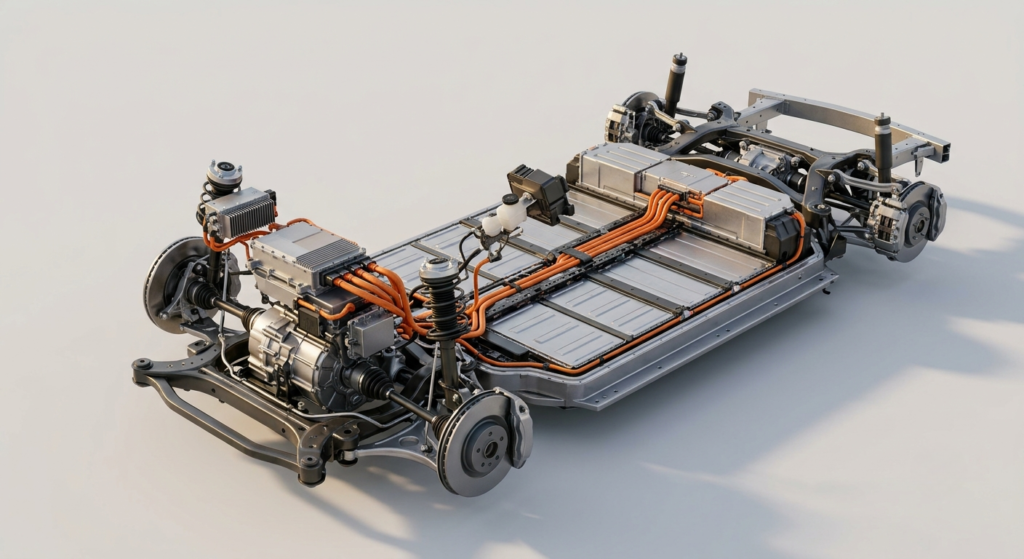
Three steps: (1) Electricity stores in a battery, (2) Power flows to electric motors, (3) Motors turn the wheels. Braking recovers energy via regenerative braking.
The Battery Pack
Modern EVs use lithium-ion batteries scaled up from smartphone tech. Capacity is measured in kWh; most EVs carry 50-100 kWh. A 60 kWh battery delivers 250-300 miles; 100 kWh pushes 400+ miles.
The Electric Motor
Electric motors deliver maximum torque from zero RPM instant, smooth acceleration. Unlike gas engines with hundreds of moving parts, an EV motor has essentially one: the rotor. This simplicity means far less maintenance.
Regenerative Braking
Regenerative braking converts kinetic energy lost during braking into electricity fed back to the battery. In city driving, it recovers 10-20% of energy. Many EVs offer one-pedal driving, where lifting off the accelerator slows the car enough that you rarely touch the brake pedal.
Charging Levels
| Level | Power Source | Speed | Best For |
| Level 1 | 120V outlet | 3-5 mi/hr | Emergency only |
| Level 2 | 240V outlet | 15-30 mi/hr | Home daily charging |
| DC Fast | High-power station | 150-350 mi/hr | Road trips |
Level 2 is the sweet spot for home charging, fully charging most EVs overnight. DC fast charging hits 80% in 20-40 minutes but costs 2-3x more per mile than home charging.
EV vs Hybrid: What’s the Real Difference?
An EV (BEV) runs entirely on electricity and plugs in. A hybrid (HEV) uses gas + electric but cannot plug in. Hybrids save fuel; EVs eliminate emissions.
Can a Hybrid Run on Electric Only?
Most HEVs drive under 2 miles on electricity alone at very low speeds. PHEVs, by contrast, travel 25-60 miles electrically before the gas engine starts.
Do Hybrids Need to Be Plugged In?
No. HEVs recharge via regenerative braking and the gas engine. Only PHEVs require plugging in to maximize electric range.
Which Saves More Money?
Over 10 years, a BEV saves $6,000-$10,000 vs. a comparable HEV. Break-even occurs around year 4-5 due to higher upfront EV prices.
EV vs PHEV: Which Should You Buy in 2026?
Choose BEV if you have home charging, drive under 60 miles daily, and plan to keep the car 5+ years. Choose PHEV if you lack home charging or take frequent long trips.
Daily Driving Habits
Under 40 miles/day with home charging: BEV handles everything. 40-100 miles or no home charging: PHEV offers flexibility.
Upfront Cost vs. Long-Term Savings
BEVs cost $5,000-$15,000 more upfront than gas cars, but incentives close the gap. PHEVs sit between HEVs and BEVs in price. Long-term ownership favors BEVs.
Charging Access
Home charging costs $0.03-$0.05/mile vs. $0.12-$0.15/mile for gas. Without home charging, public stations are less convenient and more expensive.
The Real Cost of Owning an EV in 2026

Total ownership includes purchase price, charger installation, insurance, electricity, maintenance, and depreciation. Most buyers break even by year 4-6, with long-term savings of $6,000-$14,500.
Purchase Price
New EVs: $28,000 (Nissan Leaf) to $100,000+ (luxury). Used EVs: 40-50% below new after 3 years. Gas cars start around $22,000.
Fuel Savings
The U.S. Department of Energy estimates EV drivers save up to $14,500 in fuel costs over 15 years. At 12,000 miles/year, that’s $800-$1,500 annually in electricity vs. gasoline.
Maintenance Costs
EVs need no oil changes, spark plugs, or transmission fluid. Annual maintenance: $300-$500 (EV) vs. $800-$1,200 (gas). Regenerative braking extends brake life to 100,000+ miles.
Hidden Costs
EV insurance runs 10-20% higher due to expensive battery repairs. Depreciation is steeper in years 1-3. Home Level 2 charger: $500-$2,000 installed.
Government Incentives
Federal tax credit: up to $7,500 (new), $4,000 (used). State rebates: $1,000-$5,000 additional. Check the U.S. Department of Energy’s AFDC website for current programs.
5 Common EV Mistakes First-Time Buyers Make
(1) Ignoring daily driving distance, (2) Not checking home charging, (3) Buying new when used is better value, (4) Skipping the test drive, (5) Forgetting cold weather cuts range 15-30%.
Mistake #1: Ignoring Daily Driving Distance
The average American drives 37 miles/day well within every modern BEV’s range. Buy for your actual needs, not hypothetical road trips.
Mistake #2: Not Checking Home Charging
Apartment dwellers without dedicated parking may lack home charging options. Verify before buying.
Mistake #3: Buying New When Used Is Better
New EVs depreciate rapidly. A CPO EV with remaining warranty delivers 80% of the experience at 50% of the cost.
Mistake #4: Skipping the Test Drive
EVs feel completely different instant torque, one-pedal driving, near-silent operation. Always test drive.
Mistake #5: Forgetting Cold Weather Range Loss
Batteries lose 15-30% range in freezing temperatures. Cold-climate buyers should budget for larger batteries or more frequent charging.
Which EV Type Is Right for You? The 5-Second Framework
Answer three questions daily distance, home charging access, and budget to find your match.
Question 1: Daily Driving Distance?
- Under 40 miles: BEV or PHEV
- 40-100 miles: PHEV or BEV with home charging
- 100+ miles: HEV or PHEV
Question 2: Can You Charge at Home?
- Yes: BEV ideal; PHEV great too
- No: HEV or PHEV with public plan
- Shared outlet: PHEV is safer
Question 3: Your Budget?
- Under $30K: Used BEV or new HEV
- $30K-$50K: New PHEV or entry-level BEV
- $50K+: Premium BEV
The Verdict
| Profile | Recommended | Why |
| Short commute, home charging, long-term | BEV | Lowest cost, zero emissions |
| Mixed driving, occasional long trips | PHEV | Flexibility, no range anxiety |
| No home charging, budget-focused | HEV | Better MPG, no infrastructure |
EV Acronyms Cheat Sheet: Every Abbreviation You Need
Here are the 15 most important EV acronyms organized by category.
Vehicle Types
| Acronym | Full Form | Meaning |
| EV | Electric Vehicle | Umbrella term |
| BEV | Battery Electric Vehicle | 100% battery, no gas |
| PHEV | Plug-in Hybrid EV | Electric + gas, plugs in |
| HEV | Hybrid EV | Gas + electric, self-charging |
| FCEV | Fuel Cell EV | Hydrogen-powered |
| ICE | Internal Combustion Engine | Traditional gas/diesel |
Charging & Power
| Acronym | Full Form | Meaning |
| kWh | Kilowatt-hour | Battery capacity |
| kW | Kilowatt | Charging speed/motor power |
| CCS | Combined Charging System | DC fast charging standard |
| CHAdeMO | CHArge de MOve | Japanese fast charging |
Technology & Features
| Acronym | Full Form | Meaning |
| V2G | Vehicle-to-Grid | Sends power to grid |
| V2H | Vehicle-to-Home | Powers house from car |
| V2L | Vehicle-to-Load | Powers appliances |
| OTA | Over-the-Air | Wireless software updates |
| MPGe | Miles Per Gallon Equivalent | Efficiency rating |
Top Benefits of Electric Vehicles in 2026
(1) Zero emissions, (2) Lower running costs, (3) Instant acceleration, (4) Quieter ride, (5) HOV lane access.
Zero Tailpipe Emissions
EVs produce no exhaust while driving. Lifecycle emissions are 50-70% lower than gas cars, rising to 80-90% in regions with renewable grids.
Lower Running Costs
Electricity costs $0.03-$0.05/mile vs. $0.12-$0.15/mile for gas. Combined with reduced maintenance, EV owners save $800-$1,500 annually.
Instant Acceleration
Electric motors deliver 100% torque from zero RPM. A Hyundai Ioniq 5 out-accelerates many sports cars from 0-30 mph.
Quieter, More Comfortable
No engine noise or vibration reduces driver fatigue and makes highway conversation effortless.
HOV Lane and Parking Perks
Many states allow EVs in HOV lanes solo. Some cities offer free or discounted parking and reduced tolls.
Frequently Asked Questions
What does EV stand for in cars?
EV stands for “Electric Vehicle” any car using electricity from a battery or fuel cell to power electric motors.
What does EV mean in hybrid cars?
In hybrids, “EV mode” means driving short distances using only the electric motor. HEVs: 1-2 miles. PHEVs: 25-60 miles.
What is the difference between EV and PHEV?
An EV (BEV) runs 100% on battery and must plug in. A PHEV has battery + gas engine electric for 25-60 miles, then gas takes over.
How long do EV batteries last?
Warrantied for 8 years/100,000 miles. Average degradation: 2.3%/year. A 300-mile battery still delivers 240+ miles after 10 years.
Can you charge an EV with a regular outlet?
Yes, via Level 1 (120V), but it only adds 3-5 miles/hour. Level 2 (240V) home charging is recommended for daily BEV use.
Are EVs more expensive to insure?
Generally 10-20% higher due to battery repair costs. The gap is narrowing as repair networks expand.
Do electric vehicles need oil changes?
No. BEVs have no engine oil, transmission fluid, or spark plugs. Maintenance: tires, brake fluid, cabin filter only.
What is the cheapest electric car in 2026?
The Nissan Leaf starts around $28,000 new. Used EVs offer exceptional value 3-year-old models often sell for 40-50% below original price.
How much does it cost to charge an EV at home?
$0.03-$0.05/mile. At 12,000 miles/year: $400-$600 in electricity vs. $1,500-$2,000 in gasoline.
Should I buy an EV or hybrid in 2026?
Buy EV if you have home charging, drive under 60 miles daily, and keep cars 5+ years. Buy a hybrid if you lack home charging or take frequent long trips.
Key Takeaways
EV means Electric Vehicle. The four types are BEV, PHEV, HEV, and FCEV. Your ideal choice depends on driving habits, charging access, and budget.
The Bottom Line
Now you know what EV stands for, how each type works, and what ownership costs in 2026. The technology has matured, charging infrastructure has expanded, and the financial case for electrification has never been stronger.
Your Next Step
Ready to take the next step? Explore our EV buying guides, compare models side-by-side, or use our total cost of ownership calculator to see your potential savings. The future of driving is electric and it starts with understanding what EV really means.



0 Comments