A hybrid car is kind of a blend of a gasoline engine and one or more electric motors, and that combo helps with better fuel economy, and less exhaust out of the tailpipe. In real life, you’ll most often run into four main types of hybrids: mild hybrids (MHEV), full hybrids (HEV), plug-in hybrids (PHEV), and range extender hybrids (REX). They’re never exactly the same though, since the battery capacity, how long you can coast along purely electrically, and whether you actually have to plug the vehicle in, can shift quite a bit from one to the next.
- MHEV: Think “electric assistance” not “battery only”, so it can’t truly go anywhere purely on electricity.
- HEV: a self charging arrangement, so it can keep moving for a bit using electric power, then rely on the system overall to manage the rest.
- PHEV: you plug it in to get roughly 20–50 miles of electric driving, after that the gas side typically takes over more often.
- REX: the electric portion does the work most of the time, while the gas engine is basically there as a generator not really as the main propulsion.
Introduction
Getting a hybrid car in 2026 is supposed to be easy. It isn’t. You walk onto a lot and suddenly there’s a whole maze of acronyms like MHEV HEV PHEV REX, all of them talking about efficiency, and somehow every single one also comes with trade-offs you don’t notice at first. A lot of people leave scratching their heads, and many choose the wrong hybrid for how they actually drive.
At Modren Vehicles, we’ve dug through every hybrid category, spent time with the 2026 models, and pulled together the real world cost numbers. This guide cuts through the jargon, sort of fast and direct. You’ll see how each hybrid setup really works, which one fits your daily route, and just as importantly if the fuel savings can ever catch up to the higher sticker price. When you’re done, you’ll know exactly which hybrid type belongs in your garage, not the one that just sounded good on the sales floor.
What Is a Hybrid Car?
A hybrid car kind of uses two systems , kind of at the same time, an internal combustion engine and an electric motor. There’s a battery pack that holds that extra energy and it gets filled up not by plugging in most of the time, but through things like regenerative braking, and also from electricity made by the engine itself. Then the onboard computer sort of decides which source to use, or maybe mixes them together, so the whole setup stays efficient.
How the hybrid setup works in normal words
Most hybrids include three main components, a gasoline engine, an electric motor, and a battery pack. Unlike a fully electric vehicle you don’t usually plug in the car after a ride, except with plug-in hybrids.
Instead the battery recharges itself while you drive, and that part feels a bit like magic but it’s pretty straightforward. When you slow down or brake, the motor flips roles and acts like a generator, turning the car’s movement into electricity again. That whole process is regenerative braking, and it’s often the key idea behind why hybrids can do so well at efficiency.
The shared feature almost every hybrid has: regenerative braking
With regenerative braking, the car can reclaim as much as 30% of the energy that would normally vanish as heat when you brake. In busy stop-and-go streets, this can make a noticeable difference, compared to cars that run on gas only.
Every one of the four hybrid categories uses regenerative braking too, even if the battery size and the strength of the electric motor end up being very different from model to model.
The 4 Main Types of Hybrid Cars, explained
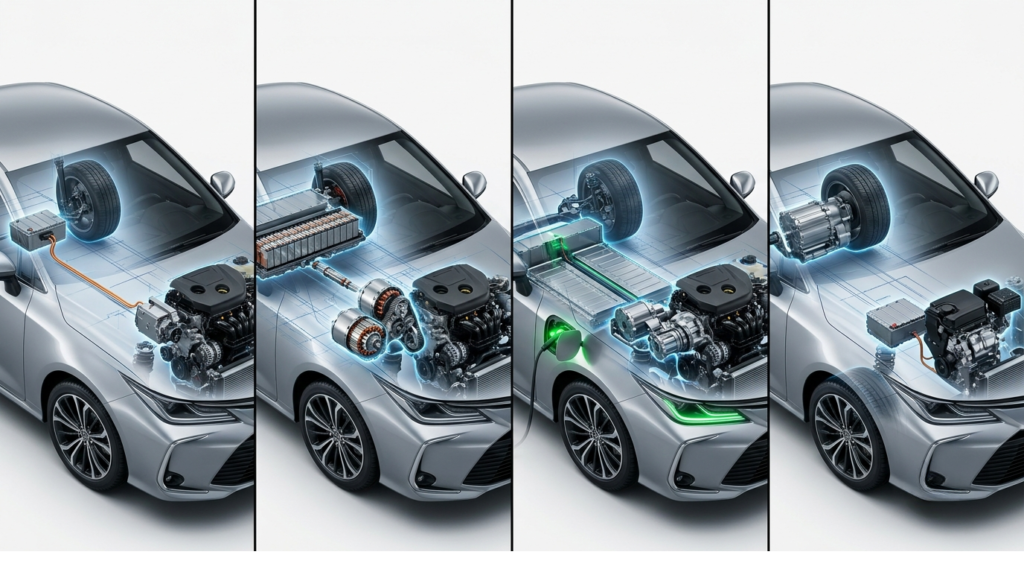
Hybrid cars usually fall into four main groups: mild hybrids (MHEV), full hybrids (HEV), plug-in hybrids (PHEV), and range extender hybrids (REX). Now the MHEV types mostly give electric support, like not really taking over but just nudging.
HEVs can actually drive for short stretches using electric power alone, then they switch back when needed. PHEVs let you plug in and get a decent chunk of electric distance, often like 20–50 miles, before the gas system truly has to do the heavy lifting. Then you’ve got REX cars that run mainly on electric motors as the whole point, with a gas generator trailing along as a kind of backup plan when the battery gets low.
1. Mild Hybrid Electric Vehicles (MHEV)
Mild hybrids, or MHEVs, use a small 48-volt battery and a compact electric motor, but it can’t propel the car by itself. Instead, the motor comes in alongside the gasoline engine during acceleration, and it also smooths out start-stop behavior, you know the stop light moments.
So it feels more like an “electric nudge,” not like full-time electric roaming. In real life, MHEVs often improve fuel efficiency by something like 10–15% compared with similar non-hybrid gas cars. You’ll find this idea in cars like the Audi A5 and the Volvo XC40, pretty often.
2. Full Hybrid Electric Vehicles (HEV)
Full hybrids, sometimes parallel hybrids too, can run for brief distances, usually around 1–3 miles, on electric power only. After that, at higher speeds, the gasoline engine basically takes the lead, or both systems blend together kind of at once.
The battery is typically small, under about 1.5 kWh, and it recharges itself through regenerative braking, like collecting energy back while slowing down. The Toyota Prius, the Honda Civic Hybrid, and the Toyota Camry Hybrid are all well known examples people mention a lot.
3. Plug-In Hybrid Electric Vehicles (PHEV)
PHEVs go with a larger battery, commonly about 8–15 kWh, and you can recharge it by plugging into a wall, or a charging point. They usually manage 20–50 miles on pure electric power, before the gas engine becomes more important.
For commuting, a PHEV can feel almost like a simple electric car during weekdays, then act like a hybrid when you’re doing longer trips on weekends or whatever. Some options people talk about for 2026 include the Toyota RAV4 Prime and Hyundai Tucson Plug-In Hybrid.
4. Range Extender Hybrids (REX)
Range extenders are basically electric vehicles first, then there’s a small gasoline engine that works as a generator only. It doesn’t turn the wheels directly, it just makes extra electricity, sort of indirectly.
Good examples of this setup include the BMW i3 REx (discontinued) and the Mazda MX-30 R-EV. REX hybrids can lower “range anxiety,” because the generator helps extend the journey, but they’re still pretty rare in today’s market overall.
Mild Hybrid vs Full Hybrid: The critical difference
What really matters is the electric-only capability. With a mild hybrid, you don’t get pure battery driving, the electric bits just nudge along. Basically the electric motor helps the gasoline engine along the way. With a full hybrid, you can actually let the vehicle run on electricity for short stretches, especially at lower speeds. That’s why the fuel savings can be bigger, mostly in city kind of routes where you stop and go.
Can a Mild Hybrid run on electric power alone ?
No. A mild hybrid, usually using a 48-volt setup, simply doesn’t have the battery size or oomph to move the car by itself. The motor is more like a torque helper during acceleration and it can support coasting with the engine off sometimes, but the gas engine is still involved whenever the car is truly moving. So mild hybrids are often simpler and less expensive, yet they’re generally not as efficient as full hybrids.
Real world MPG: Mild vs Full Hybrid comparison
In EPA style testing mild hybrids usually show about 3–5 MPG better results than their non-hybrid gas versions. Full hybrids tend to jump around 10–15 MPG improvements. For instance, the gas Hyundai Elantra posts around 37 MPG combined, while the Elantra Hybrid reaches about 54 MPG, which is roughly a 46% improvement that a mild hybrid setup can’t really match.
How Plug-In Hybrids Work, and Who should actually get one
A plug in hybrid kind of does two jobs, and for the first 20–50 miles it behaves like a regular electric car. After that it swaps over to hybrid mode and it’s using gas plus electric power at the same time. To get the best value out of it you really need to plug it in, like on a consistent basis. PHEVs tend to fit well if you have home charging access and most days your drive is under 40 miles or so.
PHEV Electric Range, what 20–50 miles really means in practice
A lot of people quote numbers, but the typical American commute is about 27 miles round trip. So if your plug in hybrid has something like 35 miles of electric range, then it can cover most everyday driving without touching the gasoline.
For those longer weekends, the gas engine basically takes over and helps prevent range anxiety. That said, PHEVs are often heavier and not as efficient as full hybrids once the battery runs out, so keep that tradeoff in mind.
Do you really need a home charger ? The honest answer, a bit messy but true
You do not absolutely need one, but if you can’t plug in regularly, a PHEV can turn into an expensive, less efficient full hybrid. Even if you charge sometimes in public, it usually won’t give you the daily electric miles that make the whole thing worth the extra cost. If you have no home charging, or no reliable workplace charging either, it’s usually smarter to pass on the PHEV and grab a full hybrid instead.
Series versus Parallel hybrid: the kind of layout every buyer ends up learning anyway
On a parallel hybrid , the gas engine and the electric motor can both push the wheels in a direct way. With a series hybrid, the gas engine is basically only a generator, it makes electricity, then the wheels run solely on an electric motor. Most newer hybrids Toyota, Honda, and friends use a series-parallel setup that sort of mixes both styles, even when it feels like it should be one or the other.
Parallel Hybrids: Gas plus electric, going straight to the wheels
Parallel hybrids are pretty much the default design. The engine and motor tie into the transmission , and the car’s controller decides which source to rely on. Toyota’s Hybrid Synergy Drive is a well known example: two electric motors plus a planetary gear set keep things switching without making a big show. This arrangement tends to shine when you’re cruising at highway rates, where direct engine work is usually the most worthwhile.
Series Hybrids: the engine is kind of “only” a generator
In a series hybrid, the gasoline engine doesn’t have a mechanical link to the wheels at all. It just spins to run a generator, then charges the battery, and the battery feeds the electric motor. The benefit is that the engine can stay near its best RPM range, basically always landing where efficiency is highest. Honda’s newest Civic and Accord hybrids lean mostly series, even if they still behave like a full hybrid in everyday driving.
Series-Parallel Hybrids: Toyota and Honda juggling both
Today’s hybrids kinda blur the boundary on purpose. Toyota’s system is mostly parallel, but it can slip into series behavior when the engine output is higher than what the wheels need at that moment. Honda’s system leans series, but it can also connect the engine straight to the wheels using a clutch during steady cruising. That “either way is possible” strategy is a big reason these cars can reach 50+ MPG in real world use, not just on paper.
Which Hybrid Type Saves the Most Money? A Real Cost Breakdown
Full hybrids typically deliver the fastest payback for average drivers. PHEVs save the most if you have home charging and a short commute. Mild hybrids save the least but cost the least upfront. Your break-even point depends on annual mileage, gas prices, and electricity costs.
The 4-Year Payback Math Every Shopper Should Do
Consider the Toyota RAV4: the gas AWD model gets 29 MPG combined and costs $29,675. The hybrid AWD gets 40 MPG and costs $31,225 a $1,550 premium. At 14,000 miles per year and $3.10/gallon gas, the hybrid saves $412 annually in fuel. That’s a 3.7-year payback before financing costs, or roughly 4.5 years with a typical 7% auto loan. If you drive less than 10,000 miles yearly, the hybrid premium may never pay back.
Hidden Costs: Insurance, Maintenance, and Depreciation
Hybrids cost slightly more to insure due to complex powertrains. However, maintenance is often lower regenerative braking reduces brake wear, and the engine cycles off frequently, reducing oil degradation. Depreciation is favorable: popular hybrids like the Prius and Camry Hybrid hold value better than gas equivalents due to sustained demand.
3 Hybrid Buying Mistakes That Cost Buyers Thousands
The costliest mistakes include buying a PHEV without home charging, ignoring highway MPG penalties, assuming tax credit eligibility, overlooking total cost of ownership, and choosing the wrong hybrid type for your commute distance.
Mistake #1: Buying a PHEV Without Home Charging Access
Without nightly charging, a PHEV operates as a heavy, inefficient hybrid. You’ll carry a large, depleted battery that adds weight but delivers no benefit. If you can’t charge at home or work, buy a full hybrid instead.
Mistake #2: Ignoring the Highway MPG Penalty
Hybrids shine in city driving but offer smaller gains on the highway. A Camry Hybrid gets 51 MPG city but only 44 MPG highway. If 80% of your driving is interstate cruising, your savings will be a modest factor into your payback calculation.
Mistake #3: Assuming All Hybrids Qualify for Tax Credits
As of 2026, only some plug-in hybrids qualify for federal tax credits, and eligibility depends on final assembly location and battery sourcing. Full hybrids and mild hybrids do not qualify. Verify current IRS guidance before counting on a credit.
Top Hybrid Models by Type in 2026
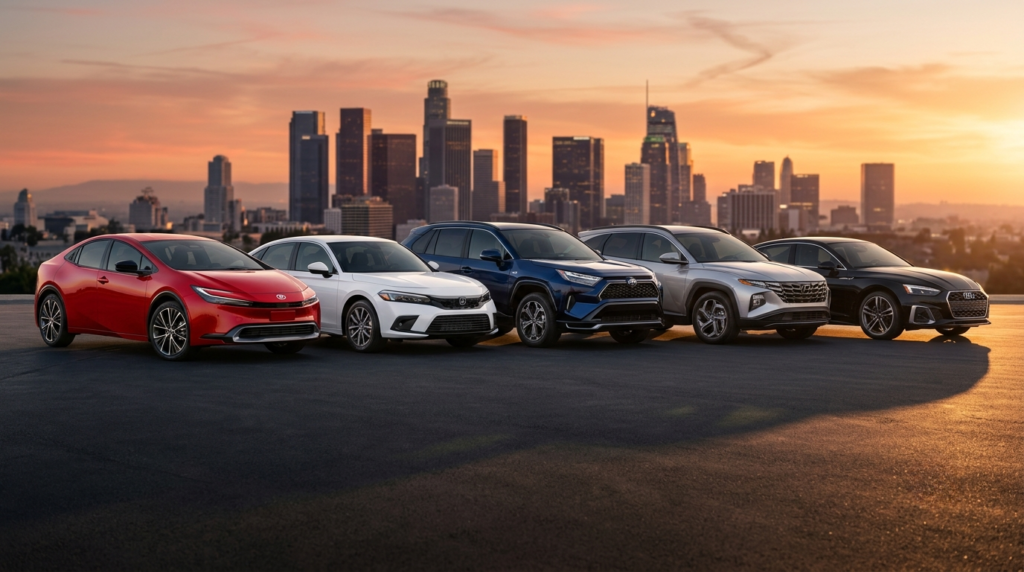
The best full hybrids of 2026 include the Toyota Prius (57 MPG), Honda Civic Hybrid (49 MPG), and Toyota Camry Hybrid (51 MPG). Top PHEVs include the Toyota RAV4 Prime and Hyundai Tucson Plug-In Hybrid. Leading mild hybrids include the Audi A5 and Volvo XC40.
Best Full Hybrids: Toyota Prius, Honda Civic Hybrid, Camry Hybrid
The 2026 Toyota Prius leads all hybrids with 57 MPG combined and a starting price near $28,550. The Honda Civic Hybrid balances efficiency with sportier handling at $28,750. The Toyota Camry Hybrid now all-hybrid for 2026 delivers 51 MPG city in a spacious midsize sedan package.
Best Plug-In Hybrids: RAV4 Prime, Hyundai Tucson PHEV
The Toyota RAV4 Prime offers 42 miles of electric range and 302 horsepower, a rare blend of efficiency and performance. The Hyundai Tucson Plug-In Hybrid provides 33 miles of electric range with a more affordable entry price and generous standard features.
Best Mild Hybrids: Audi A5, Mazda CX-60, Volvo XC40
Mild hybrids work best in luxury vehicles where the technology enhances refinement rather than pure efficiency. The Audi A5 and Volvo XC40 use 48-volt systems to deliver smoother stop-start operation and marginal MPG gains without the cost complexity of full hybrid systems.
Which Hybrid Is Right for Your Driving Style? (Decision Framework)
City commuters under 30 miles daily should choose a PHEV. Mixed drivers benefit most from full hybrids. Highway-focused drivers see the best value from mild or full hybrids. Use your commute distance, charging access, and budget to decide.
City Commuter Under 30 Miles/Day → PHEV
If you have a garage outlet and your daily round-trip is under 35 miles, a PHEV functions as an EV during the week. You’ll visit gas stations rarely and enjoy the lowest per-mile energy costs of any hybrid type.
Mixed Highway/City Driver → Full Hybrid
Full hybrids excel in varied driving. The Toyota Camry Hybrid and Honda Civic Hybrid adapt seamlessly between electric city cruising and efficient highway running. No charging infrastructure required.
Long-Distance Highway Driver → Mild Hybrid or Full Hybrid
For drivers covering 20,000+ highway miles yearly, a mild hybrid offers lower upfront cost with modest gains. A full hybrid still wins if you encounter traffic regularly, but the payback period stretches longer at steady interstate speeds.
Hybrid Reliability in 2026: What the Data Says
Hybrids are significantly more reliable than gas-only cars. According to Consumer Reports’ latest survey, hybrids experience 15% fewer problems on average than conventional vehicles. PHEVs are more complex and report more issues than standard hybrids.
Hybrid vs Gas: 15% Fewer Problems
The data is clear: hybrid powertrains reduce engine stress by cycling the gas motor off frequently. Brake wear drops thanks to regenerative braking. The result is lower maintenance costs over 100,000 miles compared to gas equivalents.
Battery Longevity: What 200,000 Miles Tells Us
Toyota Prius taxis have demonstrated hybrid battery lifespans exceeding 200,000 miles with minimal degradation. Modern lithium-ion packs in PHEVs are newer but show similar durability patterns. Most manufacturers warranty hybrid batteries for 8–10 years or 100,000 miles.
The Future of Hybrids: Trends Through 2027
Hybrid sales are surging globally up 27% in key markets as buyers seek efficiency without EV charging dependency. Automakers are expanding hybrid lineups across SUVs and trucks, positioning hybrids as a permanent solution, not just a bridge technology.
Why Hybrid Sales Are Up 27% Globally
Falling battery costs, improved regenerative braking systems, and buyer skepticism toward full EVs have fueled hybrid demand. Models like the 2026 Hyundai Palisade Hybrid and Toyota Land Cruiser Hybrid prove hybrids now power every segment from compact sedans to full-size SUVs.
FAQ: Your Hybrid Questions Answered
How many types of hybrids are there?
There are four main types: mild hybrids (MHEV), full hybrids (HEV), plug-in hybrids (PHEV), and range extender hybrids (REX).
Can hybrids run on electricity only?
Some can, but not all. Full hybrids drive 1–3 miles electrically. PHEVs manage 20–50 miles. Mild hybrids cannot drive on battery power alone.
Are hybrid cars self-charging?
Full and mild hybrids self-charge through regenerative braking and engine-generated power. PHEVs must be plugged in to maximize electric range, though they can self-charge partially while driving.
Which hybrid has the best MPG?
The 2026 Toyota Prius leads with 57 MPG combined. The Hyundai Elantra Hybrid follows at 54 MPG combined.
Is a hybrid better than a fully electric car?
It depends on your situation. Hybrids require no charging infrastructure and work for any trip length. EVs cost less per mile but require charging access and planning for long trips.
Do hybrids qualify for tax credits?
Only some PHEVs qualify for federal tax credits as of 2026. Full hybrids and mild hybrids do not. Check IRS.gov for current eligible models.
How long do hybrid batteries last?
Most hybrid batteries last 150,000–200,000 miles. Manufacturers typically warranty them for 8–10 years or 100,000 miles.
Are hybrids more expensive to maintain?
No. Hybrids often cost less to maintain due to reduced brake wear and less engine stress. However, PHEVs may have higher repair costs if complex electronics fail.
Quick Reference: Hybrid Type Comparison Table
| Feature | Mild Hybrid (MHEV) | Full Hybrid (HEV) | Plug-In Hybrid (PHEV) | Range Extender (REX) |
| Electric Range | None | 1–3 miles | 20–50 miles | 0 (battery dependent) |
| Need Plugging In? | No | No | Yes | Yes |
| Best For | Highway drivers | All-around use | Short commuters | Range-anxious EV buyers |
| Avg. MPG Gain | +10–15% | +40–60% | +80%+ (if charged daily) | Varies |
| 2026 Example | Audi A5 | Toyota Prius | RAV4 Prime | Mazda MX-30 R-EV |
| Price Premium | Lowest | Low | High | Highest |
Find Your Perfect Hybrid with Modren Vehicles
Start your hybrid search by matching your driving habits to the right hybrid type, then compare 2026 models using real-world cost and reliability data.
Choosing the right hybrid doesn’t require an engineering degree, just honest answers about how you drive, where you park, and what you can spend. At Modren Vehicles, our hybrid guides, comparison tools, and fuel-savings calculators cut through the marketing noise.
Browse our 2026 hybrid reviews to see how the Prius, Civic Hybrid, and RAV4 Prime stack up in real-world testing. Use our hybrid vs. gas savings calculator to find your exact break-even point. Whether you’re ready to buy or still researching, we’ll help you drive away confident.



0 Comments