Postal service electric vehicle funding refers to the $3 billion appropriated under the Inflation Reduction Act (IRA) Section 70002 to help the U.S. Postal Service purchase zero-emission delivery vehicles and install charging infrastructure. As of early 2026, the program faces severe delays: only about 612 electric NGDVs have been delivered out of 45,000 planned, while charging station installation sits at just 27.9% completion. The total fleet modernization investment is expected to reach $9.6 billion by 2028.
- $3 billion in IRA funding for USPS EVs and infrastructure
- 612 electric NGDVs delivered (of 45,000 planned)
- 27.9% of charging stations installed (of ~14,000 planned)
- $77,692 cost per electric NGDV
- 66,000 EVs targeted by 2028
Introduction
The U.S. The Postal Service is attempting one of the largest federal fleet electrification projects in American history but the execution has become a case study in government procurement challenges. With $3 billion in taxpayer funding from the Inflation Reduction Act and a $9.6 billion total investment plan, the USPS aims to deploy 66,000 electric delivery vehicles by 2028. Yet as of mid-2026, the program remains woefully behind schedule, sparking congressional investigations, political opposition, and widespread public scrutiny.
At Modern Vehicles, we track fleet modernization programs nationwide to give you accurate, data-driven insights into government EV investments, vehicle specifications, and industry trends.
This guide breaks down everything you need to know about postal service electric vehicle funding: where the money came from, where it went, why delivery is stalled, and what happens next. Unlike news reports that stop at the headline, we analyze the engineering, economic, and political factors driving this $9.6 billion program including the five critical mistakes that put it years behind schedule.
What Is Postal Service Electric Vehicle Funding?
Postal service electric vehicle funding is the federal financial support provided to the U.S. Postal Service to accelerate the transition from its aging gasoline-powered delivery fleet to battery electric vehicles. The funding comes primarily from Section 70002 of the Inflation Reduction Act (IRA) of 2022, which appropriated $1.29 billion for zero-emission vehicle purchases and $1.71 billion for charging infrastructure at USPS facilities. These funds remain available through September 30, 2031.
The funding supports the USPS’s broader “Delivering for America” 10-year transformation plan, which calls for acquiring 106,000 new delivery vehicles between 2023 and 2028. Of these, at least 66,000 are planned to be battery electric including 45,000 purpose-built Next Generation Delivery Vehicles (NGDVs) from Oshkosh Defense and 21,000 commercial off-the-shelf (COTS) electric vans.
The Inflation Reduction Act and the $3 Billion Allocation
The Inflation Reduction Act of 2022 marked a turning point for USPS fleet electrification. Before the IRA, the Postal Service had committed to only 10% electric vehicles in its initial NGDV order, a figure criticized by the EPA, environmental groups, and 16 states that filed lawsuits.
The $3 billion injection enabled USPS to increase its electric commitment to 75% of the initial 60,000 NGDV order and commit to 100% electric purchases for all vehicles delivered from 2026 through 2028.
How Section 70002 Directs Funds to USPS Clean Fleets
Section 70002 specifically appropriates funds through the Postal Service Fund (39 U.S.C. § 2003), making the money available without fiscal-year limitations. This structure gives USPS flexibility but has also drawn criticism for lack of spending transparency.
As of February 2024, the USPS Office of Inspector General reported that $112.3 million had been invested in charging infrastructure from IRA funds, while no IRA funds had yet been used for actual vehicle purchases.
The Delivering for America Plan: Fleet Modernization Context
The fleet replacement is urgent. The USPS operates over 235,000 vehicles, many of which are Grumman LLVs built between 1987 and 1994 now 30+ years old, lacking air conditioning, airbags, and anti-lock brakes.
The Postal Service estimates maintaining this aging fleet costs over $700 million annually. The NGDV program is designed to replace these vehicles with safer, more efficient models while cutting carbon emissions 40% by 2030.
USPS NGDV Update 2026: How Many Electric Mail Trucks Have Been Delivered?
As of early 2026, the USPS Next Generation Delivery Vehicle program remains severely behind its original production schedule. While USPS announced in December 2025 that more than 35,000 new vehicles are on the road, the vast majority of these are internal combustion engine (ICE) models or commercial off-the-shelf vehicles, not the purpose-built electric NGDVs that represent the core of the electrification plan.
Current Delivery Numbers: 612 EVs vs. 35,000 Planned
The most alarming figure comes from a December 2024 Washington Post investigation: by November 2024, only 93 electric NGDVs had been delivered out of 3,000 originally expected in that timeframe.
By early 2026, production reports indicate approximately 612 electric NGDVs have been built, a tiny fraction of the 45,000 battery-electric models contracted. Meanwhile, only 2,600 ICE NGDVs have been delivered out of 16,500 planned.
The Oshkosh Defense Contract Timeline and Repeated Delays
Oshkosh Defense, a military vehicle manufacturer with no prior commercial delivery van experience won the $6 billion NGDV contract in February 2021. Initial deliveries were scheduled for 2023, then pushed to June 2024, then further delayed. The first production NGDVs finally reached USPS facilities in August 2024, with the inaugural vehicles deployed in Athens, Georgia. By May 2025, the first production models were delivered to additional locations.
Congresswoman Valerie Foushee (NC-04) sent a formal letter to Oshkosh in September 2025 demanding answers on production delays, noting that “serious concerns about the execution and timeliness of this project have arisen.”
Charging Infrastructure Progress: Only 27.9% Complete
Vehicle delivery is only half the problem. As of early 2025, USPS had installed roughly 3,900 charging stations, just 27.9% of the planned ~14,000 total. The delays stem from weather disruptions, utility coordination challenges, inconsistent equipment standards, and facility readiness issues including construction delays and safety concerns. Without adequate charging infrastructure, widespread EV deployment is impossible regardless of vehicle production rates.
Are the New USPS Trucks Electric? NGDV Specs and Powertrain Options
The new USPS Next Generation Delivery Vehicles come in two powertrain configurations: battery electric (BEV) and internal combustion engine (ICE). While USPS has committed to 100% electric purchases for vehicles delivered from 2026 through 2028, the current fleet mix includes both types as the agency phases out its aging Grumman LLVs.
Battery Electric NGDV vs. Internal Combustion Engine Versions
- BEV NGDV: Zero-emission battery electric with an estimated 70-mile range and energy consumption of 1.34 kWh per mile (equivalent to 25.2 mpg-e). The 70-mile range accommodates 95% of all USPS delivery routes based on route distance analysis.
- ICE NGDV: Fuel-efficient gasoline engine with an estimated 14.7 mpg dropping to just 8.6 mpg when air conditioning is running. This marginal improvement over the old LLV fleet (which averages 8.2 mpg) drew sharp criticism from the EPA.
Key Features: Air Conditioning, Safety Tech, and Cargo Capacity
Unlike the old Grumman LLVs, every NGDV includes air conditioning, airbags, anti-lock brakes, 360-degree cameras, automatic emergency braking, and enhanced cargo capacity for modern e-commerce package volumes.
Letter carriers have praised the ergonomic improvements, with one Erie, PA carrier noting the vehicle “will not go into gear if the seat belt is not clicked” and the parking brake engages automatically.
70-Mile Range and Route Suitability for Electric Delivery
The BEV NGDV’s 70-mile range is sufficient for the vast majority of postal routes, which average well under that distance.
However, using the heater can reduce range by up to half a significant concern for winter operations in northern climates. The vehicle is designed so that only about 20% of battery capacity is used daily on typical routes, providing a substantial buffer.
New Postal Vehicles Cost: $77,692 per EV vs. Commercial Alternatives
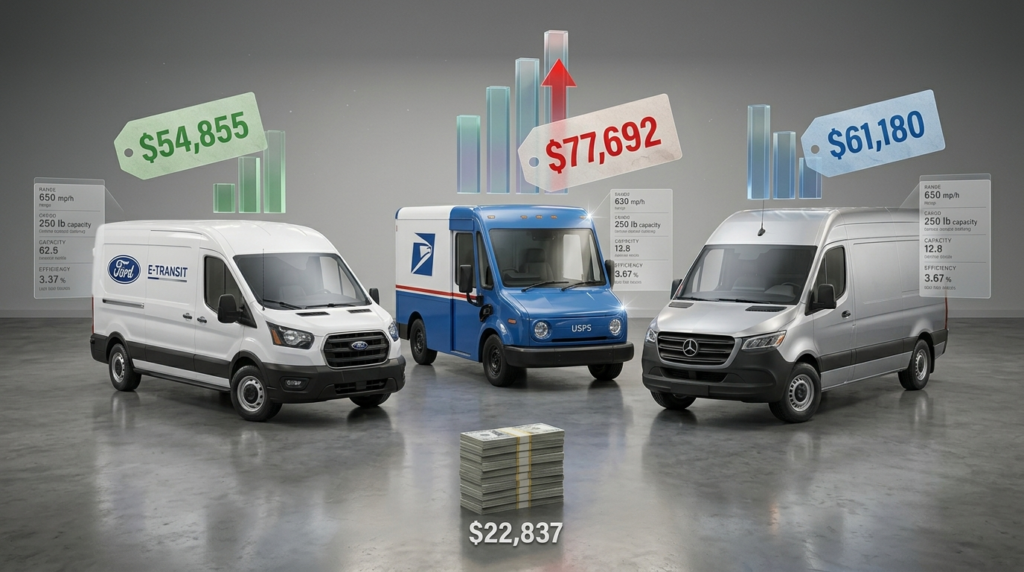
The cost of the USPS NGDV program has become a focal point of criticism, with the Postal Service paying significantly more per vehicle than comparable commercial alternatives.
NGDV Pricing Breakdown: Electric vs. Gas-Powered Models
As of March 2023, the USPS agreed to pay Oshkosh Defense:
- $77,692 per electric NGDV (e-NGDV)
- $54,584 per ICE NGDV
These figures represent a substantial premium over off-the-shelf commercial delivery vans.
Cost Comparison: USPS NGDV vs. Ford E-Transit vs. Mercedes eSprinter
| Vehicle | Type | Base Price (2026) | Price vs. e-NGDV |
| USPS e-NGDV | Custom electric | $77,692 | Baseline |
| Ford E-Transit | COTS electric | $54,855 | -$22,837 |
| Mercedes eSprinter | COTS electric | $61,180 | -$16,512 |
| Mercedes Sprinter (ICE) | COTS gas | $50,830 | -$26,862 |
Sources: USPS contract pricing, manufacturer MSRP data
Why USPS Chose a Custom-Built Truck Over Off-the-Shelf Options
The USPS required a purpose-built, right-hand-drive vehicle optimized for mail delivery, a specification no commercial off-the-shelf van fully meets. The NGDV includes unique features like standing-height cargo access, mailbox-height delivery windows, and specialized routing equipment.
However, critics argue that the 21,000 COTS vehicles in the plan (including Ford E-Transit vans) prove that commercial alternatives could have satisfied a larger portion of the fleet needs at lower cost.
USPS Electric Vehicle Plan Faces Opposition: Political Challenges Explained
The postal service electric vehicle funding program has become a political battleground, with Republican lawmakers seeking to claw back the $3 billion IRA allocation while environmental groups and unions push for even faster electrification.
The Return to Sender Act: GOP Efforts to Claw Back $3 Billion
In March 2025, Senator Joni Ernst (R-Iowa) and Representative Michael Cloud (R-Texas) introduced the “Return to Sender Act” legislation designed to rescind unspent IRA funds allocated to USPS EVs. Citing the Washington Post’s revelation that only 93 trucks had been delivered by November 2024, Ernst called the program a “billion-dollar boondoggle” and stated that “tax dollars should always be treated with first-class priority.”
DOGE Lawmakers and the “Boondoggle” Narrative
The opposition has been amplified by the Department of Government Efficiency (DOGE) caucus, which has framed the USPS EV program as emblematic of wasteful federal spending. A June 2025 Senate proposal sought to force the sale of approximately 7,200 USPS EVs and redirect the funding, though it failed to make it into the final tax and spending bill. Opponents cite costs, delays, and a preference for gas vehicles while defenders note that scrapping the program would waste approximately $1.5 billion in sunk costs.
Environmental Groups and Unions: The Push for 100% Electrification
On the other side, 16 states, the EPA, the United Auto Workers union, and multiple environmental organizations have sued or lobbied USPS to accelerate electrification. After initially planning only 10% electric vehicles USPS increased its commitment to 75% electric NGDVs and 100% electric purchases from 2026 onward, a shift driven largely by legal and political pressure rather than operational planning.
USPS EV Funding Timeline: From 2021 Contract to 2028 Deployment Goals
Understanding the postal service electric vehicle funding story requires tracing the program’s evolution from its origins to its current stalled state.
2021: Oshkosh Defense Wins the $6 Billion NGDV Contract
In February 2021, after a prototype competition that saw multiple candidates withdraw (including Mahindra, Utilimaster, and London Electric Vehicle Company), Oshkosh Defense was awarded a $6 billion contract to produce up to 165,000 NGDVs over 10 years. The initial plan called for only 10% battery electric vehicles.
2022: IRA Provides $3 Billion and USPS Commits to 75% Electric
The Inflation Reduction Act’s passage in August 2022 changed the trajectory. With $3 billion in new funding, USPS announced in December 2022 that it would acquire at least 66,000 electric vehicles by 2028, with 75% of NGDVs being battery electric. All vehicles purchased from 2026 through 2028 would be 100% electric.
2024–2026: First Deliveries Begin Amid Severe Production Delays
- August 2024: First NGDV vehicles delivered and begin operating in Athens, Georgia
- December 2024: Washington Post reports only 93 e-NGDVs and 2,600 ICE NGDVs delivered
- December 2025: USPS announces 35,000+ new vehicles on the road (majority ICE/COTS, not e-NGDV)
- Early 2026: Production remains far below targets; congressional scrutiny intensifies
5 Critical Mistakes in the USPS Electric Vehicle Rollout (And What They Mean for Taxpayers)
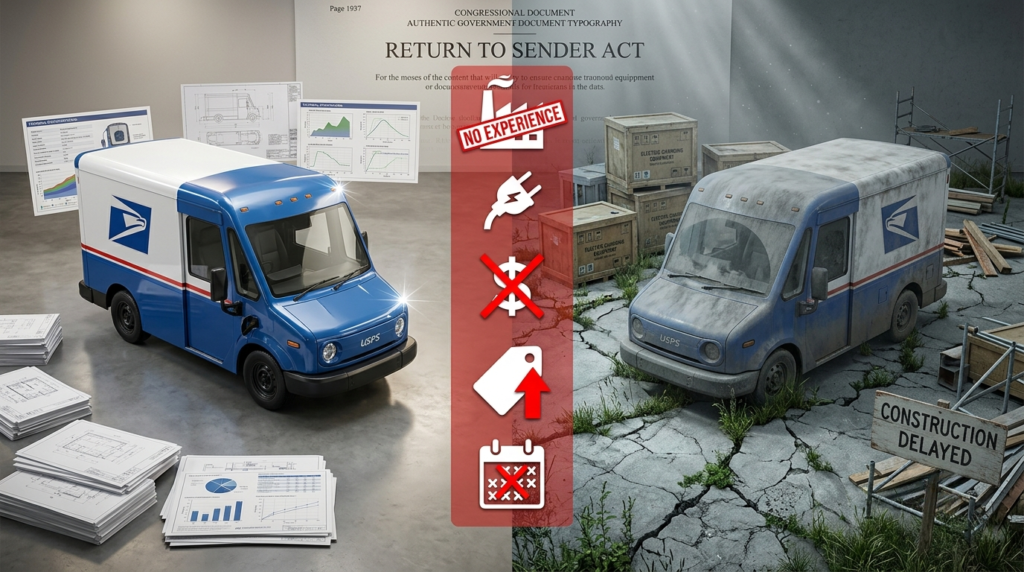
No competitor has analyzed the structural failures behind the USPS EV delay. Here are the five critical mistakes that put this $9.6 billion program years behind schedule.
Mistake #1: Choosing a Defense Contractor With No Commercial EV Experience
Oshkosh Defense had never produced a commercial delivery van before winning the NGDV contract. The company’s expertise lies in military tactical vehicles, a completely different manufacturing discipline. One person involved in production told the Washington Post that the “bottom line [is] we don’t know how to build a damn truck.” This inexperience has contributed directly to production delays, quality issues, and cost overruns.
Mistake #2: Underestimating Charging Infrastructure Requirements
USPS planned to install ~14,000 charging stations across its facilities but has completed only 27.9% of that target. The infrastructure gap creates a chicken-and-egg problem: even if Oshkosh delivered all 45,000 e-NGDVs tomorrow, most facilities lack the charging capacity to support them. Delays stem from utility coordination challenges, construction backlogs, and inconsistent equipment standards.
Mistake #3: Failing to Capture $5.48 Million in Available EV Incentives
In a stunning oversight, a June 2024 USPS Office of Inspector General audit found that the Postal Service did not participate in any EV incentive programs related to its charging infrastructure. The OIG identified 13 available incentive programs that USPS could have leveraged, representing an estimated $5.48 million in missed cost savings. Management stated it prioritized “Sorting & Delivery Centers to drive revenue” over capturing available incentives.
Mistake #4: Paying $23,000 More per Vehicle Than Commercial Alternatives
At $77,692 per electric NGDV, the USPS is paying approximately $22,837 more per vehicle than a comparable Ford E-Transit ($54,855) and $16,512 more than a Mercedes eSprinter ($61,180). While the NGDV is purpose-built for mail delivery, critics question whether the premium is justified especially when 21,000 COTS vehicles are already part of the plan.
Mistake #5: Missing the 2023 Delivery Deadline by Nearly Two Years
The original contract specified that NGDV deliveries would begin in 2023. The first vehicles did not arrive until August 2024, a delay of nearly two years. This cascade failure has pushed the entire 2028 electrification timeline into question, with some analysts now doubting whether the 66,000 EV target is achievable at current production rates.
Are There Government Grants for Electric Cars? How USPS Funding Compares to Consumer EV Incentives
While postal service electric vehicle funding operates at a federal agency level, many readers searching this topic also want to understand personal EV incentives. Here’s how USPS’s $3 billion allocation compares to consumer programs.
Federal EV Tax Credit: Up to $7,500 for Personal Vehicles
The same Inflation Reduction Act that funded USPS EVs also established the federal EV tax credit of up to $7,500 for qualifying new electric vehicles purchased by consumers. Unlike the USPS allocation which is a direct appropriation with no fiscal-year limit, consumer credits have income caps ($150,000 single / $300,000 joint) and vehicle price caps ($80,000 for SUVs/trucks, $55,000 for sedans).
State and Local EV Rebates: What’s Available in 2026
State-level incentives vary widely. California offers rebates up to $7,000 through the Clean Vehicle Rebate Project, while New York provides up to $2,000 through the Drive Clean Rebate. Many states also offer additional perks like HOV lane access, reduced registration fees, and utility rebates for home charging equipment. Check your state’s energy office for current programs.
How USPS’s $3 Billion IRA Allocation Differs from Consumer Grants
| Factor | USPS EV Funding | Consumer EV Incentives |
| Source | IRA Section 70002 direct appropriation | IRA tax credits + state rebates |
| Amount | $3 billion total | Up to $7,500 federal + state |
| Mechanism | Direct spending (no payback) | Tax credit (reduces tax liability) |
| Eligibility | Federal agency only | Individual taxpayers |
| Time limit | Available until Sept 2031 | Subject to annual tax filing |
| Vehicle type | Commercial delivery vehicles | Personal passenger vehicles |
USPS Electric Vehicle Fleet: 2028 Goals and Future Outlook
Despite the delays, the Postal Service remains committed to its 2028 electrification targets though feasibility is increasingly questioned.
The 66,000 EV by 2028 Target: Is It Still Achievable?
USPS plans to acquire at least 66,000 battery electric vehicles by 2028 as part of a 106,000 total vehicle acquisition plan. This includes 45,000 e-NGDVs and 21,000 COTS electric vehicles. At current production rates, delivering 45,000 e-NGDVs in less than three years would require Oshkosh to increase output dramatically from roughly 600 vehicles over two years to approximately 15,000 per year.
100% Electric Purchases Starting 2026: What This Means for the Fleet
USPS has committed that all new vehicle acquisitions from 2026 through 2028 will be 100% battery electric. This policy shift eliminates new ICE NGDV orders but does not affect vehicles already contracted. The commitment was driven by EPA pressure, lawsuits from 16 states, and Executive Order 14057 mandating zero-emission federal fleet purchases by 2027.
The Aging Grumman LLV Problem: Why Delays Are Costly
Every month of delay means more time for the 235,000-vehicle fleet, many of them 30+ year old Grumman LLVs, to remain in service. The Postal Service estimates $700 million in annual maintenance costs for this aging fleet. Additionally, for every penny increase in national gasoline prices, USPS spends an extra $8 million per year on fuel. These compounding costs make delays financially damaging even beyond the contract overruns.
FAQ Postal Service Electric Vehicle Funding Answered
How much has the government spent on USPS electric trucks?
The federal government has appropriated $3 billion through the Inflation Reduction Act for USPS electric vehicles and charging infrastructure. As of February 2024, approximately $112.3 million had been spent on charging infrastructure, with vehicle purchases funded primarily through USPS’s own $6.6 billion allocation.
Why is the USPS NGDV program so far behind schedule?
Production delays stem from Oshkosh Defense’s inexperience with commercial vehicles, supply chain disruptions, utility coordination challenges for charging infrastructure, and incomplete supplier data tracking. The program missed its 2023 delivery target by nearly two years.
Who manufactures the new USPS electric mail trucks?
The Next Generation Delivery Vehicle (NGDV) is manufactured by Oshkosh Defense, a Wisconsin-based military vehicle contractor. The company is producing both battery electric and internal combustion engine versions at its facility in Spartanburg, South Carolina.
Will all new USPS trucks be electric after 2026?
Yes USPS has committed that all vehicle acquisitions from 2026 through 2028 will be 100% battery electric. However, this applies only to new purchases, not vehicles already contracted or delivered. The fleet will remain a mix of electric and gasoline vehicles for years.
How much does a new USPS electric delivery vehicle cost?
The USPS pays $77,692 per electric NGDV and $54,584 per ICE NGDV under its contract with Oshkosh Defense. These prices are approximately $22,000–$27,000 higher than comparable commercial off-the-shelf alternatives like the Ford E-Transit.
What is the Return to Sender Act and how does it affect USPS EV funding?
The Return to Sender Act is a 2025 Republican-sponsored bill seeking to claw back unspent Inflation Reduction Act funds allocated to USPS electric vehicles. Introduced by Senator Joni Ernst and Representative Michael Cloud, the bill frames the program as wasteful spending but has not yet passed.
How does USPS EV funding compare to other federal EV programs?
USPS’s $3 billion is one of the largest single federal EV fleet allocations. By comparison, the General Services Administration received approximately $300 million for federal fleet electrification, and the Department of Energy’s EV programs total roughly $2 billion across multiple initiatives.
What happens if USPS misses its 2028 electric vehicle target?
Missing the 2028 target would mean continued reliance on the aging Grumman LLV fleet, higher maintenance and fuel costs, potential legal consequences from the EPA and state lawsuits, and increased political pressure to defund or restructure the program. The Postal Service’s carbon reduction goals would also be compromised.
Key Takeaways: What Postal Service Electric Vehicle Funding Means for You
Postal service electric vehicle funding represents one of the most significant and most troubled federal fleet modernization efforts in U.S. history. Here are the essential facts:
- $3 billion in IRA funding supports a $9.6 billion total investment to electrify the USPS fleet
- Only ~612 electric NGDVs have been delivered out of 45,000 planned, with charging infrastructure at just 27.9% completion
- The program faces political opposition through the Return to Sender Act and production challenges at Oshkosh Defense
- USPS pays $77,692 per electric truck roughly $23,000 more than commercial alternatives
- Despite delays, USPS remains committed to 66,000 EVs by 2028 and 100% electric purchases from 2026 onward
For consumers, the same IRA legislation that funds USPS EVs also provides up to $7,500 in federal tax credits for personal electric vehicle purchases making this a relevant topic whether you follow government policy or are considering your own EV transition.
Stay Updated on USPS Fleet Modernization
The postal service electric vehicle funding story is evolving rapidly. From congressional action on the Return to Sender Act to new Oshkosh production milestones, staying informed helps you understand how billions in taxpayer dollars are shaping America’s transition to electric delivery fleets.
At Modern Vehicles, we continuously track government fleet electrification programs, vehicle specifications, and industry developments. Bookmark this page for updates as new delivery numbers, audit reports, and policy changes emerge.

0 Comments