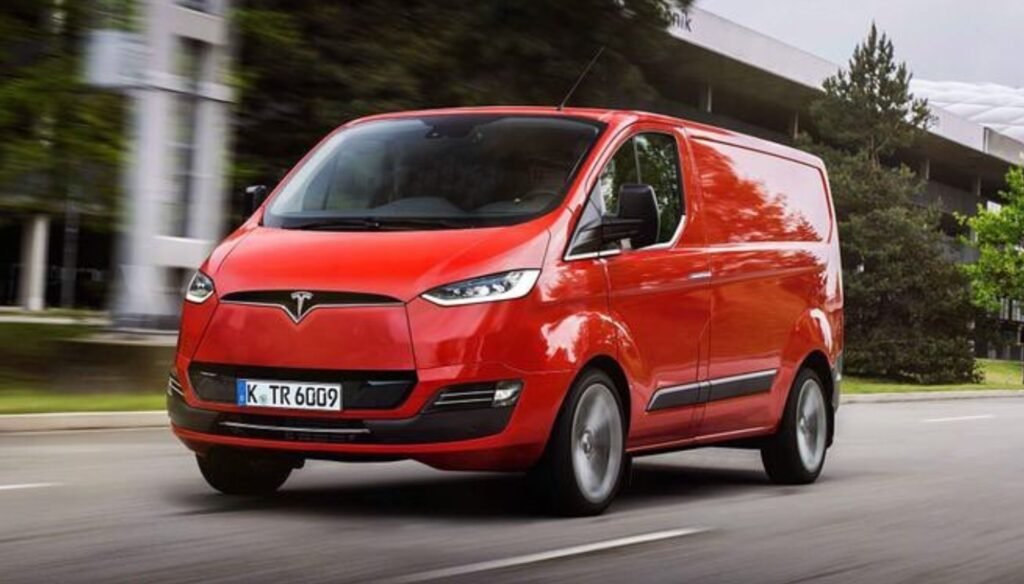
Type “Tesla Van” into Google right now and you’ll get a mess. Some articles confidently list a starting price. Others show sleek renderings that look official but aren’t. A few are years old and just got re-dated to look current. If you’ve spent any time digging through this, you’ve probably come away more confused than when you started, and honestly, that confusion is pretty justified.
So let’s slow down and actually sort through this properly — what Tesla has shown, what Elon Musk has actually said (versus what people assume he meant), what’s been spotted in the wild, and what’s still just guesswork dressed up as reporting.
First, the Part Nobody Wants to Hear: It’s Not Real Yet
Not in the sense people are looking for it, obviously. As of early 2026, there’s no such thing as the “Tesla Van” on Tesla’s website in terms of a model with price tags and order buttons, and the name isn’t final either. No delivery window exists. If you’ve seen a “2026 Tesla Van pricing” article with specific numbers, treat it the same way you’d treat a stranger telling you they know next week’s lottery numbers.
That said — and this is the part that actually makes this topic worth writing about — something real is clearly happening behind the scenes. There’s a genuine concept vehicle, a very public tease from Musk, a mystery prototype spotted at Tesla’s factory, and reports of active hiring for a new vehicle program. None of that is nothing. It’s just not a finished product yet, and pretending otherwise does readers a disservice.
The Robovan: Where This Whole Story Actually Starts
Rewind to October 2024, Tesla’s “We, Robot” event. Along with the well-known Cybercab, there was introduced the Robovan – a huge, boxy vehicle designed for autonomous operation without the steering wheel and pedals, intended to transport many people at once. About 20 people per each car, according to Musk, so we get close to a small bus rather than a van.
The design philosophy behind it wasn’t “comfortable road trip vehicle.” It was “urban transport at scale.” Think airport shuttles, corporate campus loops, dense city transit routes — situations where you need to move a lot of bodies efficiently without a human driver behind the wheel. It’s a genuinely interesting concept, and it’s real in the sense that Tesla actually built and showed it. But a stage concept isn’t a production timeline, and Tesla has a long history of showing things years before — or sometimes instead of — actually building them.
Then Musk Said the One Sentence Everyone’s Been Chewing On
Jump forward to late March 2026. An enthusiastic person on X asked Musk something like that: “Any chance of a Tesla minivan?” His response was short, vague, and instantly viral in Tesla circles: something “way cooler than a minivan” is coming.
That’s it. That’s the whole quote. And yet it’s spawned dozens of articles, countless speculative renderings, and a small industry of YouTube videos trying to decode seven words. Which, if you know anything about how Musk communicates, tracks pretty well with his usual pattern — drop a vague, exciting-sounding hint, let the internet spiral, clarify little to nothing for months.
Here’s the thing though: “cooler than a minivan” doesn’t actually tell us what it is. It just tells us what it isn’t — apparently, a boring one. From there, people have filled in the blanks in a few different directions.
Three Competing Theories, and Why None of Them Are Confirmed
Theory one: it’s a production Robovan. This is the most straightforward reading. Tesla already has a van-shaped concept sitting around; maybe Musk is just teasing that it’s finally moving toward reality, possibly reworked for private ownership instead of pure fleet use.
Theory two: it’s the so-called “CyberSUV.” This is a name the fan community and auto press coined themselves — Tesla has never used it officially — for a long-rumored, Cybertruck-styled SUV. It’s been floating around for years but never actually come to fruition. But in case Musk was referring to something in particular, we’re looking at something angular, flat-paneled, and definitely inspired by the Cybertruck and not some traditional van design.
Theory three: he’s talking about something that already exists — sort of. Some analysts think Musk may have been subtly steering the conversation toward the Model Y L, Tesla’s longer, three-row version of the Model Y that’s already selling in international markets like Australia and Thailand. It’s not new, and it’s not particularly “cooler than a minivan” on paper, but it is a genuine answer to “I want more interior space” that Tesla can point to today rather than in some future quarter.
Tesla hasn’t confirmed any of these. Musk hasn’t clarified further. And realistically, he may not have even had one specific vehicle in mind when he typed that reply — it wouldn’t be the first time an offhand tweet got treated as a formal product roadmap by people who don’t work at Tesla.
Something Was Spotted at Giga Texas, and the Timing Is Suspicious
A few days before Musk’s tweet, Tesla watchers who keep an eye on activity around Giga Texas noticed an unfamiliar vehicle frame — something that didn’t match any currently known Tesla model. On its own, that’s the kind of thing that gets dismissed as “probably a jig or a test rig for something unrelated.” But when combined with the timing of the comment just days ago, as well as the fact that Tesla has been making several hires in a prototype vehicle program, it begins to look like more than coincidence but the beginnings of an actual form for this mystery product.
Of course, this doesn’t give us any information on what this is or what it does. Prototype mules get disguised, re-bodied, and repurposed constantly during development, and factory sightings have led plenty of Tesla-watchers down wrong paths before. But it’s a real, physical signal, which is more than most rumors in this space usually get.
Why Tesla Even Wants This Right Now
And it would be wise to take a step back here, because the way all of this has timed is no coincidence.
Tesla just stopped selling the Model S and Model X, reducing the number of models in their consumer range to the Model 3, Model Y, and Cybertruck only. This really leaves a gap for people looking for something bigger than a Model Y but not interested in trucks – families bigger than five, people towing stuff around, literally everyone outgrowing the current line-up.
There’s also a longer-running thread here that goes back years. High-passenger-density urban transportation was specifically noted in Tesla’s “Master Plan Part 2” as an area where Tesla planned to introduce electric vehicles outside its regular consumer range. This led to the creation of the Semi, and then the Cybercab and Robovan. And thus, this is by no means a completely new thought that popped up in Musk’s head back in March 2026 – it’s an ambition which has been lingering around for years now.
What About Actual Numbers — Price, Range, Seating?
Here’s where I want to be really direct with you: nobody outside of Tesla knows these numbers. Not analysts, not YouTubers, not the sites publishing confident-looking spec tables. If Tesla hasn’t said it publicly, it isn’t real yet, no matter how official a chart looks.
What can be reasonably inferred — not promised, inferred — based on how Tesla has built everything else in its lineup:
Whatever this turns out to be will almost certainly share a lot of DNA with existing Tesla platforms rather than being engineered completely from scratch. Tesla doesn’t have a great track record of building brand-new architectures from zero (the Cybertruck being a partial exception, and even that borrowed heavily from existing drivetrain tech). Expect shared battery packs, shared motors, and shared software underneath whatever new sheet metal shows up.
If it leans toward the Robovan direction, prioritize passenger count and interior space over performance numbers — this isn’t shaping up to be a vehicle bragging about 0-60 times.
If it leans toward the CyberSUV direction, expect styling cues lifted straight from the Cybertruck — flat panels, sharp angles, that stainless-steel-adjacent aesthetic — positioned as a larger, pricier alternative to the Model Y rather than a budget family hauler.
That’s genuinely as far as responsible speculation can take you right now. Anyone giving you a specific dollar figure or a specific mile range is guessing, possibly confidently, but still guessing.
Timing: The Most Unreliable Part of This Entire Story
If there’s one lesson from nearly a decade of “Tesla van” chatter, it’s this: don’t trust the release dates. Tesla has talked about some version of a van, minibus, or high-capacity people-mover since at least the mid-2010s, and predicted debut years have come and gone more than once without anything materializing.
What’s different in 2026 is that there’s now physical evidence — a spotted prototype, a hiring push — suggesting actual engineering work is underway, not just talk. That’s a meaningfully different situation than a tweet with no follow-through. Yet “in active development” and “confirmed release date” are two very different statements, and Tesla’s past shows us that the difference between these two tends to be much greater than people might expect.
Quick Comparison: Robovan vs. CyberSUV vs. Model Y L
As these three tend to get mixed up in a lot of articles, here is how you can tell them apart:
Robovan is the name for a big, fully autonomous vehicle that doesn’t have a steering wheel and is meant for commercial use instead of being owned by individuals.
CyberSUV is not a confirmed name but rather an unofficial term for a long-rumored SUV inspired by Cybertruck for consumers looking for a larger and more rugged version of Model Y.
Model Y L is a real thing available for ordering in selected international markets. It is simply an extended version of the regular Model Y with a third row of seats added.
It is possible that Musk was talking about any of these vehicles or some other one altogether.
How This Stacks Up Against What Everyone Else Is Doing
It’s worth remembering Tesla isn’t operating in a vacuum here. Volkswagen has its ID. Buzz, a genuinely retro-styled electric van that’s already selling. Rivian has talked about van variants beyond its commercial Amazon delivery vehicles. Ford and other legacy automakers have their own electric van and minivan pushes in various stages. Tesla is, in a lot of ways, playing catch-up in this specific segment rather than pioneering it — which might actually explain some of the pressure behind Musk’s recent comments. “Family hauler” and “urban transport” markets have become increasingly saturated, and the current product lineup of Tesla has not yet answered in this regard, unlike the company’s competitors.
What’s Actually Worth Watching Going Forward
If you wish to monitor this yourself instead of simply reading speculation every few weeks, there are a few things that are truly worth looking out for: the quarterly earning calls from Tesla, during which Elon Musk will sometimes reveal product info amidst all the usual investment babble; any development related to “Master Plan Part 4,” which has seen Tesla change its focus to include AI, robotics and autonomy, thus possibly sidelining the personal use van despite plans for the Robovan; and continued appearances in Giga Texas, which has proven historically to be among the most reliable early indicators of upcoming Tesla vehicle releases.
Frequently Asked Questions
Is there an officially confirmed Tesla Van?
No — not as a named, priced consumer product. There’s a real concept called the Robovan, a vague but genuine tease from Musk, and a spotted prototype, but nothing Tesla has officially confirmed as a purchasable van.
Is the Robovan just the Tesla Van under a different name?
Maybe, but not necessarily. The Robovan was shown as an autonomous, high-capacity vehicle aimed mostly at commercial and fleet use. Whether it evolves into something available to regular buyers, or stays a fleet-only product, isn’t clear yet.
What will it cost?
Unknown in nature. There are no set prices and any price quoted online is mere conjecture — regardless of how certain it may sound.
When is it coming out?
Also unknown. Signs point to active development happening in 2026, based on hiring activity and prototype sightings, but there’s no confirmed release date from Tesla.
What’s the actual difference between the Robovan, CyberSUV, and Model Y L?
The Robovan is an autonomous, high-capacity vehicle that is primarily used for commercial transportation purposes. The CyberSUV is an unofficial name given to a reported Cybertruck-inspired SUV that has not been verified by Tesla at all. The Model Y L is an actual variant of the Model Y available internationally.
Why did Tesla drop the Model S and Model X if it’s talking about new vehicles? Discontinuing those two narrowed Tesla’s lineup down to the Model 3, Model Y, and Cybertruck, which actually strengthens the case for something new — Tesla now has a noticeable gap for buyers who want more space or capacity than its current lineup offers.
Conclusion
Strip away the hype, and here’s where things actually stand: a real concept exists in the Robovan, Musk has publicly teased something new without naming it, a prototype has been spotted at Giga Texas, and Tesla appears to be actively hiring for the project behind the scenes. That’s a genuinely more concrete set of signals than Tesla’s van talk has produced in years. But price, specs, and a release date are still unconfirmed, and until Tesla says something directly, the most reliable approach is treating every “official” number you see online with a healthy dose of skepticism — and waiting for Tesla to actually say it themselves.
0 Comments