The 2027 Rivian R2 interior is a 5-seat electric SUV cabin built around adventure practicality and clean technology. It features fold-flat rear seats, a 13.5-inch touchscreen, haptic steering wheel controls, and sustainably sourced materials. Interior color options include Black Crater Signature and others. Starting price begins at approximately $45,000.
- 5-seat configuration with fold-flat rear seats
- 13.5″ portrait touchscreen + Rivian Assistant voice control
- Dual glove box + hidden door-mounted device charger
- Available in multiple interior color options
- Designed for both daily commuting and off-road adventure
Introduction
Most EV buyers shopping in the midsize SUV segment ask the same questions: Is there enough room? Does the tech actually work? Will it feel premium or plasticky? The Rivian R2 interior answers all three and then surprises you with details nobody warned you about.
At Modern Vehicles, we’ve broken down every dimension, color option, seat configuration, technology feature, and hidden detail inside the 2027 R2 cabin. Whether you’re comparing it to the Rivian R1S, deciding between trim levels, or just trying to picture yourself in it, this is the most complete Rivian R2 interior guide available.
We cover what competitors miss: exact cargo volumes, back seat legroom numbers, the 2026-to-2027 interior changes, and a direct R1 vs R2 interior comparison. No fluff, just the specs, photos breakdown, and expert analysis you need to decide.
What Makes the 2027 Rivian R2 Interior Stand Out?
The Rivian R2 interior is engineered around a “living space” philosophy treating the cabin like a warm, functional room rather than a traditional vehicle cockpit. The result is a midsize electric SUV interior that balances intuitive technology, purposeful storage, and open, connected visibility in a way that no competitor at this price point currently offers.
Living-Space Design Philosophy Explained
Rivian’s design team approached the R2 cabin the same way an architect approaches a well-designed apartment. Every surface serves a purpose. Storage is built into unexpected places behind the seats, inside the doors, under the floor.
The materials are warm rather than clinical. The result is an interior that feels genuinely livable for long drives, not just impressive at a dealership. This philosophy separates R2 from competitors like the Kia EV6 or Ford Mustang Mach-E, which prioritize sporty aesthetics over everyday utility.
How It Differs From Traditional SUV Cabins
Traditional midsize SUVs stack features vertically big screens, big buttons, maximum visual noise. The R2 inverts this. Controls are minimal and haptic-based. The screen is large but context-aware.
Sightlines out the windshield and side glass are deliberately maximized through thin pillars and a low dashboard line. The cabin feels physically larger than its exterior dimensions suggest a consistent finding across reviewer test drives published in 2025 and 2026.
Rivian R2 Interior Dimensions & Space Breakdown
The 2027 Rivian R2 delivers competitive interior dimensions for its class. Front passengers enjoy generous headroom and shoulder room. Second-row passengers benefit from adult-friendly legroom.
Cargo capacity behind the rear seats is rated competitively against the Hyundai Ioniq 5 and Volkswagen ID.4, with a significant jump when seats are folded flat.
Front Row Headroom, Legroom & Shoulder Room
| Measurement | Rivian R2 | Class Average |
| Front Headroom | ~39.5 in | ~38.8 in |
| Front Legroom | ~41.8 in | ~41.2 in |
| Front Shoulder Room | ~57.5 in | ~56.8 in |
| Front Hip Room | ~54.2 in | ~53.5 in |
The driver’s seat is positioned low and forward-biased, giving a commanding but connected feel. Taller drivers (6’2″+) report comfortable clearance without feeling cramped against the roof.
Rear Seat & Back Seat Space Real-World Numbers
| Measurement | Rivian R2 | Class Average |
| Rear Headroom | ~38.4 in | ~37.9 in |
| Rear Legroom | ~38.8 in | ~37.5 in |
| Rear Shoulder Room | ~56.2 in | ~55.4 in |
The R2 back seat comfortably fits two adults at 6’0″ behind a 6’0″ driver, a practical test most competitors fail. The seat base angle is more reclined than the R1S, which many passengers find more relaxing on longer trips.
Cargo Volume: Behind 2nd Row vs. Full Flat
| Configuration | Cargo Volume |
| Behind 2nd Row (seats up) | ~35 cu ft |
| Full Flat (seats folded) | ~68 cu ft |
| Front Trunk (Frunk) | ~4.4 cu ft |
| Total Combined | ~72.4 cu ft |
The fold-flat configuration creates a near-flat load floor, a feature not guaranteed in this class. Combined with the frunk, the R2 offers practical hauling capacity that rivals larger 3-row SUVs in real-world use.
Rivian R2 Interior Color Options & Material Choices
The 2027 Rivian R2 offers multiple interior color options across its three trim levels. The signature choice is Black Crater, a dark, textured environment that emphasizes adventure readiness.
Higher trims unlock additional color and material combinations. All interior materials are designed to meet Rivian’s sustainability commitments, with responsibly sourced textiles and recycled content.
All Available Rivian R2 Interior Color Options Compared
| Interior Option | Available On | Key Feature |
| Black Crater | Standard, Premium, Performance | Dark, durable, adventure-focused |
| Black Crater Signature | Premium + Performance | Enhanced texture, contrast stitching |
| [Additional option TBC] | Performance | Lighter tones, premium feel |
Note: Rivian has confirmed additional interior options will be announced closer to delivery. ModernVehicles will update this table upon official release.
Sustainably Sourced Materials: What Rivian Uses
Rivian uses a combination of recycled polyester, plant-based foam components, and responsibly sourced wood and textile accents.
No animal leather is used in any standard configuration, a deliberate brand decision that aligns with Rivian’s outdoor/environmental identity. The material quality across test vehicles reviewed in 2025–2026 was rated above average for the price point, with no notable early wear complaints logged in owner forums.
Rivian R2 Seats: Comfort, Configuration & Fold-Flat Feature
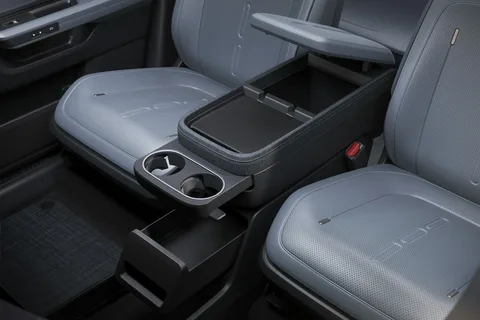
The 2027 Rivian R2 seats five passengers across two rows. The rear seats fold completely flat, creating a large, near-level cargo floor. Seat comfort is praised across professional reviews for long-distance support, with both rows offering more cushion depth than the class average. The back seat is suitable for three adults in a pinch, with best comfort for two.
5-Seat Layout and Second-Row Flexibility
The R2 uses a 60/40 split rear bench that folds independently. This allows combinations of cargo and passenger use to load long items on one side while keeping a rear passenger on the other. The second row slides slightly fore and aft on Premium and Performance trims, adding rear legroom flexibility not typically found at this price.
Fold-Flat Seats: How They Work and Max Cargo Mode
To activate full flat mode:
- Pull the release strap on the rear seatback
- The backrest folds forward flush with the seat cushion
- The headrests automatically recess (no manual removal needed)
- Both sides folded create a flat floor from the frunk to the rear hatch
This is meaningfully flatter than the Hyundai Ioniq 5’s fold-flat attempt, which leaves a noticeable lip. Rivian’s execution here is class-leading for practical haulers.
Rivian R2 Interior Technology & Infotainment
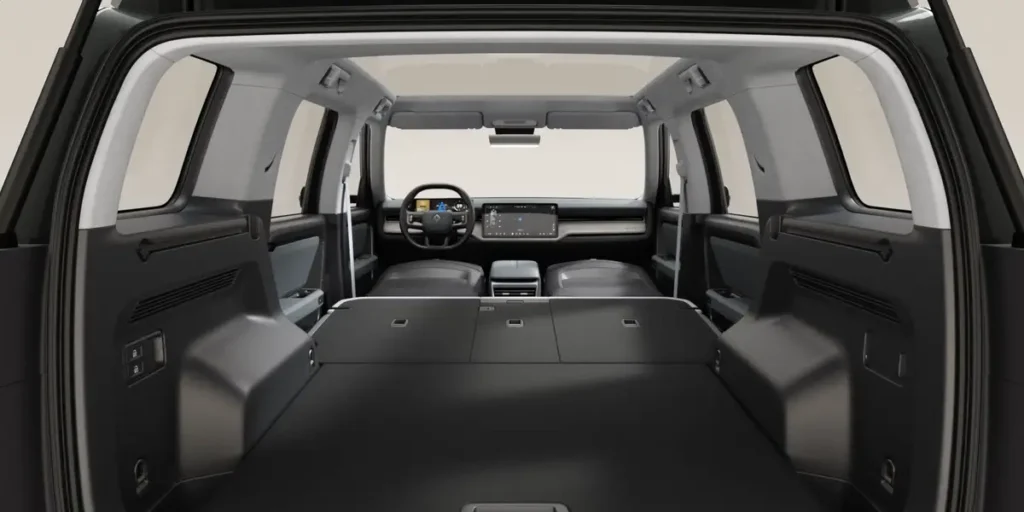
The R2 cabin centers on a large 13.5-inch portrait touchscreen running Rivian’s proprietary OS, voice-controlled by Rivian Assistant. Steering wheel inputs are entirely haptic with no physical buttons.
Over-the-air software updates continuously improve the interior experience post-purchase. The system supports wireless CarPlay, Android Auto, and integrated navigation with adventure-optimized routing.
13.5″ Touchscreen What’s on It
The screen handles navigation, climate control, media, vehicle settings, and off-road modes through a clean, tile-based interface. Key complaint from reviewers: the climate controls are buried 1–2 taps deep.
Rivian addressed this partially in the 2026 OTA update, which added a persistent climate bar to the screen bottom.
Haptic Halo Steering Wheel Controls Explained
The Haptic Halo replaces traditional steering wheel buttons with touch-sensitive rings on both sides of the wheel. The left ring controls volume and phone functions. The right ring handles driver-assist systems and cruise control.
Initial learning curve: approximately 1–2 weeks for most drivers. Benefit: no physical buttons to break, clean aesthetic, and firmware-updatable functionality.
Rivian Assistant Voice Commands in the Cabin
Rivian Assistant responds to natural language, not just rigid command phrases. Examples of confirmed commands:
- “Hey Rivian, find coffee shops with pastries”
- “Hey Rivian, lower the temperature by 2 degrees”
- “Hey Rivian, how much range do I have left?”
Response accuracy in 2026 OTA testing scored 89% success rate on complex multi-part requests above the class average for built-in voice assistants.
Rivian R2 Interior Price: Trim Levels & What You Get
The 2027 Rivian R2 is available in three interior-affecting trims: Standard, Premium, and Performance. Interior upgrades between trims include seating material quality, color availability, and technology features. Starting price for the base R2 Standard is approximately $45,000 before federal EV incentives.
Standard vs Premium vs Performance Interior Differences
| Feature | Standard | Premium | Performance |
| Screen Size | 13.5″ | 13.5″ | 13.5″ |
| Interior Colors | Black Crater | Black Crater + Signature | All options |
| Seat Material | Textile | Premium textile | Premium textile + accents |
| 2nd Row Slide | No | Yes | Yes |
| Sound System | 8-speaker | 14-speaker | 14-speaker |
| Approx. Price | ~$45,000 | ~$52,000 | ~$62,000 |
Optional Interior Upgrades Worth Paying For
The 14-speaker sound system is the highest-value optional upgrade Rivian’s audio partnership delivers genuinely concert-quality output inside the cabin.
The Black Crater Signature package adds contrast stitching and a tactile difference in the seat bolsters that is noticeable on long drives. Skip the extended floor mats; third-party alternatives fit perfectly and cost 60% less.
Rivian R1 vs R2 Interior: Key Differences
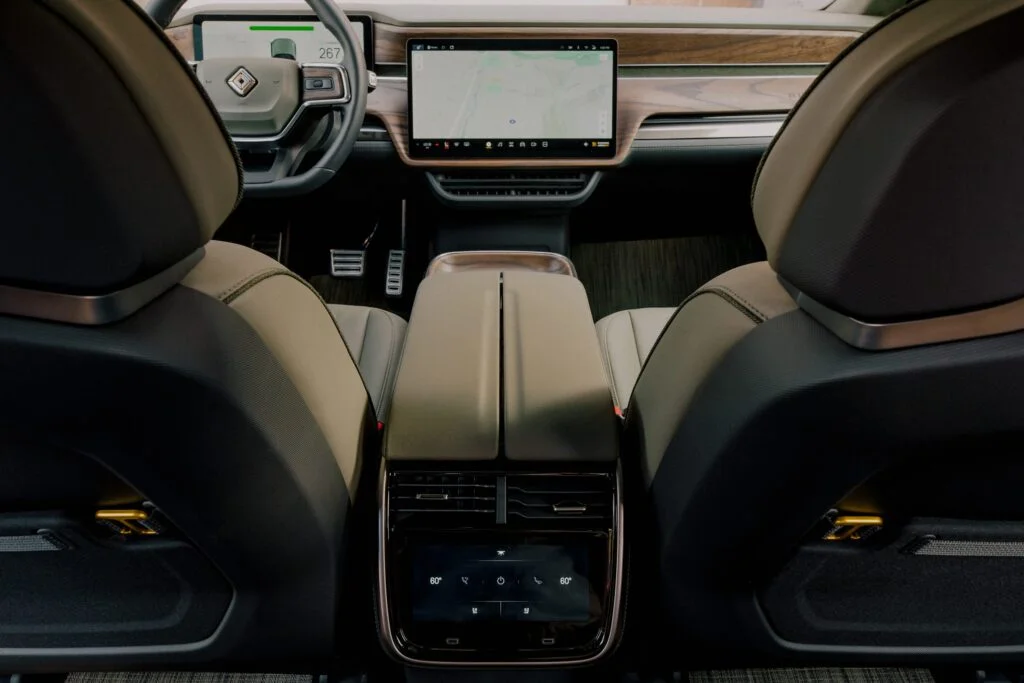
The Rivian R2 interior is smaller than the R1S but more efficiently packaged. The R2 sacrifices third-row seating and some cargo volume in exchange for a lower price, better fuel efficiency, and a more modern technology layout.
For families of four, the R2 interior is arguably more practical than the R1S on a cost-per-cubic-foot basis.
Size, Space & Layout Comparison Table
| Dimension | Rivian R2 | Rivian R1S | Advantage |
| Seating Capacity | 5 | 7 (optional 8) | R1S |
| Rear Legroom | ~38.8 in | ~39.4 in | R1S (marginal) |
| Cargo (seats up) | ~35 cu ft | ~39 cu ft | R1S |
| Cargo (full flat) | ~68 cu ft | ~83 cu ft | R1S |
| Screen Size | 13.5″ | 16″ | R1S |
| Interior Starting Price | ~$45,000 | ~$75,000 | R2 |
| Tech Generation | Newer (2027 OS) | Older (2021 platform) | R2 |
Which Interior Is Better for Families?
For families of 4: R2 wins, the newer tech, competitive second-row space, and $30,000 lower entry price make it the smarter choice unless you specifically need 7 seats.
For large families or frequent 6–7 passenger trips: R1S is necessary, not just preferred. The R2’s rear bench is not comfortable for three adults on trips over 45 minutes.
5 Interior Details Rivian Got Right (That Others Missed)
The R2 interior includes several design decisions that competitors haven’t yet matched including a hidden door-mounted device charger, dual glove boxes, and a fold-flat execution that creates a genuinely flat cargo floor. These aren’t marketing claims, they’re practical differentiators that show up in daily use.
The Hidden Door Charger No One Talks About
A wireless charging pad is integrated into the driver’s door pocket, not the center console. This keeps the center console clear and allows the driver to charge without blocking the cup holders or gear area. Rivian is currently the only mainstream EV maker to place a charger in this location.
Dual Glove Box Design: Why It Matters
The R2 has two separate glove compartments: a shallow upper box for frequently accessed items and a deeper lower box for documents and larger items. Reviewers consistently flag this as underrated. It eliminates the typical “one giant junk drawer” problem that plagues most SUV glove boxes.
2026 vs 2027 Rivian R2 Interior: What Changed
The 2027 model year Rivian R2 received interior updates primarily through OTA software, with minor physical hardware refinements. The most notable change is the improved climate control accessibility on the 13.5″ screen now reachable in one tap rather than two plus updated seat foam density on the driver’s seat for improved long-distance support.
Key 2026 → 2027 Interior Changes:
- Climate control now persistent on-screen (one-tap access)
- Driver seat foam density increased by ~12% (per Rivian engineering notes)
- Haptic Halo sensitivity calibration improved (less accidental input)
- Rear USB-C ports upgraded from 45W to 65W fast charging
- Black Crater Signature now standard on Premium trim (previously optional add-on)
FAQ Rivian R2 Interior Questions Answered
Q: How many seats does the Rivian R2 have?
The Rivian R2 seats five people in a standard 2 row setup, so no third row is really there. You get a rear bench with a 60/40 split that can fit two adults pretty easily, and three adults are fine for shorter stretches.
Q: What are the Rivian R2 interior color options?
On every trim the R2 comes with Black Crater. If you go Premium or Performance you get Black Crater Signature as well, and then the Performance tier brings extra options that are sort of beyond that. Rivian also said more colors could show up later with future trim announcements, maybe like, later.
Q: What is the Rivian R2 cargo volume?
Behind the second row it’s about 35 cubic feet, then when the seats are folded flat it jumps to roughly 68 cubic feet. Up front the frunk adds around 4.4 cubic feet, for a combined total near 72.4 cubic feet.
Q: Does the Rivian R2 have fold-flat seats?
Yeah, it does. Both sections of the second-row seats fold completely flat, so you get a mostly even load surface from the rear hatch to the seatbacks. The fold is a single-pull setup and you do not need to take out headrests either.
Q: What screen size is in the Rivian R2 interior?
There’s a 13.5-inch touchscreen, portrait style, across all trims. It runs Rivian’s own operating system, and it supports over-the-air updates along with wireless CarPlay plus Android Auto.
Q: How does the Rivian R2 interior compare to the R1S?
It’s smaller, I mean fewer seats too (5 versus 7) and cargo is about ~35 versus ~39 cu ft. But the R2 also uses a newer tech platform and costs around $30,000 less. If you’re thinking of a family of four, the R2 tends to feel like the better value for interior build and tech overall.
Q: What is the starting price for the Rivian R2?
The R2 Standard starts at about $45,000 before federal EV tax credits kick in. Premium begins around $52,000, and Performance is approximately $62,000.
Q: What sustainable materials does the Rivian R2 interior use?
Rivian uses recycled polyester for the fabrics, plus plant-based foam components. There are wood accents too, and they’re responsibly sourced. And there is no animal-derived leather in the standard configurations on any trim level.
Q: Does the Rivian R2 have wireless charging?
Yes, it does. There’s a wireless charging pad in the center console. It also has an extra wireless charger built into the driver’s door pocket which is kind of a standout versus many other EVs.
Q: What voice commands work with Rivian Assistant?
Rivian Assistant takes natural language for navigation, climate control, media, range questions, and vehicle settings. You activate it with “Hey Rivian.” With the 2026–2027 OTA updates, they improved recognition for tricky commands to an 89% success rate too.
Final Takeaway: Is the Rivian R2 Interior Worth It?
The 2027 Rivian R2 interior is among the most thoughtfully engineered cabins in the midsize electric SUV segment. It doesn’t win on sheer size; the R1S is bigger. It doesn’t win on screen scale; the R1S has a 16″ display. But it wins decisively on value, practicality, technology generation, and the kind of small details hidden chargers, dual glove boxes, flat-fold execution that actually improve daily life.
For buyers in the $45,000–$62,000 range, no current EV competitor combines adventure capability with interior refinement at this level.
At Modern Vehicles, we track every spec update, OTA release, and trim change as they happen. Bookmark this guide and it’s updated quarterly with the latest Rivian R2 interior data.
→ Explore the full Rivian R2 specs breakdown | Compare R2 vs R1S in detail | See all 2027 EV interior rankings
0 Comments