Yes, you can lease a Rivian in 2026. Rivian offers direct-to-consumer leasing through Chase Bank on the R1T truck, R1S SUV, and new R2 compact SUV. Monthly payments range from $829 for the R2 Performance to $2,029 for the R1S Quad Max on 36-month, 10,000-mile-per-year terms. The federal $7,500 EV tax credit ended September 30, 2025, but Rivian currently offers a $3,000 lease contribution on select Performance trims through July 31, 2026.
- R1T Dual Large: $1,179/mo | R1S Dual Large: $1,189/mo
- R2 Performance: $829/mo | Money Factor: .00181–.00369 (4.34%–8.86% APR)
- Due at signing: $5,724–$9,924 depending on trim and incentives
- Available in: 40+ U.S. states (see full list below)
Introduction
Leasing a Rivian in 2026 is more complex than it was a year ago. The federal EV tax credit is gone. R1 prices have climbed. And the hotly anticipated R2 Rivian’s “affordable” SUV leases at a surprisingly high monthly payment despite its lower sticker price.
Most lease guides regurgitate manufacturer numbers without explaining the math behind them. This guide does the opposite. We break down every Rivian lease by model, trim, and real-world cost. We explain why the R2 leases worse than the R1S. We show you how to calculate your own deal grade. And we flag the five mistakes that cost Rivian lease shoppers thousands.
Whether you’re comparing the R1T truck against the R1S SUV, deciding between 24 and 36 months, or trying to understand why your “affordable” R2 quote came back at $900+ per month, this guide gives you the full picture.
What Is a Rivian Lease? (Definition & How It Works)
A Rivian lease is a closed-end vehicle lease financed through Chase Bank and arranged directly through Rivian’s website with no dealership involved. You pay a monthly fee to use the vehicle for a fixed term (24 or 36 months), then return it or buy it at the predetermined residual value.
Rivian sets the price, residual, and money factor; your only variables are trim, term, mileage, and available incentives. Unlike traditional automakers, Rivian does not use franchised dealers. You configure or select an in-stock vehicle online, apply for credit, and take delivery at a Rivian service center or via mobile delivery. This direct model means the selling price is fixed and there is no haggling on MSRP.
How Rivian Leasing Differs from Traditional Dealership Leases
Traditional leases involve three parties: you, the dealer, and the lender. The dealer marks up the money factor, adds fees, and negotiates the selling price. Rivian eliminates the dealer layer entirely. The money factor, residual value, and acquisition fee are set by Chase Bank and published transparently on Rivian’s configurator.
This removes hidden dealer markups but also removes negotiation leverage. You cannot ask for a lower selling price; you can only optimize your trim selection, term length, and incentive timing.
Who Qualifies for a Rivian Lease?
Rivian requires “very well-qualified” lessees, which typically means a credit score of 720 or higher. You must reside in one of the 40+ eligible states and take delivery within the offer period.
A $500 deposit is required to place an order, and the vehicle must be ordered through the R1 Shop or configured online. Lease approval is subject to credit review by Chase Bank, not Rivian directly.
Rivian Lease States: Where Is Leasing Available?
As of July 2026, Rivian leases are available in: AK, AL, AR, AZ, CA, CO, CT, DC, DE, FL, GA, HI, ID, IL, LA, MA, MD, MI, MO, MS, MT, NC, ND, NE, NJ, NM, NV, NY, OH, OR, PA, RI, SD, TN, TX, UT, VA, VT, WA, WV. Note: Vehicle delivery in Alaska is not yet available, though leasing is technically offered.
Rivian R1S Lease Deals: 2026 Pricing by Trim
The 2026 Rivian R1S leases from $1,189 per month (Dual Large) to $2,029 per month (Quad Max) on 36-month, 10,000-mile terms. All offers require very well-qualified credit and delivery by August 31, 2026. The $3,000 lease contribution (available on Performance and Tri trims) reduces due-at-signing but does not lower the monthly payment.
| Trim | MSRP | Monthly Payment | Due at Signing | With $3K Contribution |
| R1S Dual Large | $83,990 | $1,189 | $9,084 | N/A |
| R1S Dual Large + Performance | $88,990 | $1,159 | $6,054 | ✅ Yes |
| R1S Dual Max | $90,990 | $1,309 | $9,204 | N/A |
| R1S Dual Max + Performance | $95,990 | $1,329 | $6,224 | ✅ Yes |
| R1S Tri Max | $106,990 | $1,599 | $6,494 | ✅ Yes |
| R1S Quad Max | $121,990 | $2,029 | $9,924 | N/A |
R1S Dual Motor Lease: The Sweet Spot for Most Buyers
The R1S Dual Large at $1,189/month is the entry point for most lease shoppers. It delivers 533 horsepower, 410 miles of EPA-estimated range, and seating for seven.
The Performance Upgrade ($5,000 add-on) drops the 0-60 time to 3.4 seconds and qualifies for the $3,000 lease contribution making the effective due-at-signing lower than the base Dual Large despite the higher MSRP.
For buyers who want value, the Dual Large without Performance is the cheapest monthly payment. For buyers who want the best deal structure, the Dual Large + Performance often wins.
R1S Tri Motor Lease: Performance vs. Cost
The Tri Max at $1,599/month adds 850 horsepower, a 2.9-second 0-60 time, and full-time all-wheel drive with auto-adjusting suspension. The $410 monthly premium over the Dual Large buys meaningful capability gains especially for off-road and towing use cases.
The Tri also qualifies for the $3,000 contribution, reducing due-at-signing to $6,494. If you need the power, the Tri is justifiable. If you don’t, the Dual Large + Performance offers 90% of the daily-driving experience at $440 less per month.
R1S Quad Motor Lease: Is the Flagship Worth It?
At $2,029/month, the Quad Max is a statement purchase, not a value play. It delivers 1,100+ horsepower and the most aggressive off-road calibration Rivian offers. However, the $430 monthly jump from the Tri Max is difficult to justify on lease math alone.
The Quad does not qualify for the $3,000 contribution, pushing due-at-signing to $9,924. Lease this trim only if you specifically need maximum power and plan to buy out the lease at residual.
Rivian R1T Lease Deals: 2026 Truck Pricing Breakdown
The 2026 Rivian R1T leases from $1,179 per month (Dual Large) to $1,979 per month (Quad Max). Pricing mirrors the R1S closely, with the truck commanding a $10–$50 monthly discount versus the equivalent SUV trim. The R1T’s lower lease cost is counterintuitive given its utility, but Rivian prices the R1S at a slight premium due to higher SUV demand in the luxury EV segment.
| Trim | MSRP | Monthly Payment | Due at Signing | With $3K Contribution |
| R1T Dual Large | $79,990 | $1,179 | $9,074 | N/A |
| R1T Dual Large + Performance | $84,990 | $1,149 | $6,044 | ✅ Yes |
| R1T Dual Max | $86,990 | $1,299 | $9,194 | N/A |
| R1T Dual Max + Performance | $91,990 | $1,319 | $6,214 | ✅ Yes |
| R1T Tri Max | $100,990 | $1,559 | $6,454 | ✅ Yes |
| R1T Quad Max | $115,990 | $1,979 | $9,874 | N/A |
R1T Dual Motor Lease: Best Truck Lease Value
The R1T Dual Large at $1,179/month is the cheapest way into a Rivian lease as of July 2026. It offers 533 horsepower, a 420-mile EPA range, and the R1T’s signature gear tunnel storage.
For truck buyers comparing against the Ford F-150 Lightning or Chevrolet Silverado EV, the R1T Dual Large is competitively priced especially when factoring in Rivian’s superior charging network via the NACS port.
R1T Tri Motor Lease: Towing & Off-Road Power
The R1T Tri Max at $1,559/month is the towing and off-road sweet spot. With 850 horsepower and a 11,000-pound tow rating, it outperforms most gasoline trucks in its price class. The $3,000 lease contribution applies, making the due-at-signing manageable at $6,454.
For buyers who tow regularly or plan off-road adventures, the Tri justifies its premium. For pavement-only drivers, the Dual Large + Performance delivers sufficient acceleration at $410 less per month.
R1T vs. R1S Lease: Which Costs Less Per Month?
The R1T costs $10–$50 less per month than the equivalent R1S trim. At the Dual Large level, the R1T saves $10/month. At the Tri Max level, the gap widens to $40/month. The R1S commands a premium because SUVs historically retain value better than trucks in the luxury segment, and Rivian’s residual calculations reflect this. If you are indifferent between body styles, the R1T is the marginally cheaper lease and the only way to get the gear tunnel.
Rivian R2 Lease Price: The $829/Month Reality Check

The 2026 Rivian R2 Performance with Launch Package leases at $829 per month with $5,724 due at signing but the math behind that payment is worse than the R1S. The R2’s money factor is .00369, equivalent to 8.86% APR.
That is nearly double the R1’s money factor of .00181 (4.34% APR) and makes the R2 a poor lease value despite its $57,990 MSRP. Here’s the paradox: the R2 costs $26,000 less than the R1S Dual Large but leases at a payment that is only $360 lower per month.
The culprit is the money factor. On the R1S, depreciation accounts for roughly 60% of the monthly payment. On the R2, the high APR consumes nearly 40% of the payment meaning you’re paying luxury-car interest rates on a mainstream SUV.
Why the R2 Leases Worse Than the R1S (Despite Lower MSRP)
Three factors drive the R2’s poor lease value:
- New model premium: Chase Bank charges higher rates on unproven vehicles with no resale history. The R2 has no depreciation track record, so the lender prices are at risk.
- No incentives: Rivian is not offering lease cash or contributions on the R2 because demand currently exceeds supply for the Launch Edition.
- Lower residual uncertainty: The R2’s 64% residual (36mo/10k) is healthy, but the money factor more than offsets the depreciation savings.
For context, Leasehackr’s community routinely hacks $100,000+ BMW 7-Series leases at similar monthly payments making the R2’s value proposition difficult to defend on lease math alone.
R2 Money Factor Explained: The Hidden Cost
A money factor of .00369 converts to APR by multiplying by 2,400: .00369 × 2,400 = 8.86% APR. For comparison, the R1S Dual Large carries a money factor of approximately .00181, or 4.34% APR less than half the R2’s rate. On a $59,485 vehicle, that APR difference alone adds roughly $180 per month to the R2’s payment versus what it would cost at R1-level rates.
Should You Buy the R2 Instead of Leasing It?
Yes, if you can afford the monthly payment, financing the R2 is currently the smarter move. Rivian offers 1.99% APR on select R1 purchases, and even standard R2 financing rates (5.59% APR through Chase) are significantly lower than the lease equivalent.
Over 72 months, a financed R2 Performance costs approximately $1,027/month only $198 more than leasing and you build equity. At the three-year mark, assuming the R2 holds its 64% residual, you would have approximately $4,091 in positive equity versus zero equity with a lease.
Rivian Lease Incentives & Tax Credits: What’s Still Available in 2026
The federal $7,500 EV tax credit for leased vehicles ended September 30, 2025. This was a seismic shift for Rivian leasing, as the credit had previously made high-MSRP R1 models artificially affordable. Current incentives are leaner but still meaningful for shoppers who know where to look.
The End of the $7,500 EV Tax Credit: What It Means for Your Lease
Before September 30, 2025, the federal EV tax credit applied to leased vehicles because the leasing company (Chase Bank) claimed the credit and passed savings to the consumer as a capitalized cost reduction.
This effectively made a $90,000 R1S lease at $1,000/month possible. Without the credit, Rivian has shifted strategy: smaller lease contributions on specific trims, targeted APR reductions on purchases, and inventory-based discounts in the R1 Shop.
Current Rivian Lease Bonuses: $3,000 Contribution Breakdown
As of July 1–31, 2026, Rivian offers a $3,000 lease contribution on the following configurations when ordered through the R1 Shop and leased through Chase Bank:
- 2026 R1S/R1T Dual with Performance Upgrade (Large or Max Battery)
- 2026 R1S/R1T Tri Motor (all battery configurations)
- Valid on 24- and 36-month leases only
- Must receive approval by July 31, 2026, and take delivery by August 31, 2026
This contribution reduces your capitalized cost; it does not lower the monthly payment directly. On a Dual Large + Performance, it drops due-at-signing from ~$9,000 to ~$6,000.
State & Local Rebates That Still Stack with Rivian Leases
Even without the federal credit, several states offer rebates that apply to leased EVs:
| State | Program | Rebate Amount | Lease Eligibility |
| California | CVRP | Up to $7,000 | Yes, 30+ month minimum |
| Colorado | EV Tax Credit | Up to $5,000 | Yes |
| New York | Drive Clean Rebate | Up to $2,000 | Yes |
| New Jersey | Charge Up NJ | Up to $4,000 | Yes |
| Oregon | Clean Vehicle Rebate | Up to $2,500 | Yes |
These rebates stack with Rivian’s $3,000 contribution. A California lessee could theoretically combine CVRP + Rivian contribution for $10,000 in total incentives though CVRP income caps apply.
Rivian Lease vs. Buy: The 2026 Math That Decides for You
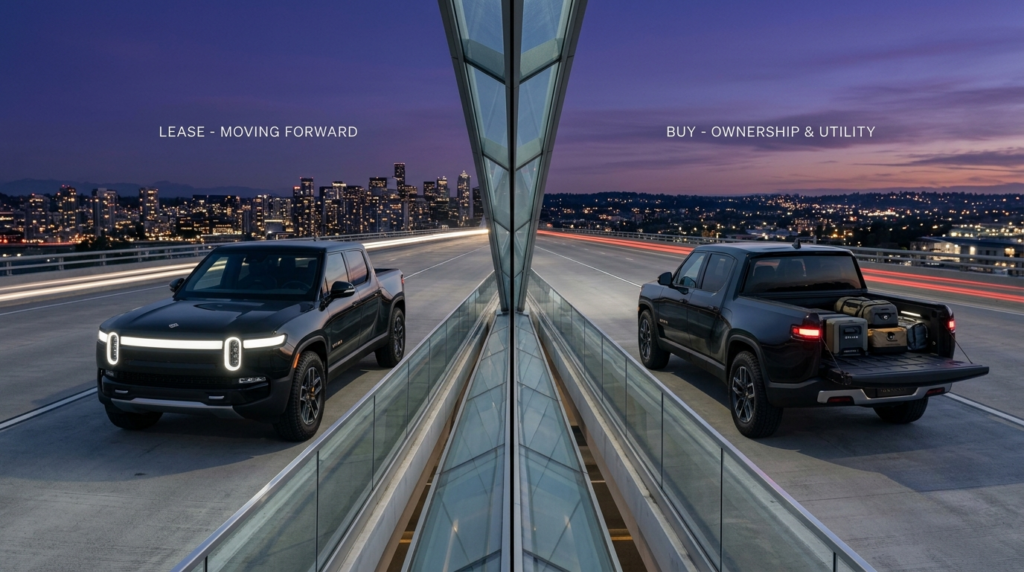
Leasing a Rivian protects you from EV depreciation volatility; buying builds equity but carries residual risk. In 2026, the correct answer depends entirely on which model you’re considering.
3-Year Total Cost: Lease vs. Finance Comparison Table
| Cost Component | R1S Dual Large (Lease) | R1S Dual Large (Finance) |
| Monthly Payment | $1,189 × 36 = $42,804 | ~$1,450 × 36 = $52,200 |
| Due at Signing | $9,084 | $9,084 (equivalent down) |
| Total 3-Year Outlay | $51,888 | $61,284 |
| Equity at Month 36 | $0 | ~$8,000–$12,000 |
| Net 3-Year Cost | $51,888 | ~$49,284–$53,284 |
At the three-year mark, financing is roughly break-even to slightly cheaper but only if the R1S retains value as projected. If depreciation accelerates (likely as R2 volume grows and Gen 3 rumors surface), the lease’s fixed residual becomes the safer bet.
When Leasing Wins: Depreciation Protection & Flexibility
Leasing wins when:
- You want to upgrade every 2–3 years as battery tech improves
- You are uncertain about long-term EV resale values
- You qualify for state rebates that require leasing (some programs do)
- You want a fixed, predictable monthly cost with no resale hassle
The lease’s “stop loss” is its most powerful feature: if the vehicle is worth less than residual at lease-end, you walk away and Rivian absorbs the loss. If it’s worth more, you can buy it out and pocket the difference.
When Buying Wins: Equity & Long-Term Ownership
Buying wins when:
- You plan to keep the vehicle 5+ years
- You can secure financing below 4% APR
- You drive significantly more than 10,000–15,000 miles per year
- You want to modify or customize the vehicle
For the R2 specifically, buying is strongly favored in 2026 due to the punitive lease money factor. For R1 models, the decision is closer and depends on your risk tolerance.
Rivian Lease Terms Explained: Money Factor, Residual & Fees
Rivian leases use Chase Bank as the captive lender, with money factors ranging from .00181 (4.34% APR) on R1 models to .00369 (8.86% APR) on the R2. Residual values vary by trim, term, and annual mileage.
How to Calculate Your Rivian Lease Money Factor
Convert money factor to APR: Money Factor × 2,400 = APR. For example:
- R1S Dual Large: .00181 × 2,400 = 4.34% APR
- R2 Performance: .00369 × 2,400 = 8.86% APR
To reverse-engineer your deal, use this formula:
Monthly Payment = (Depreciation Fee + Finance Fee) × Tax Rate
Where:
- Depreciation Fee = (Adjusted Cap Cost − Residual Value) ÷ Lease Term
- Finance Fee = (Adjusted Cap Cost + Residual Value) × Money Factor
Rivian Residual Values by Model & Trim (2026)
| Model/Trim | 36mo/10k Residual | 36mo/15k Residual | 24mo/10k Residual |
| R1S Dual Large | ~58% | ~55% | ~64% |
| R1S Tri Max | ~56% | ~53% | ~62% |
| R1S Quad Max | ~54% | ~51% | ~60% |
| R1T Dual Large | ~59% | ~56% | ~65% |
| R2 Performance | 64% | ~61% | ~70% |
Higher residuals mean lower monthly payments. The R2’s 64% residual is strong, but the money factor destroys the advantage.
Hidden Fees in Every Rivian Lease: What $9,000+ at Signing Covers
| Fee | Amount | Notes |
| Capitalized Cost Reduction | $500–$7,000 | Includes $500 deposit; remainder is negotiable |
| First Month Payment | $829–$2,029 | Varies by trim |
| Acquisition Fee | $895 | Charged by Chase Bank |
| Security Deposit | $0 | Waived for well-qualified lessees |
| Tax, Title, License | Varies by state | Typically $2,000–$4,000 |
| Disposition Fee | $495 | Charged at lease-end if you return |
Critical: The $7,000 capitalized cost reduction in Rivian’s advertised offers is NOT mandatory. You can structure a $0-down lease by rolling the cap cost reduction into the monthly payment. However, this raises your payment by roughly $200/month.
Rivian Lease Calculator: How to Score Your Deal in 60 Seconds
A Rivian lease calculator reverse-engineers your money factor, effective APR, and assigns a deal grade from A+ to F. Input your MSRP, residual value, monthly payment, and any lease bonus to see exactly what you’re paying in interest versus depreciation.
Step-by-Step: Using the Rivian Lease Deal Calculator
- Select your model and powertrain R1S, R1T, or R2; Dual, Tri, or Quad
- Enter the MSRP from Rivian’s configurator or R1 Shop
- Grab the residual value click the calculator icon on Rivian’s lease page
- Choose your term 24 or 36 months (36 is usually optimal)
- Input your monthly payment (pre-tax), lease bonus, and down payment
- Hit “Analyze Deal” to get your money factor, effective APR, and grade
What a “Good” Rivian Lease Score Looks Like (A+ to C Range)
| Grade | Effective APR | Interpretation |
| A+ | < 3.5% | Exceptional rare outside of heavy incentive periods |
| A | 3.5%–4.5% | Good typical for R1 models with standard rates |
| B | 4.5%–6.0% | Fair acceptable if you need the vehicle now |
| C | 6.0%–8.0% | Poor consider waiting for better incentives |
| D/F | > 8.0% | Walk away the R2 currently falls here |
Red Flags: Deal Grades That Mean Walk Away
- Money factor above .00300 (7.2% APR) on any R1 model rates have been better
- No lease bonus available when competitors are offering $3,000+ timing is wrong
- 24-month term quoted without your request dealers (or Rivian’s system) use this to hide higher payments
- Down payment required to “secure the rate” this is false; your rate is based on credit, not down payment
3 Rivian Lease Mistakes That Cost Buyers $5,000+
The most expensive Rivian lease mistake is putting money down. If your vehicle is totaled or stolen, that down payment is often unrecoverable. Here are the five errors that separate smart lease shoppers from overpayers.
Mistake #1: Putting Money Down on a Rivian Lease
Rivian’s advertised offers assume a $7,000 capitalized cost reduction. This is NOT required. A $0-down lease is always safer because:
- Gap insurance covers the lender, not your down payment
- If the vehicle is totaled in month 6, you lose the full down payment
- The “savings” from putting money down are minimal roughly $200/month on a $7,000 reduction
Mistake #2: Ignoring the Money Factor (APR in Disguise)
A money factor of .00369 looks harmless until you convert it: 8.86% APR. That is credit-card territory. Always multiply the money factor by 2,400 before signing. If the resulting APR is more than 2% above current auto loan rates, the lease is overpriced.
Mistake #3: Choosing the Wrong Trim for Your Driving Needs
The Tri Max is tempting, but the Dual Large + Performance delivers 90% of the daily experience at $440 less per month. Conversely, if you tow regularly, the Dual Large’s 533 horsepower may strain under load making the Tri Max the actually cheaper choice when you factor in wear and reduced efficiency.
Current Rivian Lease Specials: July 2026 Offers
Rivian’s July 2026 incentives include a $3,000 lease contribution on Performance and Tri trims, plus 1.99% APR financing on select R1 purchases. All offers require approval by July 31, 2026, and delivery by August 31, 2026.
How to Find the Best Rivian Lease Deals in the R1 Shop
The R1 Shop contains pre-built vehicles with faster delivery times and often better incentives than custom orders. Rivian prioritizes moving inventory vehicles, so lease bonuses and contribution offers frequently apply only to R1 Shop stock. Check the shop weekly; inventory rotates and the best deals disappear quickly.
Limited-Time Offers: When Rivian Discounts Deepen
Historical pattern analysis shows Rivian intensifies lease incentives in three scenarios:
- End of quarter (March, June, September, December) sales target pressure
- New model launch windows R2 launch diverted attention from R1, creating temporary R1 deals
- Inventory buildup when R1 Shop stock exceeds 30-day supply, bonuses increase
Rivian Lease FAQ: Your Top 10 Questions Answered
Q1: Can you lease a Rivian in all 50 states?
No. Rivian leases are available in 40+ states as of July 2026. Alaska, Hawaii, and several rural states have limited or no leasing availability. Check Rivian’s configurator with your zip code for confirmation.
Q2: How much is due at signing for a Rivian lease?
Due at signing ranges from $5,724 (R2 Performance) to $9,924 (R1S Quad Max). This includes first month payment, acquisition fee, capitalized cost reduction, and estimated taxes. You can structure a $0-down lease by rolling the cap cost reduction into the monthly payment.
Q3: What credit score do I need to lease a Rivian?
Rivian requires “very well-qualified” credit, typically 720 or above. Lower scores may be approved with higher money factors or larger security deposits. Chase Bank makes the final credit decision, not Rivian.
Q4: What happens at the end of a Rivian lease?
You have three options: (1) return the vehicle and pay the $495 disposition fee, (2) buy it at the predetermined residual value, or (3) extend the lease month-to-month (subject to approval). Third-party buyouts may be restricted by checking your contract.
Q5: Can I buy out my Rivian lease early?
Early buyouts are possible but may include remaining rent charges and fees. Contact Chase Bank directly for your payoff quote. Note that Rivian’s lease structure can make third-party buyouts more complex than traditional automakers.
Q6: Does Rivian offer 0% APR leasing?
No. Rivian does not currently offer 0% APR on leases. The lowest money factor observed in 2026 is .00181 (4.34% APR) on R1 models. The R2 carries a significantly higher rate of .00369 (8.86% APR).
Q7: What is the lease mileage allowance?
Standard Rivian leases include 10,000 miles per year. You can select 12,000 or 15,000 miles, but this lowers the residual value and increases your monthly payment. Excess mileage is charged at $0.30 per mile.
Q8: Are Rivian lease payments tax-deductible for business use?
Yes, if the vehicle is used for business, lease payments may be partially or fully deductible. Consult a tax professional. The IRS allows standard mileage rates or actual expense methods for leased business vehicles.
Q9: Can I transfer my Rivian lease to someone else?
Lease transfers (assumptions) are subject to Chase Bank approval. Rivian does not guarantee transfer eligibility. Contact Chase Bank for the specific process and any transfer fees.
Q10: Will Rivian lease prices drop when the R2 Standard launches?
Likely yes. The R2 Standard (starting at $44,990, arriving late 2027) will create downward pressure on R1 lease rates as Rivian shifts volume targets. Additionally, R2 lease money factors should improve as production ramps and resale data accumulates.
Rivian Lease Trends: What’s Coming in Late 2026 & Beyond
R2 Standard and RWD variants arriving in late 2027 will lower entry lease prices to approximately $600/month. R1 Gen 3 refresh is rumored for 2027–2028, which would depress current Gen 2 residual values and potentially improve lease rates on remaining inventory.
R2 Lower-Priced Variants: When $600/Month Leases Become Real
The R2 Standard starts at $44,990, $13,000 less than the current R2 Performance. Even with the current punitive money factor, a $45,000 vehicle at 64% residual would lease at roughly $650–$700/month with $0 down. If Rivian subsidizes rates as R2 inventory builds, $550–$600/month becomes realistic by Q1 2027.
R1 Gen 3 Refresh: Will It Kill Current Lease Residuals?
A Gen 3 R1 announcement would immediately pressure Gen 2 residuals. Lease residuals are set at signing and cannot change so existing lessees are protected. However, new Gen 2 leases would likely see lower residuals (higher payments) or require heavier incentives to move inventory. If you’re considering an R1 lease, locking in current residuals before a Gen 3 announcement is strategically sound.
Your Next Step: Compare Rivian Lease Deals & Calculate Your Payment
The best Rivian lease deal is the one you understand before signing. Use our lease calculator to compare R1T, R1S, and R2 payments side-by-side. Input your zip code for state-specific incentives and get an instant deal grade.
- Compare all three models in one view
- See your effective APR not just the monthly payment
- Check state rebate stacking for maximum savings
- Get a deal grade from A+ to F before you commit
Conclusion
Rivian leasing in 2026 is a tale of two markets. The R1 lineup offers reasonable value with transparent residuals and competitive money factors especially on Performance trims that qualify for the $3,000 contribution. The R2, despite its lower MSRP, is currently a poor lease value due to an 8.86% APR equivalent that consumes nearly 40% of the monthly payment.
Your decision framework is simple: if you want an R1, lease it the depreciation protection is worth the premium. If you want an R2, finance it. The lease math doesn’t work at current rates. And regardless of model, never put money down, always convert the money factor to APR, and use a calculator to verify your deal grade before signing.
Ready to find your Rivian lease deal? Calculate your payment now and see if you’re getting an A+ or getting taken for a ride.



0 Comments