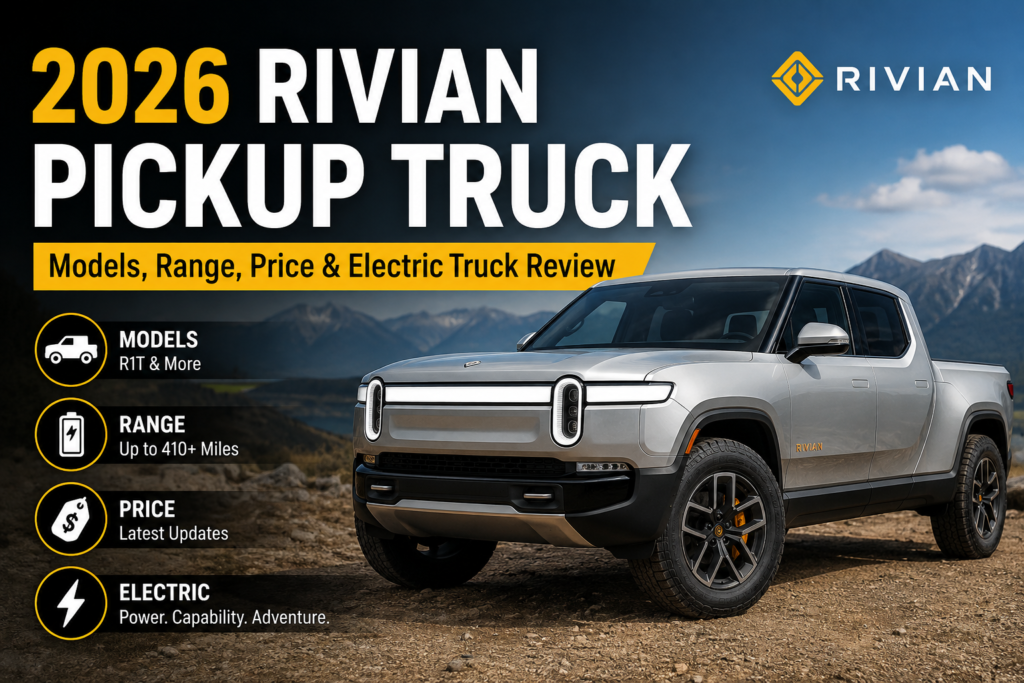
Let’s clear something up first, because it trips a lot of people up: Rivian only makes one pickup truck. It’s called the R1T. If you came here expecting to compare a “Rivian truck lineup” the way you might sort through Ford’s F-150 variants, that’s not really how this works. There’s the R1T, and then there’s a stack of motor and battery combinations you can pick from within it. That’s the whole truck side of Rivian’s business right now.
So instead of pretending there’s more to compare, let’s actually dig into the one truck that matters — what it costs in 2026, how far it’ll actually take you on a charge, what genuinely changed this year versus what’s just marketing noise, and where it lands against the other electric trucks people cross-shop it with.
Rivian’s Only Pickup Truck: Meet the 2026 R1T
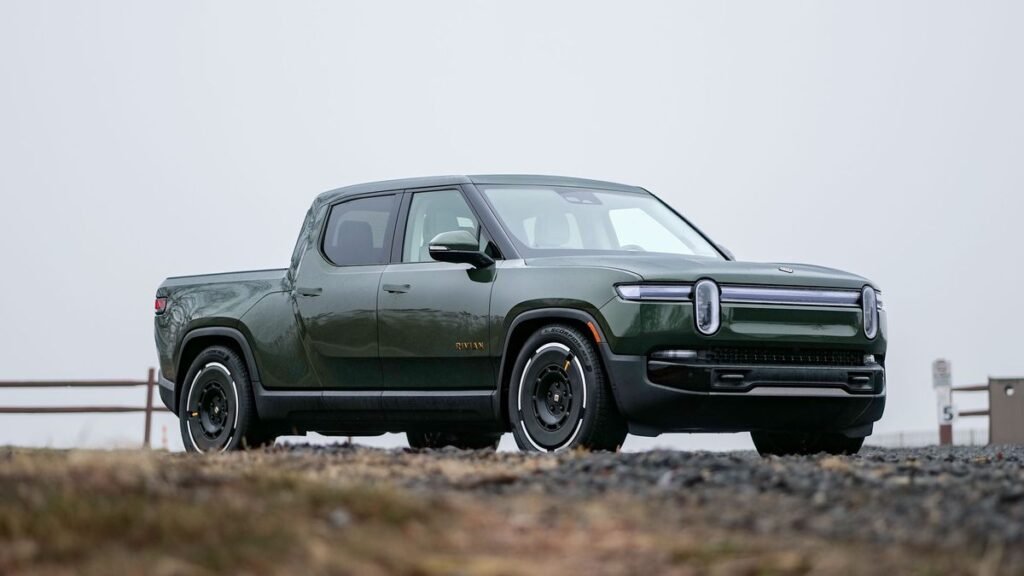
The R1T shares its bones with Rivian’s R1S SUV — same platform, same front end, same interior layout up to a point, just with a bed bolted on where the third row would normally sit. It’s a big truck, for what it’s worth. We’re talking about 217 inches long, close to 88.4 inches wide, and roughly 78 inches tall, <cite index=”3-1″>with a bed that comes in at four feet six inches</cite>. Not the biggest bed in the class, but this was never really built to compete on cargo length alone.
The one change this year that actually matters, more than any spec bump: <cite index=”4-1″>every 2026 R1T ships with a native North American Charging Standard port</cite>, so it plugs straight into Tesla Superchargers with no adapter dangling off the front of your truck. If charging anxiety was the thing keeping you from pulling the trigger on an R1T before, that particular worry just got a lot smaller.
2026 Rivian R1T Price: Trims and Starting Costs
Pricing has moved around a bit through the model year, and honestly, different sites are quoting slightly different numbers depending on when they last checked in with Rivian. Here’s roughly where things sit as of mid-2026:
| Trim | Starting Price |
| Dual Standard (Standard Battery) | ~$70,990 |
| Dual (Large Battery) | ~$77,990 |
| Dual (Max Battery) | ~$84,990 |
| Tri-Motor (Max Battery) | ~$100,990 |
| Quad-Motor (Max Battery) | ~$115,990 |
| Quad Launch Edition | ~$119,990–$121,885 |
None of that includes the destination and freight fee, which <cite index=”11-1″>Rivian bumped from $1,800 up to $1,895 for 2026</cite>. That fee’s the same no matter where you take delivery, so don’t let the sticker price on the configurator fool you — add that in before you get attached to a number.
If you’re trying to figure out which trim actually makes sense financially, it’s the Dual Motor with the Max battery. <cite index=”5-1″>It offers the longest range in the entire lineup for a fairly modest jump over the base model</cite>. It’s already quick. Unless you have a specific reason to want three or four motors, you’re probably not going to miss them.
Motor Options: Dual, Tri, and Quad
Rivian keeps this simple, even if the underlying engineering isn’t. Dual, Tri, Quad — basically fast, faster, and “why does my truck do this.”
Dual-Motor is the base setup, all-wheel drive with power split across two motors. Stock, it makes 533 horsepower. <cite index=”5-1″>There’s an optional Performance Upgrade that pushes that to 665 horsepower and 829 lb-ft of torque</cite>, if you want more without moving up a whole trim.
Tri-Motor brings a third motor into the mix, mostly for sharper handling and more precise torque control off-road, splitting power between the front and rear axles more deliberately than the Dual can.
Quad-Motor is the one people talk about at parties. Rivian rebuilt it for 2026, and the difference is not subtle — <cite index=”4-1″>it now makes 1,025 horsepower and 1,198 lb-ft of torque, up from 835 horsepower in the previous version</cite>. For a bit of perspective, that torque number is within a few pounds-feet of a heavy-duty diesel truck engine. Which is a genuinely strange thing to be able to say about a vehicle that can also spin all four wheels independently and do a stationary donut for fun.
Battery Packs and Range
This is where picking the right trim actually matters, because range swings more than you’d expect depending on the battery and even the wheel size you choose.
- Standard Battery (Dual Standard): around 258 to 270 miles, wheels dependent
- Large Battery (Dual): roughly 300 to 330 miles
- Max Battery (Dual): up to about 420 miles with the smaller wheel option — the longest range Rivian offers right now
- Max Battery (Tri-Motor): around 371 miles
- Max Battery (Quad-Motor): around 374 miles
Here’s the part that catches people off guard: you’d assume the top-dog Quad-Motor would also lead in range, but it doesn’t. <cite index=”3-1″>Both the Tri and Quad, running the same 140-kWh Max battery, land at 371 and 374 miles respectively</cite> — less than what the Dual Motor gets with that same-size pack. More motors buy you speed and traction, not extra miles. If range is what actually keeps you up at night, not 0-to-60 numbers, the Dual Motor Max is the one to configure.
Performance: Power, Torque, and 0–60 Times
Even the “slow” version of this truck isn’t slow. <cite index=”5-1″>The base Dual-Motor gets to 60 mph in about 4.5 seconds</cite>, which is quicker than a lot of gas-powered sports sedans people still brag about at car meets. Bump up to the Performance package or the Tri-Motor and it sharpens further. The Quad-Motor is really the one built to show off — independently controlled torque at each wheel, which translates to both genuinely quick acceleration and serious off-road traction, not just a party trick for stoplight launches.
Towing and Payload
For a truck, towing numbers matter as much as anything on the spec sheet, and the R1T holds up fine here. <cite index=”3-1″>Properly equipped, it’ll tow up to 11,000 pounds and carry a payload of up to 2,317 pounds</cite>. One thing worth being honest about — this isn’t a Rivian-specific issue, it’s true of every EV on the market — towing anywhere close to that max is going to eat into your range fast. If towing is a regular part of your life and not just a once-a-summer boat trip, plan on more frequent charging stops than the window sticker range would suggest.
Storage is one of the R1T’s genuinely clever features, separate from the bed itself. <cite index=”3-1″>There’s a 9.9-cubic-foot front trunk, plus a gear tunnel running through the middle of the truck that adds another 11.7 cubic feet</cite>. That tunnel is a great spot for muddy boots, recovery straps, or anything you don’t want bouncing around loose in the bed.
Interior, Tech, and Comfort
Climb inside and it feels less like a work truck and more like a tech-forward SUV, which makes sense given how much it shares with the R1S. <cite index=”3-1″>You get a 15.6-inch center touchscreen, a 12.3-inch digital gauge cluster, and a 6.8-inch screen for rear passengers as standard</cite>, plus navigation, six USB-C ports scattered around the cabin, a wireless charging pad, and a ten-speaker sound system.
Two things worth knowing before you fall in love with all that glass: there’s no Apple CarPlay or Android Auto, and a lot of what you’d normally control with a physical button gets routed through that center screen instead. Some people genuinely don’t care. Others find it maddening within a week. Test drive before you commit — this is one of those things you either adapt to instantly or never quite forgive.
Want better sound? <cite index=”3-1″>Rivian offers a Premium Audio upgrade, and there’s also a small removable Bluetooth speaker built for camping, sold across every trim for around $400</cite>. That speaker, for what it’s worth, is a genuinely fun little accessory — not something you’d expect a truck company to bother making, but there it is.
Charging
The switch to native NACS is the biggest real-world change for 2026, full stop. It’s not just about Superchargers themselves, it’s what that access does to your actual road-trip planning — Tesla’s charging network is still the densest fast-charging footprint in the country by a good margin. Rivian also runs its own growing network of Adventure Network chargers, so you’re not entirely dependent on someone else’s infrastructure either.
At home, it works about like you’d expect from any modern EV. A Level 2 home charger will bring a depleted battery back to full overnight without much thought required. On the road, DC fast charging can add a meaningful chunk of range in well under an hour, though exactly how much depends on the charger’s output and which battery pack you’re running.
Safety and Driver-Assist Tech
Every 2026 R1T comes with a decent base layer of driver-assist tech — forward collision warning with automatic emergency braking, adaptive cruise control, lane departure steering assist, blind-spot warning, rear cross-traffic alert, and a 360-degree camera setup.
Above that baseline, <cite index=”4-1″>Rivian offers an optional hands-free system called Autonomy+, which works on freeways and, now, two-lane roads too</cite>. Where a lot of competitors want you paying a monthly subscription for similar features, <cite index=”4-1″>Rivian charges a single one-time fee of $2,500</cite> and you’re done. If you spend a lot of time on the highway, that’s honestly one of the better value adds on the whole configurator.
What’s Actually New for 2026
Stripping away the fluff, here’s what genuinely changed this year:
- A native NACS port on every trim, meaning Tesla Supercharger access with zero adapter
- A rebuilt Quad-Motor setup with a serious jump in horsepower and torque over last year’s version
- Autonomy+ now covers two-lane roads in addition to highways
- Prices ticked up modestly across most trims
- The destination fee went up slightly too
Nothing here is a total reinvention. This reads more like Rivian polishing something that already worked, rather than starting over.
How the 2026 R1T Stacks Up Against Other Electric Trucks
The field’s gotten crowded since the R1T first showed up, and it’s no longer the only interesting option in the segment. Against the Ford F-150 Lightning, the R1T generally wins on off-road capability and interior polish, but the Lightning tends to undercut it at the lower trims if price is your main concern. Compared to the Chevy Silverado EV, it’s a similar story — Chevy comes in cheaper at entry level, but the R1T pulls ahead in range on its top configurations and just feels more refined day to day. The Tesla Cybertruck is kind of in its own lane at this point — more of a statement than a straightforward comparison, though it does pull from some of the same performance-focused buyers.
Where the R1T really separates itself is the combination of real off-road chops, a genuinely nice interior, and a brand personality built around the outdoors rather than the job site. It’s less “work truck” and more “lifestyle vehicle that happens to have a bed” — and that framing matters when you’re deciding whether it fits your actual life.
Is the 2026 Rivian R1T Worth It?
It’s probably a good fit if:
- You want real off-road ability without giving up daily-driver comfort
- Long range and quick charging matter more to you than shaving a few thousand off the sticker price
- The idea of a one-time fee for hands-free driving beats another monthly subscription
- You tow occasionally, but not consistently at the truck’s absolute limit
It’s probably not the right fit if:
- You can’t live without Apple CarPlay or Android Auto
- You need the cheapest possible entry point into an electric truck
- You’re towing heavy loads on a regular, commercial-type basis, where the range hit becomes a real logistics problem, not just an inconvenience
- You’d rather reach for a physical button than tap through a touchscreen menu
Frequently Asked Questions
What is Rivian’s pickup truck called?
It’s the R1T. Rivian only makes one pickup right now, spread across a few trims and battery options.
How much does the 2026 Rivian R1T cost?
Roughly $70,990 to start on the base Dual Standard trim, climbing to around $120,000 for the top Quad Launch Edition — before the destination fee gets added on.
What is the range of the 2026 Rivian R1T?
It ranges from around 258 miles on the base Standard Battery setup up to roughly 420 miles on the Dual Motor with the Max battery pack.
Does the 2026 Rivian R1T have Tesla Supercharger access?
Yes. Every 2026 R1T comes with a native NACS port, so it charges at Tesla Superchargers without needing an adapter.
How much can the Rivian R1T tow?
Up to 11,000 pounds when properly equipped, with a max payload capacity around 2,317 pounds.
Is there a Rivian R2 or R3 pickup truck? No, both of those are SUVs, not trucks. The R1T is still Rivian’s only pickup.
Final Thoughts
The 2026 Rivian R1T isn’t a complete reinvention of last year’s truck, and it doesn’t need to be. The changes that did show up — native Tesla Supercharger access, a much stronger Quad-Motor, and a driving-assist system that now covers more road types — are the kind of upgrades that actually change how you’d live with the truck day to day, not just numbers padded onto a spec sheet. It’s still priced above a lot of its competitors, and that touchscreen-first interior isn’t going to click with everyone. But if what you actually want is an electric truck that can genuinely handle rough terrain, tow a reasonable load, and cover real distance on a single charge, the R1T is still one of the strongest trucks you can buy right now — electric or otherwise.

0 Comments